רשומה קשורה ל-טקסט ספרותי: T-S Misc.35.87
טקסט ספרותי T-S Misc.35.87- ציטוט
- Gideon Bohak, The Sentencing of Jesus (Gzar-dina de-Yeshu): The 'Authentic' Jewish Protocols of the Trial of Jesus (Open Book Publishers, 2026).
- Relation to document
- Digital Edition
- Digital Translation
Editor: Bohak, Gideon
Translator: Bohak, Gideon (in English)
T-S Misc.35.87 1r
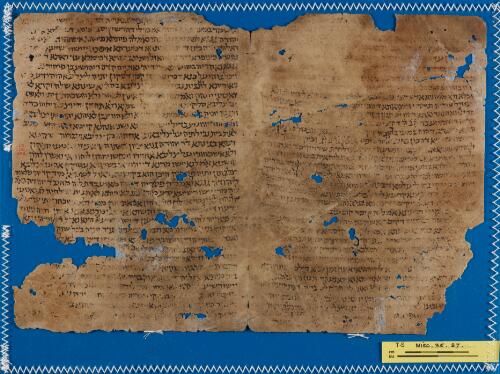
Folio 1v (second section)
- ו֯א֯מ֯' [ ] עוברא דאית במעהא דכר הוא או נוקבה. אמ' ליה יישו מאי
- [ד]בעי֯ מלכא֯ אעב֯ד֯ה אם דכר אם נוקבה. בההיא שעתא אמ' קיסר לפילטוס הגמונא
- [ ... ] י֯תה֯ון עד תשעה ירחי עד דניחזי אי יַלֵּדָּה {אי<לא֯>ילדה} אי לא ילדה. אזל
- פ֯י[לטוס] ואסרינון תש֯עה ירחי. והות תשע ירחי לישראל עקתא
- סגיא֯ה. אז֯ל֯ [ר']י֯ה֯ו֯ש֯[ע] בן֯ פרחיה בסתרא וכתב כ֯ת֯בי ואיגרי בכולוהי מדינתא
- דהוו בהוו יש' ואמ' הכי גזירו תעניתא תלתא יומי דלא ליטעום איניש
- מיכלא ולא מ<י>שתיא אלא דתעני בליבא שלימא קמי קב''ה ולא ליבדו יש' ולא
- ליבטיל אוריה ונימוסי ומצואתא דהכי והכי פ֯ע֯ל֯ י֯ישו רשיעא. קָמו כולהון
- מדינ<א>תא ואתרואתא דהוו יש' תמן וגזרו תעניתא תלתה יומי ובעו רחמי מן
- מריה דרחמי. ועבד ק'ב'ה' דהיכי עבד בה֯ון בכל עדן ובכל שע֯א֯ ואתהפ֯יך
- ההוא עוברא דהוה במעי ב{ת}<ר>{י}תיה דקיסר והוה אבנא וניבטל כל עצ֯ת֯יה֯
- דיישו רשיעא דהכין כתיב י'ה'ו'ה' ה'י'פ'י'ר' ע'צ'ת' ג'ו'י'ם' וגו'. וכיון דהפיך ק'ב'ה
- לההוא עוברא אבנ֯א֯ עברו תשעה ירחי ולא ילידת. שדר קיסר ואתיוה
- ליישו רשיעא. אמ' ליה אמאי לא קא ילדת. אמ' ליה אית בעמא דיהודאי
- דאחדין לולדא במעי אימיה תריסר ירחי. לבתר תריסר ירחי שדר בתריה
- ואתייה ליישו. אמ' ליה עברו תר יסר ירחי ואמאי לא קא ילדה. אמ' ליה
- דילמא עיסקי במילי עלמא דבתולתא היא ולא נפיק ולדא עד דתיבעיל.
- ואי יהבת לי רשותא אנא קרענא ליה לכרסה ומפיקנא ליה ממעי אימיה
- כד חי וידכר וידע מרי קיסר דאנחנא בני אלהא דשמיא ואית בן יוכלא
- למ עבד כל מילי דבעינא. אמ' ליה קיסר קום עיביד הכי. וקם יישו רשיעא
- ובז֯עה לכרסה דברתיה דקיסר ואשתכח ההוא֯ ו֯ל֯[ד]א א֯בנא במעהא
- [ד]ה֯ה֯יא בתולתא. בההיא שעתא אמר {לק<י>=} ל[י]ה֯ קיסר אחיה בעא ולא יכי֯ל.
- [מתי]ב קיסר ואמ' ליה ליהושע בן פרחיה ולמרינוס סבא רבה אינשי אילין
- [דא]טעו לביריאת[א] וק[ט]לו בתריה דמלכא מאי דיניהון דאילין א[ינשי] חיבין
- [א]ת֯[ו]ן ל[ ... קט]ל֯א אמ֯ר֯י֯ן֯ קי֯סר מלכא לית בידן יומא דין אלא בידא [דק'ב']ה' ובידך.
- אמ' [להון] גוב֯ר֯י֯א אילין יהודאי אינון ומן עמא דילכון אינון וקא
- [עסקי?] ב֯חרשיא די֯נ֯ו֯ ב֯ה֯ו֯[ן ד]ינא דאוריתא ואילא נעקר יתכון מן עלמא.
- [בההיא ש]ע֯תא֯ טעינו י֯ת֯ה֯[ון ב]פרזלא ואובילו יתהון לטבריה ואתקינו ליוחנן
- [אילנא ו]צלבו יתיה בחמ[יש ש]עי מן יומא ובתר כן קברו יתיה. ובתריה
- [איתוה ליי]ש֯ו ובעו לאצל[בא י]תי[ה] וכיון דחזא דצליבא קאיי למיצלב יתיה
- [אמר? מילי דח]ר֯ש֯ין ופרח מ[ידהון] ו֯פ֯[ר]ח֯ באוי֯ר֯ שמיא כע֯ו֯פא. אמ' יהודה
- [גננא לר' יהושע בן פרחי]ה [... אזיל ב]תריה א[מ]ר֯ [ליה זי]ל֯ [בההיא] שעתא֯
Folio 2r (third section)
- [אידכי? ו] א֯מר֯ [שמא מפר]ש֯א ופרח בתריה. וכיון [דחזיה] יישו [רשיע]א אזל
- ואיטמר במערתא דאליהו ואמ' מילי דחרשין וסגר פומא דמע֯ר֯תא. את֯א֯ ר֯'
- יהודה גננא לפתחא דמרעתי ואמ' לה פיתחא פיתחא איפתחי דא[נ]א שליח[א]
- דאלהא רבה כיון דשמע פיתחא דמערתא איפתח. ויישו רשיעא [אד]מי {נ֯}
- נפשי[ה] כציפרא דתרנולא ואזל ויתיב בטורא דכרמלא עד דאתא ר' יה֯[ו]ד֯ה֯
- גננא ואחדיה בשושיפא דידיה ואתייה קדם ר' יהושע בן פרחיה. וא[סקוהי]
- וצלבוהי על כנא דכּרוב֯א֯. ומן קמי ד<י>סקון יתיה לצליבא הוה ידע מ֯' כ֯ת֯[יב]
- באוריתא ל<א>תבית נבילתיה על צליבא בההיא שעתא שלח וקרא לאי֯[נשי]
- דאטעי יתהון ואמ' להון אם֯ [ת]ז֯ל֯ון אתון למחר ולא משכחתון יתי ולא פיג[רי]
- על צליבא סליקית אנא לרקיעא דשמיא ולא תחזון יתי. וצלבו יתיה כד חי
- ורגמו יתיה בא֯בנא ומית על צליבא ולא הוו צבן לאחתא יתיה מן צליבא.
- אמ' להו ר' יהושע בדיל יישו רשיעא נשני אנחנא קיימא דאוריתא דכתיב
- לא תבית נבילתיה על צליבא וג'. אחתוה מן צליבא וקברוהי ברהטא
- דמיא בגינתא דר' יהודה גננא. וכיון דאתו הנך אינשי דאטעי יתהון
- ולא אשכחוהי על צליבא אחדרו ותפשו יתהון ליהודאי ואמרו להון
- קושטא אמ' לנא יישו מרנא די יהודאי בשיקרא עסיקין אם על צליבא
- צלבתון יתיה פיגר֯יה היכן הוא בקושטא דאזל לשמיא. מיד קריה פלטוס
- ליהודה גננא ואמ' ליה פיגריה די֯י֯שו מאי עבדת ליה. מתיב ר' יהודה ואמ'
- ליה מרי יישו רשיעא ידע מה דכת' באוריתא לא תבית נבילתיה וג' ואטעי
- {יה}<י>תהון לאינשי אילין ואמ֯' להון אם אתיתון מחר ולא תשכחון יתי על צליבא
- תדעון דילשמיא סליקית והשתא אי צבי מרנא אנא איתי יתיה ואחז֯י
- ית פיגריה להון֯ ו֯[י]ה֯י֯[מ]נ֯ו֯[ן וי]דעון דיישו רשיעא הוא. ואזל ר' יהודה גננא
- ואסקיה מן קי֯בריה ורמא חבל֯[א] בכרעיה [ו]גרר יתיה בכל שוק[י טבריה]
- ואכריז עלוהי הדין יישו בר פנדרא רשיעא דימר[ד] באלה[א דשמיא]
- דלית ל֯י֯ה֯ ת֯ני. ואובליה ק[מ]י פילט֯וס וקר֯[א ... ...]
- מן דהי מ֯[ינ]ו֯ ודלא הימינו. מ֯ת֯י֯ב֯ [פ]י֯לט֯ו[ס הגמונא? ... ]
- דקברת יתי֯ה בבית שקיא ד֯מ֯י֯א֯ ו֯ה֯שת֯א֯ זיל וקב֯ר֯ [יתיה בא]ת֯ר֯[א דקברין]
- ביה מיתיא. אזל יהודה גננא וקבר יתיה בבריא [ד]מ֯י[א ויומא דאי]צ֯ט֯ל֯י֯ב֯ [ביה]
- ישוו רשיעא֯ נצראה ארבסר יומי לירח נ[י]סן הוה וכד֯ הדרו וא[פקו]ניה֯
- מן קבריה וגר֯ר֯ו֯ [י]ת֯י֯ה֯ בשוקי טבריה עשר֯י֯ן֯ וחד֯ ל֯ירח ניסן הוה. ו[מן דעבד]
- דינא רבא֯ בייש֯ו רשיעא הוא יעביד ד֯י[נא ופור]ע֯נ֯ותא בע֯ג֯ל֯ה֯ עם ש֯נאי
- עמיה וכל [מן דש]ב֯ק֯ פולחן אלהא֯ דש֯[מיא ופ]לח ו[... נש]בע לשמיא
Folio 1v (second section)
- and said: “[ ] the foetus that is in her belly—is it male or female?” Yeshu said to him: “What
-
the king wishes, I will make it, whether male or female.” At that moment Caesar said to Pilatus the governor:
-
“[Let us arrest] them for nine months, until we see whether she gave birth or did not give birth.
-
Pi[latus] went and imprisoned them for nine months. And there was great distress for Israel (i.e., for the Jews) for nine months.
-
[R.] Yehoshuʿa ben Peraḥiah went in secret and wrote messages and letters to all the towns where Israel were (i.e., where there were Jews),
-
and said thus: “Decree a fast of three days, so that no man would taste
-
food or drink, but will fast in earnest before the Holy One, blessed be He, so that Israel (i.e., the Jews) would not
-
be destroyed, and the Torah and the laws and the commandments would not be annulled, for such and such was done by Yeshu the wicked.” And all
-
the towns and places where there were Israel (i.e., Jews) rose and decreed a fast of three days, and asked for mercy from
-
the Master of Mercy. And the Holy One, blessed be He, did for them (i.e., for the Jews) as he had done in every period and every time,
-
and the foetus that was in the belly of Caesar’s daughter turned into a stone, and all the counsel of Yeshu the wicked was annulled,
-
for thus it is written: “The Lord overturned the counsel of the nations, etc.” And because the Holy One, blessed be He,
-
had turned that foetus into a stone, nine months passed and she did not give birth. Caesar sent and they brought
-
Yeshu the wicked. He (Tiberinus) said to him: “Why did she not give birth?” He (Yeshu) said to him: “There are among the Jews
-
those who bind the baby in its mother’s belly for twelve months.” After twelve months he (Tiberinus) sent after him
-
and brought Yeshu. He said to him: “Twelve months have passed, and why did she not give birth?” He (Yeshu) said to him:
-
“Perhaps we are dealing with “the matters of the world,” for she is a virgin, and the baby will not come out until she is penetrated.
-
If you grant me permission, I will cut open her belly, and will extract it from its mother’s womb
-
alive, and my master, Caesar, will remember and know that we are the sons of the God of Heaven, and we have the ability
-
to do everything we want.” Caesar said to him: “Go and do so.” And Yeshu the wicked rose
-
and tore up the belly of Caesar’s daughter, and that foetus was discovered to be a stone in the womb of
-
that virgin. At that moment Caesar said to him: “Bring her back to life.” He tried (to), but could not.
-
Caesar [answer]ed and said to Yehoshuʿa ben Peraḥiah and to Marinus the great elder: “These men
-
[who mis]led the people and killed the king’s daughter— what is the judgment of these [men]?
- You must... [execu]tion." They said: "King Caesar! At this time we cannot (execute people), but only [the Holy One, blessed] be He, and you can.”
-
He said [to them]: “These m[en] are Jews, and they are from your people,and they [deal] with
-
magic, judge them (according to) the judgment of Torah, and if not—we will uproot you from the world.”
-
[At that t]ime they burdened th[em with] iron (chains) and led them to Tiberias. They set up [a tree] for Yoḥanan,
-
[and] crucified him on the fif[th h]our of the day, and after this they buried him. And after him
-
[they brought Ye]shu, and were about to cruci[fy h]im. But when he saw the cross set up to crucify him
-
[he said words of m]agic, and flew out of [their hands], and flew in the air of the heaven like a bird.
-
Yehudah [the gardener said to R. Yehoshuʿa ben Peraḥiah: “Should I go a]fter him?” He said [to him: “G]o.” At that moment
Folio 2r (third section)
-
[he (i.e., Yehudah) purified himself?] and said [the Ineffable Na]me, and flew up after him. When Yeshu the [wicked saw him] (i.e., Yehudah), he went
-
and hid himself in the cave of Elijah, and he said words of magic and shut the mouth of the cave. R. Yehudah came
- to the opening of the cave, and said to it: “Opening, opening, open up! For I am [the] messenger
-
of the Great God.” When the opening of the cave heard (this), it opened up. And Yeshu the wicked
-
[disg]uised himself as a rooster, and went and sat on Mount Carmel, until R. Yehudah the gardener came
-
and held him with his cloak, and brought him before R. Yehoshuʿa ben Peraḥiah. And [they raised him up]
-
and they crucified him on a cabbage stalk. But from before they raised him to the cross, he knew what [is writt]en
-
in the Torah, “Do not let his corpse remain overnight on the cross.” At that moment he sent and called the pe[ople]
-
whom he had misled and said to them: “If you come tomorrow and do not find me, nor my bo[dy],
-
on the cross—I ascended to the firmament of Heaven, and you will not see me.” They crucified him alive,
-
and they stoned him with a stone, and he died on the cross. And they did not want to take him down from the cross.
-
R. Yehoshuʿa said to them: “Because of Yeshu the wicked we shall change the law of the Torah? For it is written,
-
‘Do not let his corpse remain overnight on the cross’, etc.' They brought him down from the cross and buried him in the water-channel
-
in the garden of R. Yehudah the gardener. When these people whom he had misled came,
-
and did not find him on the cross, they surrounded and caught the Jews and said to them:
-
“Yeshu our master told us the truth, that the Jews are dealing with a lie. If you crucified
- him on the cross, where is his body? In truth, he went to Heaven.” Immediately Pelatus summoned
-
Yehudah the gardener, and said to him: “The body of Yeshu— what did you (sg.) do with it?” R. Yehudah answered and said
-
to him (i.e., Pilatus): “My master! Yeshu the wicked knew what is written in the Torah, ‘Do not let his corpse’, etc., and he misled
- these people, and said to them, ‘If you come tomorrow and do not find me on the cross,
-
you will know that I ascended to Heaven’. And now, if our master wishes, I will bring him, and will show
-
his body to them, and they will bel[ieve], and they [will kn]ow that it is Yeshu the wicked.” R. Yehudah the gardener went
-
and brought him up from his tomb, and threw a rope on his leg and dragged him in all the street[s of Tiberias],
-
and proclaimed upon him: “This is Yeshu, son of Pandera, the wicked, who rebelled against the God [of Heaven],
-
besides whom there is none.” He (i.e., Yehudah) brought him (i.e., Yeshu) [bef]ore Pilatus, and he summo[ned ...
-
and there were] those who believed (that it is the body of Yeshu), and those who did not believe. [Pi]latu[s the governor?] answered
-
[ ... “This person?] whom you buried in the water-trough—and now, go and bury [him in the p]lace [where they bury]
- the dead." Yehudah the gardener went and buried him (i.e., Yeshu) in the [wa]ter-holes (?). [The day on which]
-
Yeshu the wicked, the Nazarene, [was cruc]ified was the fourteenth day of the month of Nisan. And when they returned and br[ought] him
-
out of his tomb and dragged him in the streets of Tiberias—it was the twenty- first of the month of Nisan. [He who brought]
-
a great judgment upon Yeshu the wicked—He will quickly bring a jud[gment and retri]bution on the enemies of
-
His people, and (on) who[ever aban]dons the worship of the God of H[eaven and wor]ships and [... and swe]ars by the name
T-S Misc.35.87 1v
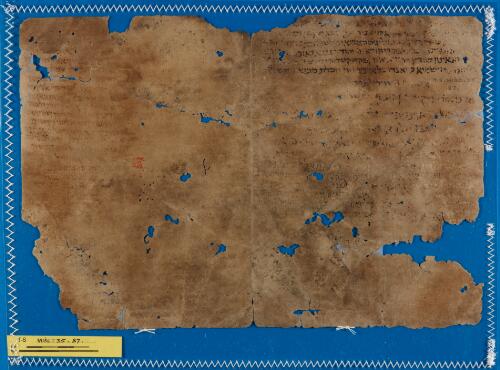
Folio 1r (first section)
- ..........................]ישו מ[...................................
- ...]שמהתהו[ן מתיי ונ]קי ובוני [ונצר ותודה ......................
- [... ר'] יהושע בן פרחיה אמ' ליה למתיי [למה אתקרי שמ]ך מתיי. אמ' [ליה דעלי
- אמ'] דויד [מתי] אבוא ואראה פני אל'ם. אמ' ליה ש[טי]א לאו הכי אמר עליך ד[ויד
- מתי ימות] ואבד שמך. ופקיד עלוהי וחנקוהי. א[תווה לנ]קי. אמ' ליה [למ]ה
- [את]קרי שמך נקי. אמ' ליה עלי אמר [דויד] נקי [כפים] וב[ר לב]ב. אמ' לי[ה
- לנקי ש]טיא לאו [ד]אמ' עלך קרא ונקה לא אנקה. ופקיד על[והי ור]מו[ה]י גו אתון
- [נורא יקי]דתא. [... ...] לבוני [אמ' למה א]תקרי לך [ב]וני אמ' ליה דעלי אמ' קרא
- [בני בכורי] יש' א[מ' ליה ר' י]הוש[וע בן פרחיה שטי]א הכי אמר עלך קרא הנה אנכי
- [הרג את] בנך בכור[ך ופקיד ]ע֯ל֯והי ורגמוהי. ובתריה קרא לנצר. אמ' ולמה
- [אתקרי שמך נצר. אמ' לי]ה דעלי אמ' קרא ונצר משרשיו יפר{א}<ה>. אמ' ליה שטיא הכי
- [אמר] ע[לך] ק[רא] אתה השלכת מקברך כנצר נתעב. ופקיד עלוהי וקטים
- רישיה. ובתריה אתווה לתודה. אמ' ליה למה אתקרי שמך תודה. אמ' ליה
- דעלי אמ' דויד מזמור לתודה. אמ' ליה שטיא הכי אמ' עלך דויד זובח <תודה> יכבדנני.
- ופקיד עלוהי וקטלוה. מתיב פילטוס הגמונא לר' יהושע בן פרחיה חמשה
- תלמידוי דיישו רשיעא דאטעו֯ ע[ל]מא איתקטילו ויוחנן מצבענא רביה
- דיישו ואיהו חיבין קטלא. מתיב ר' יהושע וא[מ'] לפילטוס אם צבי מר֯נא
- נישלח ונודעיה ל[טב]רינוס קיסר והי֯כ[י ד] י֯י֯מר֯ לנא נעביד של֯ח֯ו֯ ליה
- הכא שבעה גוברין דאטעו כולי עלמא והכי עסקיהו כוליה מה דהוו עבדין.
- [וכדש]מע טברינוס קיסר מלכא שלח איתינון קדמי. ואובלינון לויתה. ואז[לו]֯
- ע֯מ֯הון א֯ל֯י֯ג֯וס הגמונא ומרינוס סבא רבא [ור'] י֯הושע בן פרחיה ורבי [יהוד]ה
- [גננ]א לטבריא מדי[נ]תא רבתא. ואזלו כולהון לקמי טברינוס קיסר. ולכ[...
- יוחנן מ]צבענא לקמיה אמר להו[ן טבר]ינוס קיסר מאי עסקיכ֯[ון ... ...].
- מתי֯בין ואמ֯רין ליה דאנח[נא] בני א[להא] דשמיא וסיפ[רי]ן אי֯ל֯[ין
- ד]ב֯ידנא ל֯א֯ו ד֯ילנא אינון. אמ' להון ומנן אינון. [אמרין לי]ה י֯תנ[..
- ד]אסו[תא] אינון וכל אינש דבעי אסותא מסי[נא] יתיה ואי[... ל]אחאה א[...
- ...] לאמתא אמיתנא וכל מידי דבעינא למעבד עבידנא [...
- ...] ע[ק]רא ד֯לא אולידת ומעיקא יכילנא למיתן [ל]ה ולד בלא גבר. ואף מן ד[...
- ...] לאפקא רוחיה ואם בעי לממת לחישנא ליה[... ...] לה[...
- ... ] אי אם בעינא לא'ם בחנא טבא איתיה [ ... ... ] אמרנא[ ...
- ...] לעול[... ...] אלין [... ...]א א
[.....] מינכו[ן... ... ... ] ליה א [... ... ... ] ב֯ל֯א֯ גבר֯. מתיב יישו ואמ' ה[י]ן֯. [ ... ... ] יישו מילין דחרשיא ואתעברת. מ֯ת֯[יב ...
(final line numbers require consultation of multispectral images)
Folio 1v (fourth section)
- [דיישו ... ואלהא? ד]שמ[י]א הו י ֯עביד להון ניסא ב֯ע֯ג֯ל או בז֯מ֯ן ֯ק֯ר[יב].
- [...]ן טברינו ס קיסר ואאליגוס הגמונא ופילטוס הגמונא ור' יהוש[ע
- בן פרח]יה ומרינו[ס ס]בא רבה דיהודאי ור' יהודה גננא ואוכלוס[י] דבני
- [טבר]יא אינון סהדין דא֯י֯תוה וזקפוהי וקטלוהי ליישו רשיע[א] דימ֯ר֯[ד
- ב]א֯ל֯ה֯א רבה דשמיא. כן יאבדו כל אויביך יי' וג'. חסלת מעשה יישו ה֯נ֯[וצרי?]
Folio 1r (first section)
- [... ... ] Yeshu [ ...
- ... th]eir names [are Matai and Na]qi and Buni [and Netzer and Todah ... ]
-
[... R.] Yehoshuʿa ben Peraḥiah. He said to Matai: “[Why is] your [name called] Matai?” He said [to him: “Because about me]
-
David [said], ‘[Matai (=When)] will I come and be seen before God?’.” He said to him: “F[oo]l! No! Thus said D[avid]
-
about you, ‘[Matai (=when) will he die] and his name perish’!” And he decreed upon him, and they strangled him. Th[ey brought Na]qi. He (Yehoshuʿa ben Peraḥiah) said to him: “[Why i]s
-
your name called Naqi?” He said to him: “About me [David] said, ‘Neqi (=The one who has clean) [hands] and a p[ure hea]rt’.”
-
He said to [Naqi: “F]ool! No, for the Bible said about you, ‘and He (God) shall naqe not yenaqe (=shall by no means absolve (the sin))’.” And it was ordered ab[out him and they th]rew him into a
-
[fie]ry furnace. [... ...] Buni. [He (Yehoshuʿa ben Peraḥiah) said: “Why are] you called Buni?” He said to him: “Because about me the Bible says,
-
‘Israel is [beni (=my son), the firstborn]’.” [R. Ye]hosh[uʿa ben Peraḥiah] sa[id to him: “Foo]l! Thus says the Bible about you,
-
‘Behold I [will kill] binkha (=your son), the firstbo[rn’.” And it was ordered] about him and they stoned him. And after him he (i.e., Yehoshuʿa ben Peraḥiah) summoned Netzer. He said: “And why
-
[is your name called Netzer?” He said to hi]m: “For about me the Bible says, ‘and a netzer (=sprout) will grow from its roots’.” He said to him: “Fool! Thus
-
the Bi[ble said a]bo[ut you], ‘you were cast out of your tomb like a detested netzer (=sprout)’.” And it was decreed upon him,
-
and his head was cut off. After him they brought Todah. He (Yehoshuʿa ben Peraḥiah) said to him: “Why is your name called Todah?” He said to him:
-
“For about me David said, “A psalm for todah (=thanksgiving)’.” He said to him: “Fool! Thus said David about you, ‘He who sacrifices todah (=a thanksgiving offering) honors me’.”
-
And it was decreed upon him, and they executed him. Pilatus the governor answered R. Yehoshuʿa ben Peraḥiah: “The five
-
disciples of Yeshu the wicked who misled the wo[rl]d have been executed, and Yoḥanan the Dyer—
-
Yeshu’s teacher—and he (Yeshu) deserve to be executed.” R. Yehoshuʿa answered and said to Pilatus: “If our master wishes,
-
we shall send and inform [Tibe]rinus Caesar and whatever he shall tell us, we shall do.” They sent to him:
-
“There are seven men here, who misled the whole world and such is their business”— everything they had been doing.
-
[When] King Tiberinus Caesar [he]ard, he sent: “Bring them tome!”And they brought them to him.
-
And Aligus (?) the governor and Marinus the great elder, [and R.] Yehoshuʿa ben Peraḥiah and Rabbi [Yehud]ah
-
the [gardener] we[nt] with them to Tiberias, the great town. And they all went before Tiberinus Caesar.
-
And when [Yoḥanan] the Dyer and Yeshu [came] before him, [Tiber]inus Caesar said to them: “What is [your] business [and who are you?]?”
-
They answered and said to him that “We ar[e] the sons of the G[od] of Heaven; and [thes]e boo[ks]
-
that are in our hand are not ours.” He said to them: “And where are they from?” [They said to hi]m:
-
“They are [books of] heal[ing], and every person who needs healing, we he[al] him, and if [we want] to revive [we revive and if we want]
-
to kill we kill, and everything we want to do—we do.
-
[And a] barren [woman] who did not give birth and is suffering—we can give her a child (even) without (intercourse with) a man.
-
And also, whoever his soul [is about] to come out, and if he is about to die, we whisper [in his ear? and...].
-
And if we want to...
[Caesar said... “I do not ask] of you [ . . . . . . can you grant her a son without] a man?” Yeshu answered and said: “Y[es].” [ ... ... ] Yeshu [whispered?] words of magic, and she became pregnant. [Caesar] ans[wered]
Folio 1v (fourth section)
- of [Yeshu ... and the God of] Heaven will work a miracle for them quickly and within a sh[ort] time.
-
[ ... ] Tiberi[nus] Caesar and Aaligus the governor and Pilatus the governor and Rabbi Yehoshu[ʿa
-
ben Peraḥ]iah, and Marinus the great elder of the Jews, and R. Yehudah the gardener, and crowds of the sons of
-
[Tiberias?]—they bear witness that they brought and crucified and killed Yeshu the wicked, who rebelled
-
against the great God of Heaven. “Thus may all your enemies, Lord, perish” etc. Here ends The Story of Yeshu the Na[zarene?].