نصوص أدبيّة: T-S AS 201.93
نصوص أدبيّة T-S AS 201.93What's in the PGP
- صورة
- 1 Transcription
- 1 Translation
الوصف
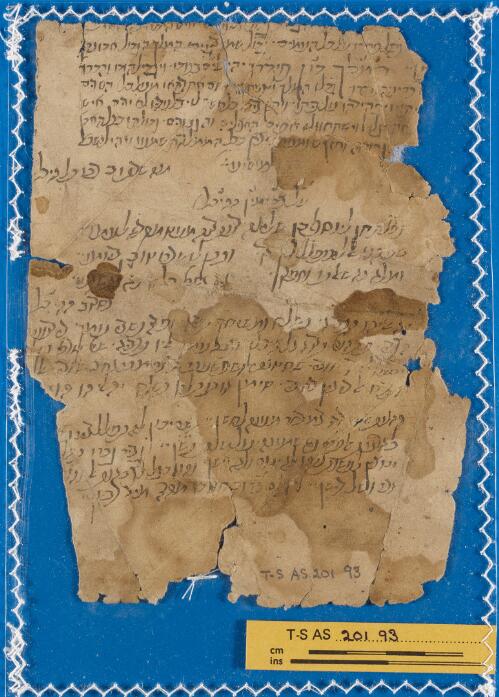
Recto: Praises for the King Don Pedro, in Hebrew, followed by some Hebrew poetry. In a fifteenth- or sixteenth-century Sephardi scribal hand. Verso: Fragmented instructions in Judaeo-Turkish for novice archers regarding the usage of a “thumb-stall” (זהכיר), i.e. “zihgīr” in Ottoman Turkish and Persian (زهگير): “a ring, generally of bone, worn by archers on the thumb, to save it from being cut by the bow-string” (Steingass, 631). The instructions were recorded beneath a list, possibly accounts, and they feature a simplified syntax/grammar that is common among educational manuals for beginners. This educational genre for archery students in the Ottoman Empire was known as kavsnâme—from Arabic “qaws” “قوس” (bow). Although it is unclear whether these instructions in Judaeo-Turkish comprise an excerpt from a known archery manual in Ottoman Turkish, their tone and subject matter resonate clearly with the kavsnâme genre. For example, one of the most widely-read archery manuals in Arabic from pre-modern Egypt (c. 1368 CE) dedicates a chapter to the usage of a thumb-stall (or “thumb-guard”) and another chapter details “faults and injuries” that can result from bows, arrows, and thumb-stalls. The latter section from Ṭaybughā al-Ashrafī al-Baklamishī al-Yūnānī’s didactic poem “Essential Archery for Beginners,” helps contextualize why the geniza fragment mentions “blood” (probably from an injury)—with Ṭaybughā’s description of various splits to archers' skin and fingernails, such as: “splits across the thumb-nail” and “splits down the nail” (p. 118). Although it seems less likely as an alternative translation, it should also be noted that “blood” could hold metaphorical meaning in this context. In an earlier chapter, Ṭaybughā compares a bow’s anatomy to that of a human being—likening “glue” to the “blood” of a bow: “for even as a man is built on four foundations, namely, bone, flesh, arteries, and blood, so is the (composite) bow formed in like manner inasmuch as the wood corresponds to bone in man, the horn to flesh, the sinews, which are intricately disposed through its members, to the arteries, which are intricately disposed through man’s members, and the glue to the blood by which the whole is held together” (Latham and Paterson, Saracen Archery, 6). MCD Translation of Ṭaybughā al-Ashrafī al-Baklamishī al-Yūnānī, Ghunyat al-ṭullāb fī maʿrifat al-ramy bi-al-nushshāb: Latham, J.D. Paterson, W.F. Saracen Archery: An English Version and Exposition of a Mameluke Work on Archery (ca. A.D. 1368). London: The Holland Press, 1970. _________________________________ Notes on lines 3-5: Line 3: - “Mütekadir(a)” in Ottoman Turkish, “(an eye) intently fixed”: James Redhouse, A Turkish and English Lexicon (1890), 1719, https://app.lexiqamus.com/en/buildlq?_word=%D9%85%D8%AA%D9%83%D8%A7%D8%AF%D8%B1&search_type=redhouse - The scribe’s understanding of Turkish vowel harmony appears to be elementary enough that they did not differentiate between -ler -lar verbal endings: e.g. the causative verb kavuşturmak (“to cause to come together” “to join together”) requires the verbal ending -lar (לאר-). - The verb kavuşturmak can also have the alternate meaning “to touch” or “to obtain.” New Redhouse Turkish-English Dictionary (1986): 622. Line 4: - The word “ācizin” is possibly a misspelling of “عجز” + second-person possessive suffix = âcizin (lit. “your inability”). New Redhouse Turkish-English Dictionary, 8. In terms of pronunciation, the scribe might have heard aleph instead of ʿayn if someone was reading aloud to them. Line 5: - “Ṭānırlar” in Ottoman Turkish, “become acquainted” or “acquaint yourself” (sp. interchangeably as “ṭānımak” or “tanımak). Expressed here in the aorist verbal tense (ṭānırmak) in the form of a request or command: New Redhouse Turkish-English Dictionary, 1094. - “Süreler” in Ottoman Turkish, “to cause to touch” or “to make touch”: Tevfik, Lugat-ı Ebuzziya (1890), 571 (=lems etmek / لمس ايتمك); "Sürmek," https://en.wiktionary.org/wiki/s%C3%BCrmek - “Zihgīr” in Ottoman Turkish and Persian, “bow-stop” or “thumb-stall” (زه گیر or زهگیر): New Redhouse Turkish-English Dictionary, 1285; Steingass, A Comprehensive Persian-English Dictionary (1892), 631: https://dsal.uchicago.edu/cgi-bin/app/steingass_query.py?page=631#gsc.tab=0 (“A ring, generally of bone, worn by archers on the thumb, to save it from being cut by the bow-string, a thumb-stall.”)
العلامات
Editor: Dudley, Matthew
Translator: Dudley, Matthew
T-S AS 201.93 1v
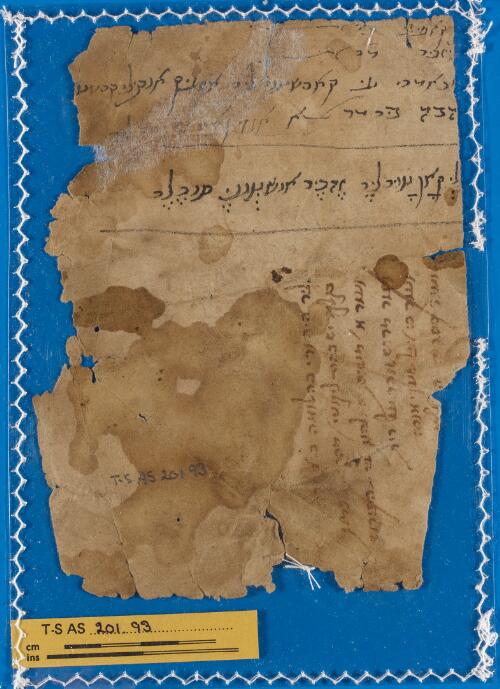
Verso, Judaeo-Turkish section
- קאפיגי ל.--------
- ...]ייזכיר ד.-----
- ... מת]כאדרי יגי קאבשטורליר אזגיק אוקילי קבשט[...
- ...]הבה בירדר אלא אגזין א.. [...] שורליר(?)
- ...]לי קָאן טָנירליר זֶהכֶיר אושטֻנגֶי סורֶלֶר
Verso, Judaeo-Turkish section
- door-keeper 3__(thirty-___)
- …]eyzgīr/-eyzkīr(?) 4__ (four ___ )
- …] (an eye) intently fixed toward the inside, bring it together, touch[ing]/touch slightly with an arrow [...
- ...] ... it is (together) as one, unless your inability(?) [...] ask,
- …] ... become acquainted to blood (from) [...], touch the thumb-stall onto it…
Verso, transliteration
- kapıcı
- …]eyzgīr/-eyzkīr(?)
- … müte]kādire içi kavuşturlar azıcık okile kavuşt[up/urlar...
- …]hba birdir illā ācizin [...] sorlar
- …]lī qān ṭanırlar zihgīr üstüne süreler
T-S AS 201.93 1r