מכתב: T-S 13J25.5
מכתב T-S 13J25.5What's in the PGP
- תמונה
- 1 Transcription
- 1 Translation
תיאור
Fragment of a letter from Sharira Gaon. Around 970. The content is similar to his letters in T-S 28.24 and T-S 10 J1, in which he asks for communities’ support in his Yeshiva (Pumbedita). (Gil, Kingdom, vol. 2, Doc. #25) VMR
תגים
Editor: גיל, משה
Translator: Outhwaite, Ben (in English)
T-S 13J25.5 1r
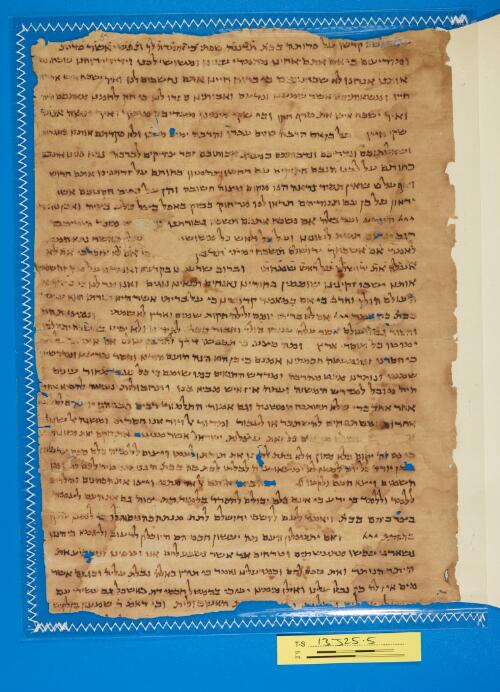
recto
- [מוד]ים לשם קדשו על פדותה ככת תרננה שפתי כי אשמרה לך ונפשי אשר פדית
- ומודיעים כי אם אתם אחינו מחמדי עינינו ומשושי לבנו וידידי רוחנו שכחתם
- אותנו אנחנו לא שכחנוכם כי כרוח חיינו אתם נחשבים לנו ואיך ישכח איש את רוח
- חייו ומשאותיכם אשר שמענו ונדעם ואבותינו ספרו לנו כי חק לחמנו מאתכם היה
- ואיך ישכח איש את טרף חקו וכי שקי מימינו מעדיכם מושך ואיך ינשה אנוש
- שקי חייו על כן אם הרבה שנים עברו והרבה ימים משכו ולא פקדתם אותנו באגרותי[כם]
- ושאלותיכם ונדריכם ונדבותיכם כמנהג אבותיכם זכר צדיקים לברכה נכח פנינו אתם
- כחותם על לבנו הנכם חקוקים עם רחשו תהמיון כחותם על זרועינו אתם חרוש[ים]
- ואף על פי שאין תמיד נראה הנו מקום מצוה חשובה והן על כפים חקנוכם אשר
- יראון על כן עם תנודיהם תראו לנו מרחוק כבזק באפל כצל סלע בציה ואכן נאמר
- ייי היודע ועד באלה אם נשכח אתכם תשכח גבורתנו ומ[דברי]ם מזכר הוריכם
- רוב ע[תי]ם תשת לשונינו ועל כל ראש כל משושי[נו אתם] תעלון כאשר נבא המב[שר]
- לאמר אם אשכחך ירושלם תשכח ימיני תדבק [לשוני לח]כי אם לא אזכרכי אם לא
- אעלה את ירושלם על ראש שמחתי וברוב שרעפ[י]נו בקרבנו ואמרנו על מה זה שכחתם
- אותנו ישבו זקינינו שוממין בחורינו נאנחים תנאינו נוגים ואנו מר לנו כי נראה א[יך]
- העולם הולך וחרב כי אם כמאמר קדושינו כי על בריתו אשר היא תורתו הוא עומד
- ככת כה אמר ייי אם לא בריתי יומם ולילה חקות שמים וארץ לא שמתי ונמצאת הו[לך]
- וחסור גם העולם אשר עליה עמדו הולך ואבוד ככת לא ידעו ולא יבינו בחשכה יתהלכו
- ימוטו כל מוסדי ארץ ומה בצע כי תכבשו דרך לחרבן עולם אם אמרתם [ ]ל[ ]
- כי חסרנו ונתמעטה חכמתינו אמנם כי כן הוא הנה הועם הודינו וחסר מדענו ומדרשינו
- שממו ונותרנו מעט מהרבה ומדרש התנאים כמו שומם כי כל נער מאור עינים
- היה מובל למדרש המשנה ועתה אין איש מביא בנו ותחבולות נעשה להביא אחד
- אחר אחד כדי שלא תשתכח המשנה וגם אמורי התלמוד רבים בבניהם יוצאים למלאכות
- אחרות ומסתפחים להשתכר או לעבור ומדור אל דור אנו חסרים ומשנה אל שנה
- א[ ] וש[א]לו מי [ג]רם כל זאת עצלות ישראל אשר מנעום את חקם ואת מזונותיהם
- כי מי זה יקום בלא מזון הלא בתת אלהינו את תורתו לעמו ויצום ללמדה כלם ספק צרכיהם
- ו[ה]מן יורד כל יום למען לא ימצאו עלה לבלתי לכת בה ככת הנני ממטיר לכם לחם מן
- השמים ויצא העם ולקטו וג' ו[ב]הביאו אותם אל אדמתנו ויצו את הכהנים והלויים
- ללמד וללמד כי ידע כי אינם כלם יכולים להפרד בלמוד דת צוה גם את העם לעמד
- בצרכיהם ככת ויאמר לעם ליושבי ירושלם לתת מנת הכהנים והלויים למען יחזקו
- בתורת ייי ואם יתעצלון העם מה יעשון חכמיהם היוכלון לרעוב ולצמא כי הננו
- נשארנו עכשו מתעשתים וטרחים עד אשר נשבע לחם אנו וטפינו ונשביע את
- היתר הנותר ואת טפם לחם וכמו עלינו נאמר כי תהיו כאלה נבלת עליה וכגנה אשר
- מים אין לה כי נבלו עלינו ואזלו מימינו יען כי בהמשל חכמי דת כאשכל גם עשירי עם
- [בני] ישראל מ[שו]לים [כאשכ]לות [וכזמורו]ת האשכולות וכי דאמ' ר' שמעון בן לקיש
- [אומה זו כגפן נמשלה זמורות שבה אלו בעלי בתים אשכולות שבה אלו תלמידי חכמים]
[We] thank His Holy Name for ransoming it, as it is written: My lips will jubilantly cry out when I sing praises to you, and my soul, which you have ransomed (Psalms 71:23). And [we are hereby] informing [you] that though you—our brothers, the delights of our eyes, and the joys of our hearts and our friends in spirit—may have forgotten us, we have not forgotten you; for you are considered by us the very essence of our life, and how can a man forget the essence of his life?! And [we have not forgotten] your contributions, of which we have heard and known, and of which our forefathers told us (Psalms 78:3), for you used to provide our daily bread, and how can a man forget the food that is his need? And [we have not forgotten] that the provision of our water is from you, and how can a man fail to recall the source of his life?
Therefore, though many years have passed and many days have gone by and you have not been in contact with us, [whether in the form of] letters, [legal] questions, votive offerings or donations, as was your forefathers’ custom—may the memory of the righteous be for a blessing—[yet, despite all this] you are foremost in our thoughts. You are inscribed like a seal upon our heart; you murmur with its stirring; like a seal upon our arms you are engraven. And despite the fact that it is not always seen, it is the place of an important precept. And behold on the palms (Isaiah 49:16) we have engraven you, which will be seen.
Therefore, with their movements you will appear to us from a distance like lightning in the darkness, like the shade of a rock in the wilderness. And indeed it is said: the Lord is the one who knows and a witness (Jeremiah 29:23) in these matters. If we should forget you, may our strength be forgotten. And we [praise] the memory of your parents so often, our tongues become dry. And above our highest joy [you] will be set, as the messenger prophesied, saying: If I forget you, O Jerusalem, let my right hand wither, let [my tongue] cleave to my palate if I do not remember you, if I do not set Jerusalem above my highest joy (Psalms 137:5–6). And with a great deal of contemplation we say: “For what reason have you forgotten us?” Our elders sit desolate, our young men are sighing, our teachers are grieving, and we suffer bitterly because we see how the world continues to be laid waste. Though surely it is in accordance with the bidding of our Holy One, because on His covenant, which is his Law, [the world] stands. As it is written: Thus said the Lord: “As surely as I have established my covenant with day and night, the laws of heaven and earth” (Jeremiah 33:25). And [because His Torah] is found continually to be diminishing, so also the world that rests upon it continues to perish, as it is written: They neither know nor understand. They walk about in darkness. All the foundations of the world are shaken (Psalms 82:5). And what profit is there that you forge a path for the world’s destruction? If you say [about us] that we are lacking and that our wisdom has diminished, truly it is so.
Certainly our splendour has been tarnished, our learning is diminished and our schools are desolate. We are left, few from many. The school of the teachers is like a wasteland, for every bright-eyed lad used to be brought to the house of study, but now no one brings his son and we must employ stratagems to bring them one by one so that the Mishnah will not be forgotten. Also many of the children of the talmudic scholars are leaving for other activities and taking their place among the salary-earners or emigrating. And from generation to generation we are becoming fewer, and from year to year [we are shrinking in number . . . ].
What has brought about all this? The inaction of Israel, who withhold from them their stipend and their sustenance. For who can stand without sustenance?! When He gave his Torah to his people, ordering them to study it, each according to the sufficiency of his needs, did not manna descend every day so that they could not find a pretext not to follow it? As it is written: Behold, I will rain down bread from the heavens for you, and the people will go out and gather it etc. (Exodus 16:4). And when He brought them to their land, and ordered the priests and the Levites to study and to teach because He knew that not all were able to dedicate themselves to the study of law, he also ordered the people to attend to their needs. As it is written: He ordered the people, the inhabitants of Jerusalem, to deliver the portions of the priests and the Levites so that they might devote themselves to the Torah of the Lord (2 Chronicles 31:4). And if the people display inaction, what will their sages do? Should they go hungry and thirsty? For we are left now calculating and toiling in order to get enough food—we and our children—and we will use the food to satisfy the remainder [of the sages] that are left and their children. And as it has been said about us: For you will be like an oak whose leaf withers and like a garden that is without water (Isaiah 1:30). For our leaves have withered and our water is exhausted, because when the sages of the law were compared to a cluster [of grapes], so also the wealthier people . . . the clusters.
T-S 13J25.5 1v