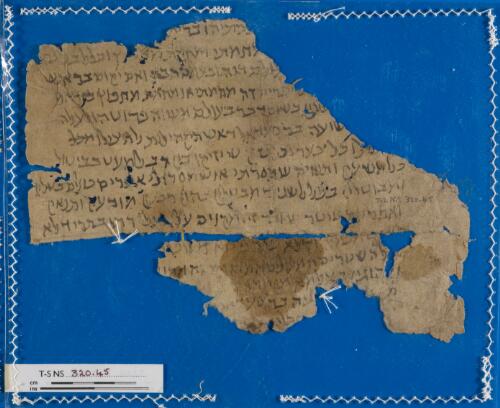
רשומה קשורה ל-מסמך שלטוני: T-S NS 320.45
מסמך שלטוני T-S NS 320.45- ציטוט
- S. D. Goitein, unpublished index cards (1950–85), #11896. Princeton Geniza Lab, Princeton University.
- Relation to document
- דיון
- ציטוט
- S. D. Goitein, "New Sources on the Palestinian Gaonate," in Salo Wittmayer Baron Jubilee Volume (Columbia University Press, 1974), 503–37.
- Location in source
- pp.525–28, 536
- Relation to document
- Digital Translation
- דיון
- מהדורה
- תרגום
- ציטוט
- משה גיל, (634–1099) ארץ-ישראל בתקופה המוסלמית הראשונהv (in Hebrew) (Tel Aviv University, 1983), vol. 2.
- Location in source
- #315
- Relation to document
- Digital Edition
- מהדורה
- ציטוט
- Brendan Goldman, "Request Presented to the Fātimid Caliph (Egypt)," in Posen Library of Jewish Culture and Civilization (Yale University Press, 2026), vol. 3.
- Location in source
- Relation to document
- Digital Translation
Editor: גיל, משה
Translator: Goitein, S. D. (in English)
T-S NS 320.45 1r
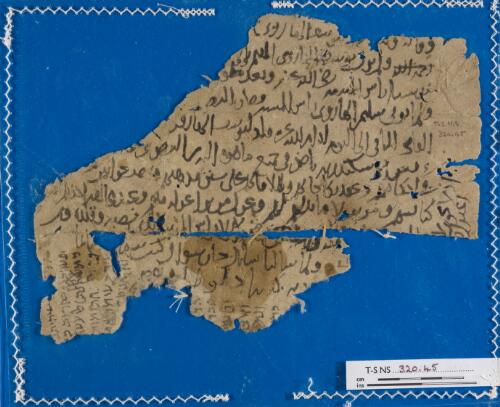
Recto
- وفاته وبـ[ـعده تولى] يوسف الهارونى [
- [[رحمه الله]] ولم يزل يوسف الهارونى المقدم با[
- يوشيا راس المثيبة رضى الله عنه وبعد //وفـ[ـاته]// طو[ل ايام سليمان الهارونى
- ولما توفي سليمن الهارونى راس المثيبة وصر التصرف [لسليمن بن يهودا
- الفاسى الباقى الى اليوم ادام الله عزه قلد ليوسف الهارونى [
- فى ثغر اﻻسكندرية ناضر فى جميع ما هوه اليه من النضر في [
- في احكامهم وعقد نكاحاتهم وطلاقاتهم على سنن مذهبهم ونصب حزانين [في
- كنايسهم ومن يتوﻻ ما يرا[[هم]] لهم وعزل من يرا عزله منهم وعند مخالفة احدهم له
- [يرجع اﻻمر . . . . . . . . . .] اﻻ راس المثيبة الذى نصبه وقلده و[
- ] ولما سالنا سايل جاز سؤالنا كتب شها[دتـ]ـنا بما
- [ علمـ]ـنا به وكتبنا خطوطنا فى يوم [
Recto - right margin
- اذ ﻻ يجوز ﻻ[حد
- اعتزال [
-
…for Joseph the Aaronite...)
-
may God have mercy upon him.And Joseph did not cease to administer the affa(irs of the Alexandrian community until the times of)
-
Joshia, the head of the yeshiva, may God be pleased with him and after the latter's (death in the times of Solomon, the Aaronite).
-
And when Solomon, the Aaronite, the head of the yeshiva, died and the office passed (to Solomon b. Judah)
-
of Fez, the present incumbent – may God increase his splendor –, he appointed Joseph, the Aaronite, (to be chief of the Rabbanite Jews)
-
in the port-city of Alexandria, namely as judge in all matters that he had administered up till then,(to wit,) decisions on
-
their civil cases, the conclusion of marriages and the enactment of divorces in accordance with the rites of their denomination, the appointment of cantors (and officiating in)
-
their synagogues, and of persons administering their emoluments, and the dismissal of anyone deserving it in his opinion. And when anyone opposes him,
-
(no action can be taken against Joseph) except by the head of the yeshiva, who has appointed him and invested him with his authority.
-
And when we were asked to testify by one who has authority to do so, we wrote this our testimony (.....)
-
(...) and we signed for him and signed ourselves on the day...
Translated by Brendan G. Goldman.
. . . his death, and af[ter him he ap]pointed Yūsuf al-Harūnī [the Kohen] . . . [may God have mercy on him], and Yūsuf al-Harūnī did not cease in administering [his orders] . . . [until today] Josiah [Ga’on; d. 1025], the head of the academy, may God be pleased with him. After [his death, in the days of Solomon al-Harūnī], when Solomon al-Harūnī [ha-Kohen Ga’on], the head of the yeshiva, died [also in 1025], the administration [of the academy] was in the hands of Solomon ben Judah al-Fāsī [of Fez], who remains until today [the head of the academy], may God make permanent his glory. [Solomon] invested Yūsuf al-Harūnī [with leadership of the Rabbanite Jews] of the port of Alexandria, so he may watch over everything that he has [to do] according [to his position] . . . [overseeing] their laws, organizing their affairs, contracting their weddings and divorces according to the practice of their school of law [i.e., Rabbanite Judaism]; and to appoint ḥazans [and] . . . [in] their synagogues [and to appoint] one who will oversee what is spent for them, and to dismiss those he decides to dismiss [from their communal leadership positions]. When someone is opposed to him . . . except for the head of the academy, whom he appointed and entrusted and . . . when we asked the questioner, he authorized his questions [Hebrew unclear]. We wrote our testimony concerning what . . . [what we knew] about it and we wrote his signature and signed on the day . . .
T-S NS 320.45 1v