טקסט ספרותי: T-S H2.152
טקסט ספרותי T-S H2.152What's in the PGP
- תמונה
- 1 Translation
תיאור
This Passover Haggadah text, preserved in the Cairo Geniza and written on parchment, presents a striking medieval version of the Passover ritual. This version of the Mah nishtanah (Four Questions; lit., “How is [this night] different”), which has ancient roots (see m. Pesaḥim 10), reflects different practices from those usual today. Among the hundreds of copies of texts for the seder, this text stands out for its calligraphic hand. The instructions are in Judeo-Arabic, the prayers are in Hebrew, and the midrash is in Aramaic. Italicized words, apart from the Hebrew biblical verses, are in Judeo-Arabic. The last paragraph is in Aramaic. (Information from Posen Library)
Translator: Reif, Stefan C. (in English)
T-S H2.152 1r
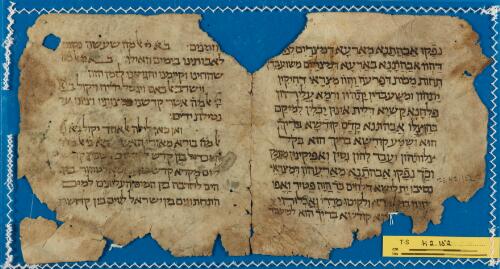
recto, left side
You, our Eternal God, are the essence of praise, and the universal sovereign. You are the one who performed miracles for our ancestors on these dates. You, our Eternal God, are the essence of praise and the universal sovereign. You have granted us a continuation of our lives and allowed us to reach this occasion.
Having drunk the contents of the qiddush cup, he washes his hands and recites the benediction: You, our Eternal God, are the essence of praise and the universal sovereign. You have brought us holiness by your precepts and instructed us in the matter of hand-washing.
If the seder is being held
T-S H2.152 1v
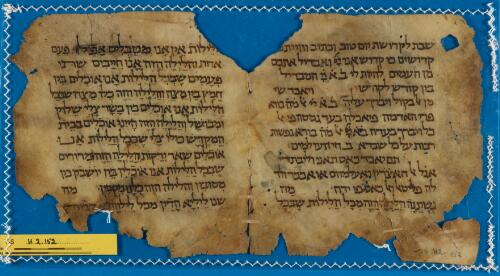
verso, right side
on Saturday night, he recites the benediction: You, our Eternal God, are the essence of praise and the universal sovereign, the Creator of fiery lights. You, our Eternal God, are the essence of praise and the universal sovereign. You created distinctions between different kinds of holiness, between holy Sabbath and festival, between the pure and impure, between the sea and dry land, between the upper waters and the lower waters, between the Jews and the non-Jews, between the holiness of the Sabbath and that of the festival. As the biblical verse states: You shall be holy to Me, for I the Lord am holy, and I have set you apart from other peoples to be Mine (Leviticus 20:26). He then takes some of the vegetables and recites the benediction: You, our Eternal God, are the essence of praise and the universal sovereign, Creator of produce from the ground. Having dipped it, he eats it all, and then recites the benediction: You, our Eternal God, are the essence of praise and the universal sovereign, the Creator of many forms of life for the benefit of all that he created. Praise to his universal existence.
He then takes the second qiddush cup and the most prominent member of the company, or his eldest son, begins to explain to them by asking, with the cup in his hand:
What is different about this night compared to all other nights?
verso, left side
On all other nights, we do not dip our food even once, while tonight we are obligated to do so twice. On all other nights, we eat bread that has risen or fat matza bread, while tonight we eat only matza. On all other nights, we eat meat that is roasted, stewed or boiled, while tonight we used to eat only roast meat in the Temple. On all other nights, we eat all sorts of vegetables, while tonight we eat bitter-tasting ones. On all other nights, we eat in a sitting or reclining position, while tonight we all recline.
What is different about this night compared to all other nights? It was on this night that our ancestors left the land of Egypt. Our ancestors had been enslaved in the land of Egypt and subject to attacks by Pharaoh. The Egyptians distressed them and enslaved them, forcing them to do the kind of hard labour that they could not survive. Our ancestors prayed to the Holy One, who is to be praised, and he heard the sound of their cries and performed miracles for them and brought them out of there. When our ancestors left the land of Egypt, they took with them bread-dough that had not risen and they baked it on [baking boards] and they picked bitter-tasting plants and ate them [with the matza].