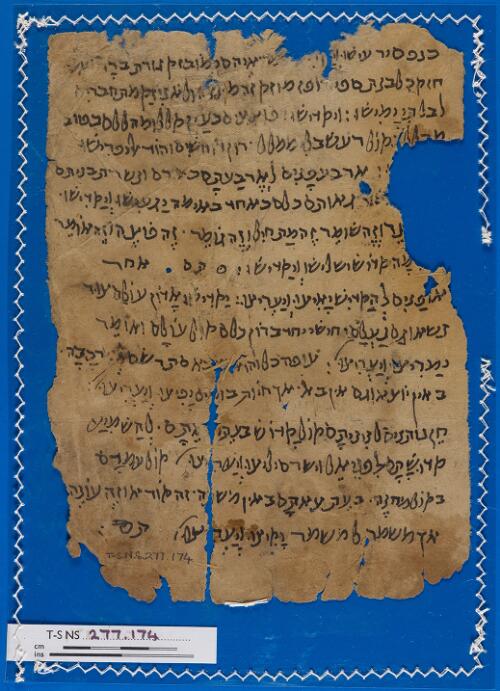
טקסט ספרותי: T-S NS 277.174
טקסט ספרותי T-S NS 277.174What's in the PGP
- תמונה
- 1 Translation
תיאור
This is an ahavah poem composed by Mevorakh ben Se‘adya (early 12th century), for recitation during the synagogue service inside the blessing “who blesses his people Israel with love [ahavah],” immediately preceding the Shema‘ in the morning service. Marked by the repetition of words, this strophic poem is written in a folk style popular among Jews and Arabs during this period. Here, drawing on Sufi traditions, the poet evokes the pool as the source of divine blessing from which blessing flows to the Jewish people. The “masters” of the pool here are the Jewish people. This poem has also been interpreted as having been meant to celebrate a wedding. (Information from Posen Library)
תמונה
תיעתוק
תרגום
Translator: Wasserman, Gabriel (in English)
T-S NS 277.174 1r
°
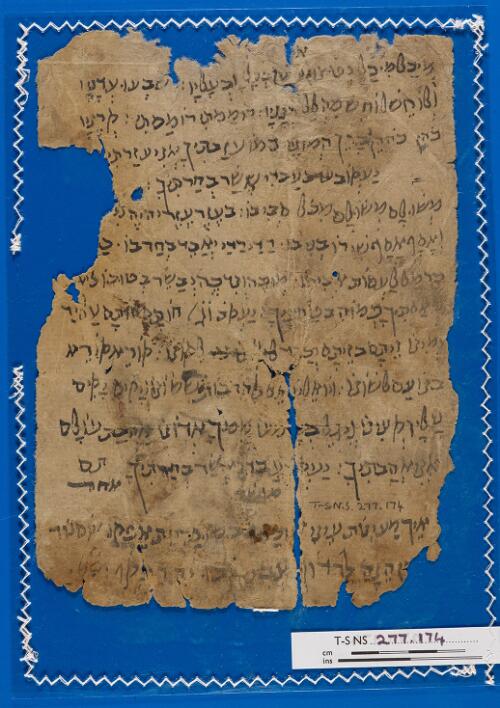
Gabriel Wasserman, "You are God, who does wonders," in Posen Library of Jewish Culture and Civilization (Yale University Press, 2026), vol. 3.
The pool (the pool!)—may its fountains flow forth.
Its masters (its masters!)—may they have enjoyment of its delights.
They utter (they utter!) praises and hymns to Him.
I have raised up (I have raised up!) his glory.
The priest (the priest!) may he bless his crowds.
[God:] Though I abandoned you, now I help you,
Jacob, my servant, whom I have chosen.
The perfect one [the Messiah] (the perfect one!), out of all who are around him,
the help [i.e., God] (the help!) will be his refuge.
And Asaph (and Asaph!) will enunciate songs.
My oppressors (my oppressors!), he [God or the messiah] will destroy with his sword.
The green wheat (the green wheat!) will produce its spring grain.
He [God] will announce, in his goodness, to the beaten and downtrodden:
[God:] I have not rejected you, just as I have promised!
Jacob my servant, whom I have chosen.
The signet-ring (the signet-ring!) upon his right hand,
the olive tree (the olive tree!) shows honor to its maker,
calling forth (calling forth!) with its sweet speech.
May He deign (may He deign!) to give great joy to them [i.e., the Jewish people],
and may He set (and may He set!) His governor [i.e., the Messiah] over them.
And they will rejoice when they hear from You, O their master:
[God:] I love you with an everlasting love,
Jacob my servant, whom I have chosen!
T-S NS 277.174 1v
°