מסמך משפטי: JRL G 63
מסמך משפטי JRL G 63What's in the PGP
- תמונה
- 1 Transcription
- 1 Translation
תיאור
Marriage contract in Arabic script. Dated 29 [Dhū] l-Ḥijja 1002 AH (1594 CE). The JRL catalogue lists the date as 31 January 1680 (29 [Dhū] l-Ḥijja 1090 AH) but this designation cannot be correct given that "اثنين" is clearly rendered as the final digit within the date. In the introduction to her edition, Jane Hathaway notes: "This sharīʿa court document resembles a marriage contract, though in much-abbreviated form. Dated 29 Dhūʾl-Ḥijja 1002 (15 September 1594), it is written in rather runny brown ink, now badly faded, and in a Maghribī hand that features several oddly- formed letters, notably د and ط. It may have been drawn up in North Africa and later transported to Cairo, or it may have been acquired in North Africa.... The couple are ʿAlī ibn Ḥadwā (‘the north wind’, or Boreas) and al-Zahrāʾ (‘the most radiant’) bint Aḥmad. They are certainly Muslim, though ʿAlī and Zahrāʾ are also attested as Jewish names in the ‘classical’ Genizah. ʿAlī is a cognate of the Hebrew Eli, the most common male name in the medieval Genizah. The bridegroom carries the nisba Madyūnī, probably referring to the town of Madyūna (Mediouna) in either northern Algeria or northwestern Morocco.... In addition to the 20 dinars, ʿAlī pledges to give his wife an enslaved woman; the term used, āma, connotes a domestic servant, as opposed to a concubine.... A final unusual feature of this document is that following the date but before the witnesses’ signatures, the scribe notes an adden- dum to the contract by Aḥmad, al-Zahrāʾ’s father, who requires the enslaved woman to serve ʿAlī’s brother Qadūr for the duration of the marriage. The document provides no clue as to why Aḥmad would introduce this condition." (Hathaway, Ottoman-Era Documents from the Cairo Geniza, 327-328, 330-331)
תגים
Editor: Hathaway, Jane
Translator: Hathaway, Jane (in English)
JRL G 63 1 / 1 leaf, recto
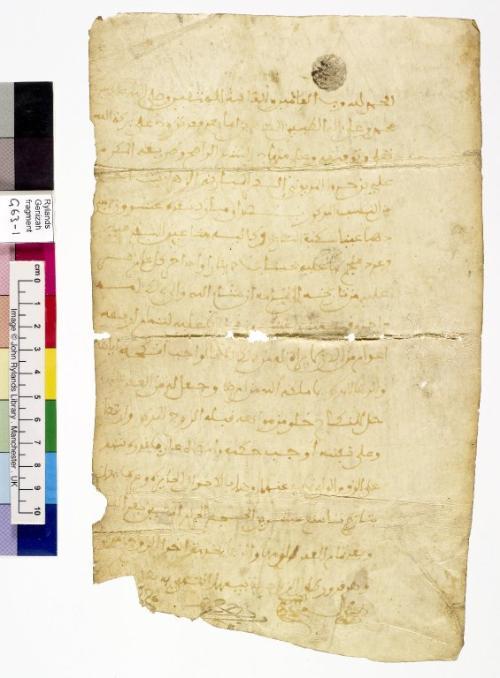
Recto, main text
- الحمد لله رب العالمين والعاقبة للمتقين وصلى الله على سيدنا
- محمد وعلى اله الطيبين الطاهرين اما بعد فقد تزوج على بركة الله
- تعالى وتوفيقه وعلى منهاج الشرع الواضح وطريقه المكرم
- علي بن حدوا المديوني البكر المباركة الزهراء بنت احمد
- من النسب المذكور بصداق مبارك نقده عشرون دينار[ا]
- ذهبا عينا سكية التاريخ وكالية مثل عين النقد مياة [؟]
- وعدد منجم لها عليه بحساب دينارا واحدا [١] خر كل عام يمر
- عليه من تاريخه الى تمامه ان شاء الله والى ذلك امة
- واحدة قيمتها عشرون ف [ضة؟] لها عليه لتمام اربعة
- اعوام من الان لا براة له من ذلك الا بالواجب انكحه اياها
- اياها والدها المذكور بما ملكه الله من امرها وجعل له من العقد عليها
- حل للنكاح خلو من موانعه قبله الزوج المذكور وارتضا
- وعلى نفسه اوجب حكمه وامهال عارفا قدره شهد
- على الزو[ج] والولي بما فيه عنهما وهما بالاحوال الجايزة وعرفا بهذا
- بتاريخ تاسع عشرين الحجة الحرام اثنين بعد الف
- وبعد تمام العقد الزمها والدها بخدمة اخوا الزوج المذكور
- وهو قدور [؟] طول الزوجية بينهما انتهى به بعد ال...
Witnesses, first
- [scribe's signature]
Witnesses, second
- شهد بذلك [؟]
- احمد
- ب[ن؟][ ]
Witnesses, third
- علي [ ]
Recto, main text
- Praise to God, lord of the universe. The (best) outcome is for the pious. May God bless our master
-
Muḥammad and his family, the good and the pure. Now then: ʿAlī [i]bn Ḥadwā al-Madyūnī married, by the blessing of God
-
the exalted, and by his granting of success, by the way of the clear law and by its noble path,
-
the blessed virgin al-Zahrāʾ bint Aḥmad
-
of the aforementioned lineage [i.e., Madyūnī], with a blessed dower in the amount of 20 dinars
-
in gold specie, current coins, trustworthy [?] just like ready cash: one hundred [?].
-
The number of instalments that he is obligated to pay her
is one dinar at the end of each year that passes,
-
from the present date until the completion [of the pay- ment], God willing, and in addition to that one female slave
-
whose value is 20 f[iddas?]; he is obligated to [give] her [the slave] by the end of four
-
years from now. There is no release from that for him ex- cept through [fulfilling] his obligation. Her [al-Zahrāʾ’s] aforementioned father gave her to him in marriage
-
inasmuch as God has given him power over her, and he [the father] has placed him [the groom], by way of contract, over her,
-
licit for marriage, free from any of its impediments. The aforementioned groom accepted this and consented
-
and took upon himself the obligation of the [lit., ‘its’] ruling and its delayed [payment], acknowledging the amount of it. Witness was borne,
-
regarding the groo[m] and the guardian [i.e., the bride’s father], regarding what is in this regarding the two of them, both of them being in a state of competence. They both acknowledged this
-
on the date 29 Dhū’l-Ḥijja 1002 [15 September 1594].
-
After the completion of the contract, her [al-Zahrāʾ’s] fa- ther required her [the slave] to serve the brother of the aforementioned groom,
-
who is called Qadūr, for the duration of their marriage. [The obligation] ends after [divorce or death?].
Witnesses, first
- [illegible, but the signer is clearly the scribe of the document; he uses the same ink to write his witness statement.]
JRL G 63 1 / 1 leaf, verso

תנאי היתר שימוש בתצלום
-
JRL G 63:
Image rights: The University of Manchester Library. Access rights: CC BY-NC-SA 4.0