מכתב: T-S AS 178.88
מכתב T-S AS 178.88What's in the PGP
- תמונה
- 1 Transcription
- 1 Translation
תיאור
Petition in Ottoman Turkish from Salmūn [al-Iskandarānī] to "a high official, possibly the governor of Egypt" per Hathaway. Dating: late sixteenth or early seventeenth century. In the introduction to her edition, Jane Hathaway notes: "T-S AS 178.88 gives voice to Salmūn himself, who petitions a high official, possibly the governor of Egypt, to take action against rapacious ‘kāshifs’ men’ who steal the sheep and other provisions that form part of the māl-i mīrī, the money and provisions that Egypt delivered to the imperial palace every year. These provisions were shipped to Istanbul from Alexandria and Damietta, and this petition underlines the customs director’s role in assembling and dispatching them. Naturally the director of the port customs would be preoccupied with protecting state property from theft and damage before it shipped out. However, this petition deals specifically with a tax farm, or muqāṭaʿa, that Salmūn controls: that of Ḫażra, possibly al-Khaḍra (‘green’ in Arabic), a village southeast of Alexandria in Buḥayra sub-province. This village and its surroundings apparently produced sheep and crops that formed part of the māl-i mīrī.... Kāshif, literally ‘inspector’, was the administrator of one of Egypt’s sub-provinces, responsible above all for the maintenance of irrigation works. The post had originated under the Mamluk Sultanate, and the Ottomans had retained it, although in the early centuries of Ottoman rule, the ranks of kāshifs were often filled with military officers from the imperial palace or the Balkans.... The kāshif of Buḥayra sub-province, immediately south of Alexandria, was responsible for the port city’s fresh water supply: once a year, he entered the city with 300 oxen, which over the course of a month, usually coinciding with September, turned the water wheels that filled the city’s 130 cisterns with water from the Naṣiriyya Canal, which formed Alexandria’s sole link to the Nile.... The followers of this kāshif and other Nile Delta kāshifs are surely the ‘kāshifs’ men’ against whom Salmūn rails. In fact, this annual ritual may have given the Buḥayra kāshif’s men the perfect opportunity to pilfer and damage the provisions intended for the palace." (Hathway, Ottoman-Era Documents from the Cairo Genizah, 130-131)
Editor: Hathaway, Jane
Translator: Hathaway, Jane (in English)
T-S AS 178.88 1r
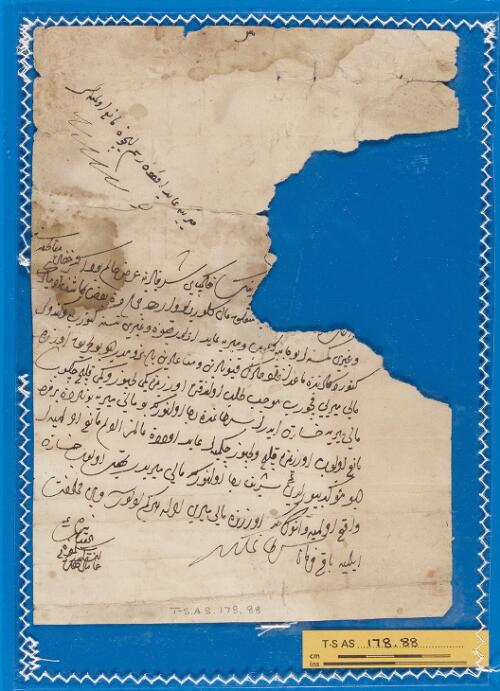
Recto, main text
- [ ] [ḥażretler]inin ḥāk-ı pāy-ı şerīflerine ʿarż-ı ḥālım budurki: Ḫażra muḳāṭaʿasına
- [ ]’e müteʿallıḳ māl gelür yerler vardır, cümleden baʿżı. kāşif ādamları
- ve ġayrī kimesneler bu cānibe gelüb, ve mīrīye ʿāʾid olur ḳoyun ve ġayrī nesne götürüb, ve kendüleri
- götürdüklerinden māʿadā, fellāḥların ḳoyunları ve metāʿların bile ‘bizümdür’ deyü bu ṭarīḳ üzere
- māl-i mīrīyi ḳaçurub, mūcib ṭaleb olunduḳda üzerimize kimi ṭopuz ve kimi ḳılıç çeküb,
- māl-i mīrīye ḫasāret iderler. Sulṭānımdan ricā olunur ki bu māl-i mīrīye bunlardan bir ferd
- māniʿ olub, üzerimize ḳılıç ve ṭopuz çekmeyeler, ʿāʾid olan mālimiz alalım māniʿ olmayalar
- deyü müʾekked buyuruldı-yı şerīf ricā olunur ki māl-i mīrīdir taḥsīl olub, ḫasāret
- vāḳiʿ olmaya ve anun ki üzerinde māl-i mīrī ola, her kim olursa, dīne müḫālefet
- eylemeye. Bāḳī fermān sulṭānımındır.
Recto, signature
-
Bende-i
-
el-faḳīr
-
Salmūn
-
İskenderānī,
-
ʿāmil-i Ḫażra
Recto, top left
-
Mīrī’ye ʿāʾid olan resm içün māniʿ olmayalar
-
deyü buyuruldı.
Recto, main text
-
My petition to the noble dust under the feet of his excellency is as follows:
-
There are places that produce income for al-Khaḍra muqāṭaʿa. Various kāshifs’ men and other people come from everywhere
-
to this region and take the sheep and other objects that be- long to the state,
-
and in addition to taking them, they even say of the peasants’ sheep and possessions, ‘They are ours’, and in this way
-
they make off with the māl-i mīrī. When we ask them why
they are doing this, some pull out a mace, some a sword,
-
and cause harm to the māl-i mīrī. From my lord is requested a definitive noble decree, confirming that no one from among these [people] may obstruct the māl-i mīrī,
-
that they may not pull a sword or mace on us, and that they must not prevent us from taking the property that belongs to us,
-
[so] that the māl-i mīrī is collected and not harmed,
-
and that no one who has māl-i mīrī in his possession, whoever he may be, shall contravene the [sacred] law.
-
The eternal command is my lord’s.
Recto, signature
-
The slave,
-
the poor one,
-
Salmūn
-
the Alexandrian,
-
tax farmer of al-Khaḍra
Recto, top left
-
An order has been issued stating that they may not hinder tax collection for the state.
T-S AS 178.88 1v
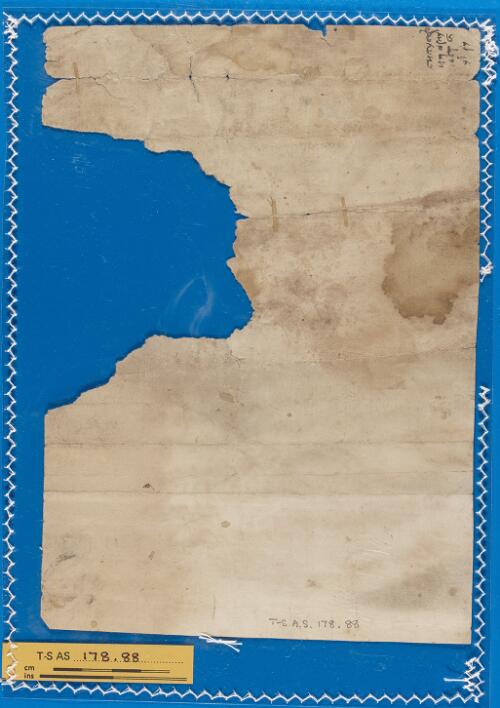
Verso, top right (Judeo-Arabic filing note)
- אן לא
- ידכל פי
- מאל סלטאן
- במעאכסה
Verso, top right (Judeo-Arabic filing note)
- Not to
- interfere in
- the state's property
- through harassment