רשומה קשורה ל-מכתב: CUL Or.1080 J21
מכתב CUL Or.1080 J21- ציטוט
- S. D. Goitein, unpublished index cards (1950–85), #12266. Princeton Geniza Lab, Princeton University.
- Relation to document
- דיון
- ציטוט
- משה גיל, (634–1099) ארץ-ישראל בתקופה המוסלמית הראשונהv (in Hebrew) (Tel Aviv University, 1983), vol. 2.
- Location in source
- #293
- Relation to document
- Digital Edition
- מהדורה
- ציטוט
- S. D. Goitein, "Parents and Children: a Genizah Study of the Medieval Jewish Family," Gratz College Annual of Jewish Studies 4 (n.p., 1975), 47 - 68.
- Relation to document
- Digital Translation
- ציטוט
- S. D. Goitein's מהדורה (1950–85).
- Location in source
- Relation to document
- מהדורה
- ציטוט
- Marina Rustow's digital translation, available online through the Princeton Geniza Project at https://geniza.princeton.edu/documents/2266/.
- Relation to document
- Digital Translation
Editor: גיל, משה
Translator: Goitein, S. D. (in English)
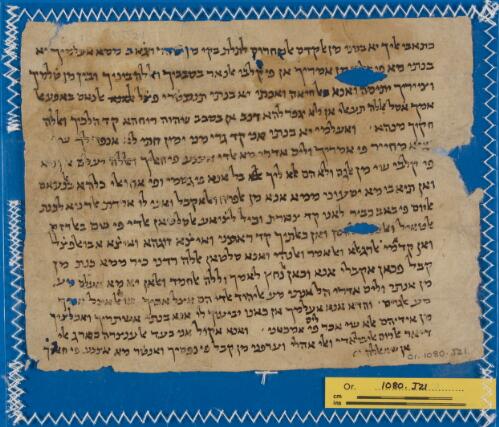
CUL Or.1080 J21 1r
Recto:
- כתאבי אליך יא בנתי מן אלקדס אלמחרוס לתלת בקי מן שהר רגאב (!) ממא אעלמיך יא
- בנתי מא פי קלבי מן אמריך אן פי קלבי אלנאר בסבביך ואללה ביניך ובין מן טלמיך
- וצייריך יתימה ואנא באלחיאה ואנתי יא בנתי תנתטרי פצל ⟦אלאנא⟧ אלנאס באפעאל
- אמך אסל אללה תעאלי אן לא יגפר להא דנב אן בסבב שהוה רוחהא קד הלכיך ואללה
- חקיך מנהא ואעלמי יא בנתי אני קד גרי מני ימין חתי לא אנפד לך שי
- ואנא מחייר פי אמריך וליס אדרי מא אלדי אצנע פי חאליך ואללה יעלם אן מא
- פי קלבי שי מן אלגם ולא הם אלא ליך ⟦אלא⟧ בל אנא פי גסמי ופי אחואלי כלהא ב/אל\נעאם
- ואן תיאבי מא יסעוני ממא אנא מן אלפרח ואלאקב{א}ל ואני לו ארדת אלדניא לכנת
- אליום פי באב כביר לאני קד צארת וכיל לציאע אלסלטאן אלדי פי ש{א}ם באלרזק
- אלטאיל ואל[. . .] אלחסן ואן כאלתיך קד ראתני ואיצא זוגהא ואיצא אבו אלפצל
- קד/א\מי אלרגאלא ואלאמר ואלנהי ואנא סלטאן אללה רדני כיר ממא כנת מן
- קבל פכאן אקב{א}לי אנא וכאן /אל\נחץ לאמך וללה אלחמד ואלאן יא מא אעלם מע
- מן אנתי וליס אדרי הל אנתי מע אליהוד אלדי הם אצל אביך או //אלי\\ אלאצל א[מ]ך
- מע אלגוים והדא אנא אעלמך אן כאנו יביעוך לי אנא בנתי אשתריך ואכלציך
- מן אידיהם אלא שי אכר //ליס\\ פי אמכאני ואנא אקול אני בעד אלענצרה כארג אלי
- דיאר אלרום אלי בלאדי ואלי אהלי וערפני מן קבל {במא} פי נפסיך ואנטר מא אצנע פי חאליך
- אן שא אללה
Recto
I am writing to you, my daughter, from Jerusalem, may God keep it, on the 27th of Rajab. I wish to tell you, my daughter, what I think about your affairs. Fire is in my heart because of you; God is between me and that one who harmed and made you an orphan while I am alive. You, my daughter, must look for alms from strangers because of the deeds of your mother. I ask God, the exalted, not to forgive her that she destroyed you in order to satisfy her cupidity. He will punish her for what she has done to you.
Know, my daughter, that I have given a solemn oath not to send you anything as long as I am uncertain about your status and do not know how to act in regard with you. God knows that I have no worry or distress except you. Otherwise, I am completely satisfied with my health and my affairs; my clothes do not hold me for happiness and good luck. Had I sought only worldly gain, then I could regard myself today as a great success, for I have become the administrator of the estates of the Sultan here in Palestine, for an ample salary and fine income. Your maternal aunt has seen me, and her husband too, and also Abu 'l-Faḍl. The police are at my disposal, command and prohibition are in my hand, and I am a sultan. God has made me happier than I had been before; so the good fortune has been mine and the misfortune has come to your mother, and praise be to God.
Now, my daughter, I do not know with whom you are, with the Jews, who are the stock of your father, or with the stock of your mother, the Muslims. But this I wish you to know: even if they wanted to sell you to me, who are my own daughter, I would buy you and rescue you from their hands, except one other thing which I cannot do.
After Pentecost I am leaving for the lands of the Rūm (Byzantium) to visit my native country and my family. Let me know before what your intentions are so that I can decide what to do with you, if God will.
Recto
- I am writing to you, my daughter, from Jerusalem, may God keep it, with three (days) remaining in the month of Rajab. What I have to tell you,
- my daughter, is what preoccupies me about your affairs. A fire [burns] in my heart because of you. God stands between me and the one who oppressed you
- and made you an orphan in my lifetime. You, my daughter, must depend on people’s kindness because of the deeds
- of your mother. I beseech God the exalted not to forgive her the sin by which, because of her greed, she destroyed you. God will set you right
- from her account. Know, my daughter, that I have sworn a solemn oath not to send you anything
- as long as I am uncertain about your status and do not know what to do about your situation. God knows that I have no
- consternation or worry other than for you. Rather, my health and my affairs are all in a state of benefaction,
- and my clothes do not hold me for happiness and good fortune. Had I sought nothing but worldly gain, then I could
- regard myself today as a great success, for I have become the administrator of a government compound in al-Shām for an ample
- salary and a good . . . [income?]. Your maternal aunt has seen me, and her husband has too, and also Abu l-Faḍl.
- At my disposal are men, commandment and prohibition, and I am powerful. God has made me better than I had been
- before. So good fortune has been mine and misfortune your mother’s, God be praised. Now, <my daughter>, I do not know with
- whom you are. I do not know whether you are with the Jews, who are the stock of your father, or the stock of your mother,
- the non-Jews. But this I wish you to know: even if they wanted to sell you to me, my own daughter, I would buy you and rescue you
- from their hands. What else could I do? I say that after Shavuʿot (ʿAnṣara), I will set out
- for the lands of the Rūm (Byzantium), my country and my family. Let me know first what your intentions are so that I can decide what to do,
- God willing.
CUL Or.1080 J21 1v