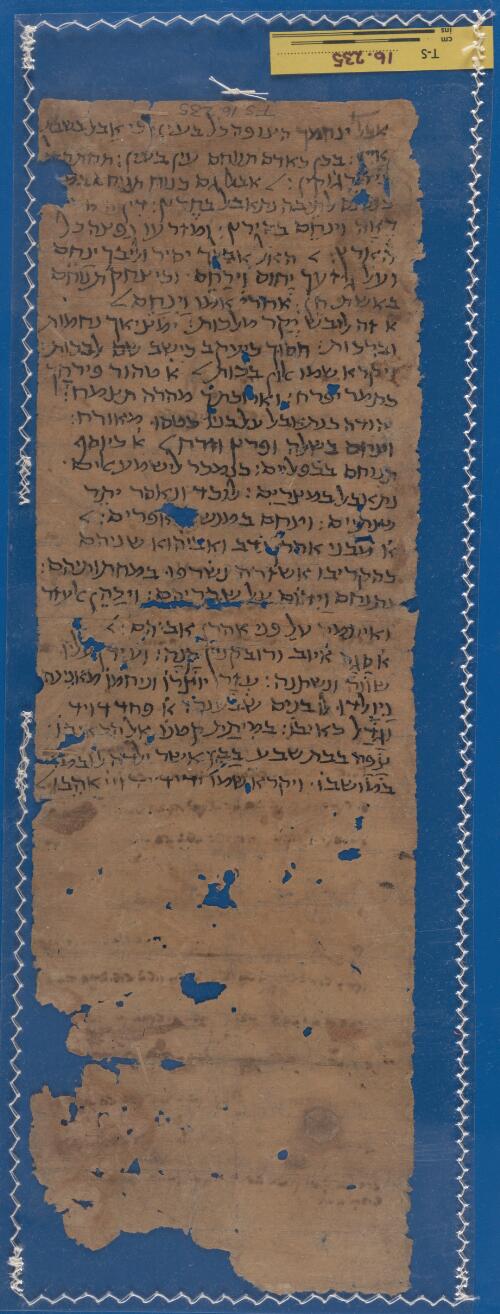
רשומה קשורה ל-מכתב: T-S 16.235
מכתב T-S 16.235- ציטוט
- S. D. Goitein, unpublished index cards (1950–85), #8227. Princeton Geniza Lab, Princeton University.
- Relation to document
- דיון
- ציטוט
- Moshe Yagur, "Letter to a Relative," in Posen Library of Jewish Culture and Civilization (Yale University Press, 2026), vol. 3.
- Location in source
- Relation to document
- Digital Translation
- ציטוט
- משה גיל, (634–1099) ארץ-ישראל בתקופה המוסלמית הראשונה (in Hebrew) (Tel Aviv University, 1983), vol. 3.
- Location in source
- #530
- Relation to document
- Digital Edition
- מהדורה
Editor: גיל, משה
Translator: Yagur, Moshe (in English)
T-S 16.235 1r
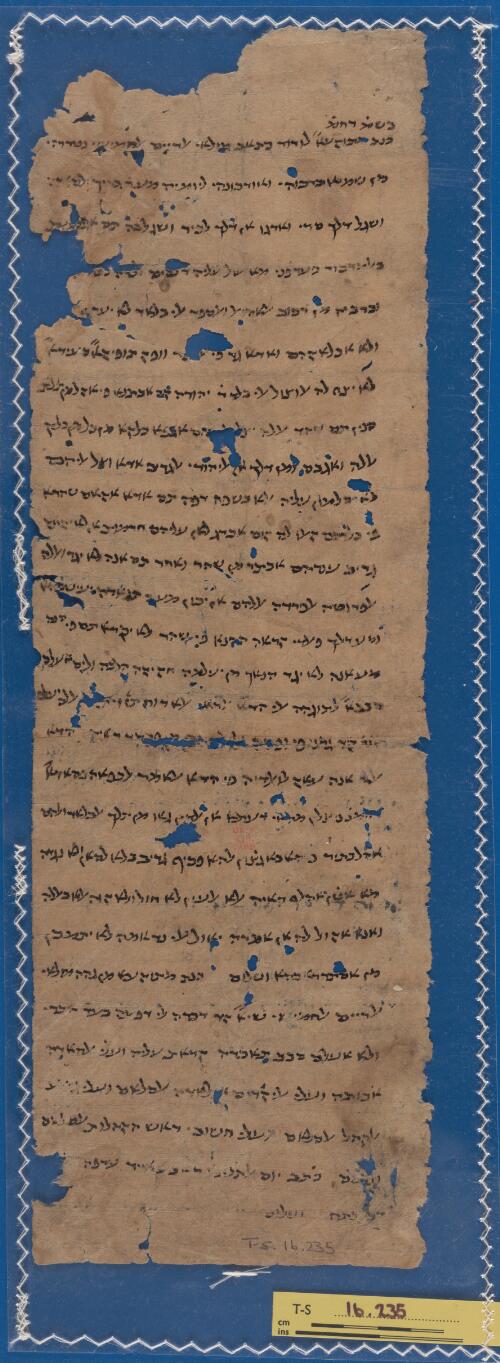
- בשמ רחמ
- כנת [מ]תוקעא לורוד כתאב מולאי אלרייס אלחמישי נטרוהי
- מן שמיא וברכוהי ואורכונהי ליומיה מע ר ברוך ולם ארה
- ושגל דלך סרי וארגו אן דלך לכיר ישגל בה תם אגתמעת
- באלמדכור פערפני מא עול עליה ר נסים ולדה נטר[ו]הי [אלהינו]
- וברכיה מן רכוב אלאהואל ואלספר אלי בלאד לא יערף [אלנאס]
- ולא אכלאקהם ואדא גד פי אל[ס]פר וופק תופיקא סעידא
- לא יצח לה אלוצול אלי בלד ר יהודה קראבתנא פי אקל מן תלת
- סנין תם שהד אללה יצל [א]ל[י קו]ם אגפא כלקא מן כל מן כלק
- אללה ואגבס ומן דלך אן אליהודי אלגריב אדא וצל אליהם
- לא יסלמון עליה אלא בשפה רפה תם אדא אקאם שהרא
- פי בלדהם קאלו לה קום אכרג לאן עליהם חרמות אן לא יקים
- גריב ענדהם אכתר מן שהר ואחד תם אנה לא יגד ואללה
- אלפרוטה אלפרדה אללהם אן יכון מעה תגארה יעיש בהא
- ומע דלך פאלדי קראה ההנא פי שהר לא יקרא תם פי סנה
- מע אנה לא יגד הנאך מן יעלמה חקיקה הלכה וליס אעלם
- סבבא לתוגהה אלי הדא אלראי אלא רוח תזזית [ו]אללה יעלם
- אנה קד גמני פי נפסי [ ]קד ראיה הדא
- אלא אנה עאק לואלדיה פי הדא אלאמה לכפאה פסאדא
- רחמ ליצלן מהאי דעתא אן אלדין גאו מן תלך אלבלאד ולהם
- אהל כתיר פיהא באגצון להא פכיף גריב בלא לסאן ולא נגדה
- מא אטן אתלף ראיה אלא אלעין לא חול ולא קוה אללה באללה
- ואנא אקול לה אן אמרה יאול אלי נדאמה לא יתמכן
- מן אסתדראכהא ושלום כנת מתופעא מן גהה מולאי
- אלרייס אלחמישי שיא קד דכרה לי דפעה בעד אכרי
- ולא אעלם סבב תאכרה קראת עליה ועלי אלחאקה
- אכותה ועלי אליקרים א[ו]לאדה אלסלאם ועלי גמיע
Translated by Moshe Yagur
In Your name, O Merciful One.
I was expecting the letters of my master—the head, the fifth [in rank], may he be protected from Heaven and blessed, and his days prolonged—to arrive with R. Barukh, but I didn’t see him. I became worried, and I hope these worries turn out for the best. Later, I met the abovementioned, and he notified me what your son, R. Nissim, may [our God] protect and bless him, decided: to make a dangerous journey, a voyage to a land [where] he does not know the people or their nature. Even if he is lucky, and things work out extremely well, he won’t be able to reach the land of R. Judah, our relative, in less than three years. And then, God is a witness, he will find himself among people whose nature is the meanest of all of God’s creation, the darkest of all.
For example, when a foreign Jew reaches them, they do not greet him with more than a word or two. And then, if he stays in their town for a month, they tell him, “Get up and leave!”—for they have banned any foreigner from living with them for more than a month. Besides that, he won’t be able—I swear to God—to get [even] a single perutah [a coin of small value], nor—God forbid—merchandise to make a living from. What is more, what he has read here in one month, he won’t read there in a whole year, since he won’t find a person there to truly teach him halakhah. I cannot think of any reason for such an idea except a bad spirit. God knows he has saddened my heart. . . . this idea. He is hurting his parents in this matter; this mistreatment is too much. May the Merciful One save us from this idea.
For the people who come from that land, even if they have a large family there, they despise it [the land]—all the more so a foreigner, who does not speak the language. I cannot see what has made him consider it, except his eyes. There is no might nor power except in God. And I say, eventually he will regret this but won’t be able to change it.
And peace.
My master, the head, the fifth, I was expecting from you that thing which you have mentioned time and again, but it did not arrive. I don’t know the reason for the delay.
I wish you, your family, your brothers, your dear children peace. Peace to the whole community, peace to the dignitaries leading the communities. And peace.
Written on Tuesday, the twenty-second of Iyyar, may God show you its blessing.
And peace.
T-S 16.235 1v