Legal document: T-S Ar.54.78
Legal document T-S Ar.54.78What's in the PGP
- Image
- 1 Transcription
Description
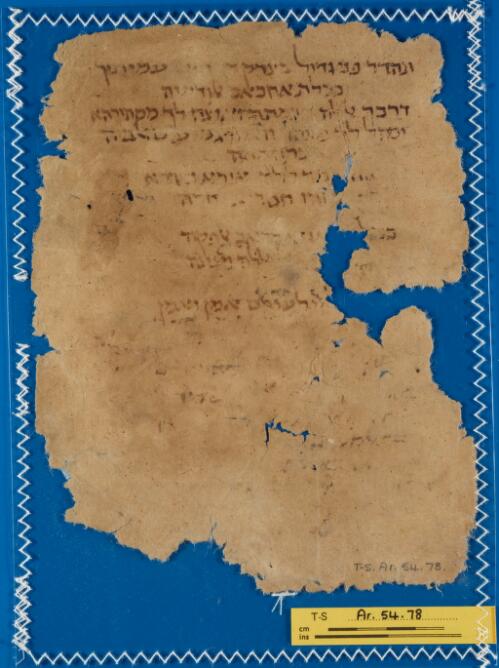
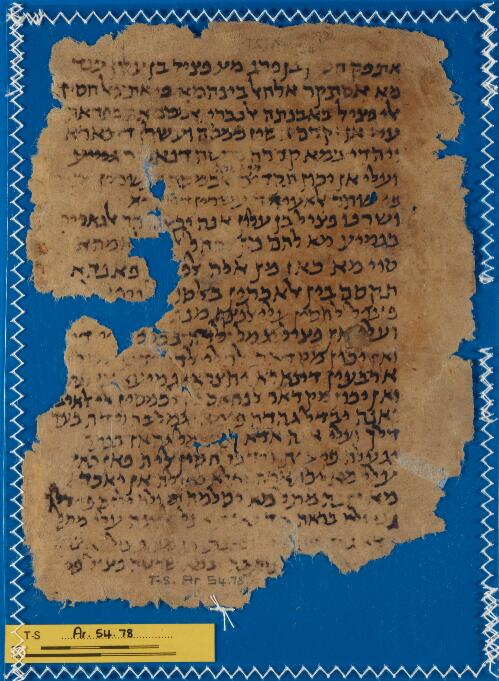
Engagement contract between Ḥusayn b. Faraj and his prospective father-in-law Fuḍayl b. ʿAllūn, for the hand of Fuḍayl's elder daughter Mufaddāt. Dating: Ca. 1000, per Goitein. Conditions: 1) Muqaddam is 25 dinars, of which 5 are paid immediately and 20 in Tishrei. 2) The fiancée receives the entire trousseau of her late mother except for the silver. 3) The silver will be divided equally between the two daughters, but Mufaddāt will receive not less than 40–50 dinars. 4) Likewise copper 40–50 dinars. 5) If Ḥusayn is not satisfied, the engagement is nullified without formalities. The text on verso is unrelated. (Information from Goitein’s index card.) A conditional engagement agreement of a young couple. Goitein estimates that this document was written around 1000AD (Soc. Med. 3:85) and that this is a betrothal deed, due to the condition that the couple will not need a bill of divorce in case the marriage would not take place. However, according to Ashur, this condition indicates a conditional engagement agreement. Furthermore, he is not familiar with other early betrothal deeds from the 12th century. Other than this deed, there is only one other case in the Geniza where conditional engagement are mentioned – TS 13 J 8.31 from 1042 (another possibility is AIU VII D 78 published in Friedman, Palestine, 2:51). The agreement was conducted between the groom and the father of the bride. There is no mention of the bride’s consent or a proof that she appointed her father as her representative. One should not assume from this that the bride was a minor, because such elements are often missing in engagement agreements (see, for example, TS 8 J 17.9d). Furthermore, when the bride was a minor, such detail was often stated explicitly. This agreement contains a unique condition, which is not known from other documents: the father agrees to pay for his son-in-law clothing (“adornments” and jewelry), meaning probably for the wedding itself. Furthermore, he will not provide these from the trousseau left by the father’s wife (apparently deceased?). Her trousseau will be divided equally between the two daughters. It is probable that this condition was demanded by the groom who wanted his bride-to-be to receive a large trousseau, as he was promised. The groom’s worries about the trousseau of his wife are also found in the condition that allowed him to check the items of the trousseau, to see that it meets his standards. In the case that it does not pleases him, he may take back the sums of money he already spent on the wedding expenses, or other expenses, and cancel the marriage. (Information from Amir Ashur's dissertation)
Editor: Ashur, Amir
T-S Ar.54.78 1v
T-S Ar. 54.78 recto
- אתפק חסין בן פרג מע פציל בן עלון ענד
- מא אסתקר אלחאל בינהמא פי אתצאל חסין
- אלי פציל באבנתה אלכברי אלמסמאה מפדאת
- עלי אן יקדם חסין כמסה ועשרין דינארא
- ויהדי במא קדרה כמסה דנאניר <<גמיע>>
- ועלי אן יכון תקדים <מן גמלה> אלכמסה ועשרין ...
- פי שהר אלאעיאד עשרין די[נא]רא
- ושרט פציל בן עלון אנה יכץ הדה אלגאריה
- בגמיע מא להם מן אלרחל אל[די] לאמהא
- סוי מא כאן מן אלה אלפ[צה] פאנהא
- תקסם בין אלאכתין באלסו[יה] וִ....לִ
- פציל לחסין עלי אלנצף מנה[א ...]
- ועלי אן פציל יגמל ולדה בכ.מ[...]. די
- ואן יכון מקדאר אלחלי אלדי דִ......
- ארבעין דינארא יחצר אלגמיע אצ....
- ואן יכון מקדאר אלנחאס ב[י]ן כמסין אלי ארב[עין ...]
- ואנה יבדל גהדה פימא יגמל בה ולדה בעד
- דלך ועלי אנה אדא אסתכמל גהאז בנתה
- יגעלה פי בית וידנו חסין אליה פאן כאן
- עלי מא יכתארה ואלא כאן לה אן יאכד
- מא יזנה מתל מא יסלמה .. ולא ילזם פי דלך
- גט ולא בראה אד כאן אתצל אלזיגה עלי מתל
- [ה]דא ... [...] וכאנת ..מ. . פציל אצ..
- [...]יתבת במא שרטה פציל פי
T-S Ar.54.78 1r