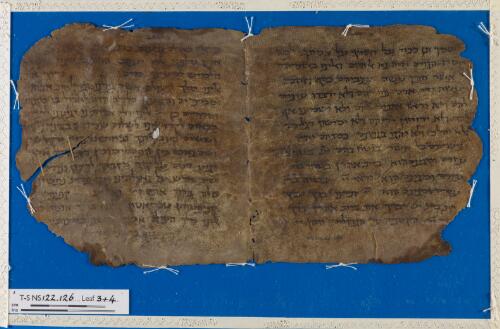
Scholarship on Literary text: T-S NS 122.126
Literary text T-S NS 122.126- Bibliographic citation
- Nicholas de Lange, "A Byzantine Haggadah," in Posen Library of Jewish Culture and Civilization (Yale University Press, 2026), vol. 3.
- Relation to document
- Translation
- Bibliographic citation
- Nicholas de Lange, Greek Jewish Texts from the Cairo Genizah (Mohr, 1996).
- Location in source
- 48–52
- Relation to document
- Digital Translation
- Bibliographic citation
- Posen Library of Jewish Culture and Civilization (Yale University Press, 2026), vol. 3: Encountering Christianity and Islam.
- Location in source
- Relation to document
- Discussion
Translator: Lange, Nicholas de (in English)
T-S NS 122.126 1r
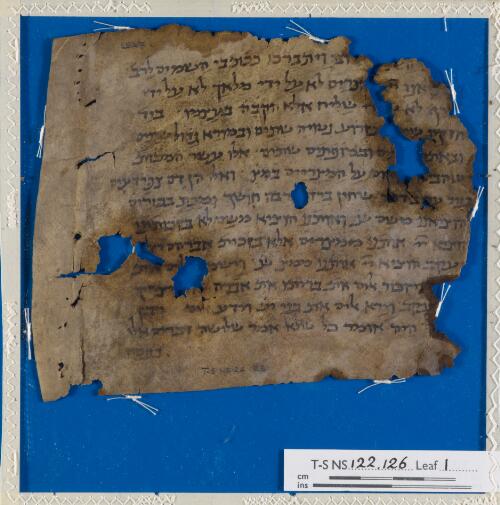
[Accordingly w]e are bound to thank, praise, laud, glorify, exalt, magnify, immortalise in song Him who lives fore[ver. Migh]ty Saviour, the Worker of Wonders, Him who did for us all] these signs and wonders and miracles, and brought us out from oppression to freedom, from affliction to ease, from constraint to latitude and from slavery to liberty; who made the mighty waters into a path and a wall of sea into dry land for us, who made the de]pths of the sea into a roadway and took us across the divided Reed Sea on foot. We say before him, Hallelujah. Praise the Lord. Praise, you servants of the Lord, praise the name of the Lord. May the Lord’s name be blessed from now and for evermore. From the rising of the sun to its setting praised be God’s name. High above all nations is the Lord; above the heavens is his glory. Who is like the Lord our God who is seated on high but lowers himself [to] see [what is] in heaven and earth? He lifts the poor from the dust, from the dunghill [he rai]ses the needy, to set him with princes, with the princes of his people. [He gi]ves the barren woman a home, happy as a mother of sons. Hallelujah.1 [When] Israel came out of Egypt, the house of Jacob out of a foreign people, [Ju]dah became his sanctuary, Israel his dominion. The sea saw and fled, the Jordan [turned b]ack; the mountains danced like rams, the hills like lambs. [What was it, sea, that made] you fee, that made you turn back, Jordan, mountains, that made you dance like rams, hills like l[ambs?] At the presence of your lord quake, earth, at the presence of the God of Jacob, who turns rock into a pool of water, granite into a spring of water. Blessed are you, Lord our God, King of the Universe, Who has redeemed us and redeemed our ancestors from Egypt, and has allowed us to reach this night, on which to eat unleavened bread and bitter herbs. So may the Lord our God and God of our ancestors allow us to reach [other] festivals that are coming towards us safely, happy at the rebuilding of your city and joyful at your worship and at the renewal of your temple. There may we partake of the paschal offerings and [other] sacrifices whose blood will land on the sides of your altar as a token of your goodwill, and we will thank you with a new song for our redemption and our spiritual rescue, selah! Blessed are you. Lord, Redeemer of Israel.1 Then they drink, and they wash their hands and say: Blessed are you, Lord our God, King of the Universe, Who has sanctified us by his commands and commanded us concerning the washing of the hands. And then he takes the half-piece of unleavened bread and recites hamotsi: [ . . . ] Blessed are you. Lord our God, King of the Universe, who brings the bread of poverty out of the earth. He gives [some] to everybody and again they say: Blessed are you, Lord our God, King of the Universe, who has sanctified us by his commands and commanded us concerning the eating of unleavened bread. And they eat it. And again he takes bitter herb and gives [some] to everybody and they say: Blessed are you, Lord our God, King of the Universe, who has sanctified us by his commands and commanded us concerning the eating of bitter herb. And they eat it. And again he takes bitter herb and unleavened bread and he gives [some] to everybody and they eat it without a blessing.
And then they eat whatever they have.
Then they wash their hands and say:
Blessed are you, Lord our God, King of the Universe, Who has sanctified us by his com[mands] and commanded us concerning the washing of the hands. And then they fill the glasses and he says: Let us bless Him of whose [food] we have partaken and by whose goodness we live. Blessed be He and blessed be his name. Blessed are you. Lord our God, King of the Universe, God praised with the Passover offering, by the eating of the bread of poverty, for by it you rescued us and [so] we bless you, our Rock, as it is written, “You open [your hand, and satisfy all living creatures with goodwill]” (Psalms 145:16). With bitter green herbs your people from the land of the cursed you redeemed, by the merit of the paschal blood, statute, law and covenant, as it is written, “You shall eat [and be satisfied and bless the Lord your God]” (Deuteronomy 8:10). Hasten redemption for those who keep the commands, in memory of Zion, the sacrificial worship, as it is written, “The Lord rebuilds Jerusalem” (Psalms 147:2). And he recites the thanksgiving and then they drink. And again they fill the glasses and they say: Not to us. Lord, not to u[s but] to your name ascribe glory, for your love and faithfulness (Psalm 115).
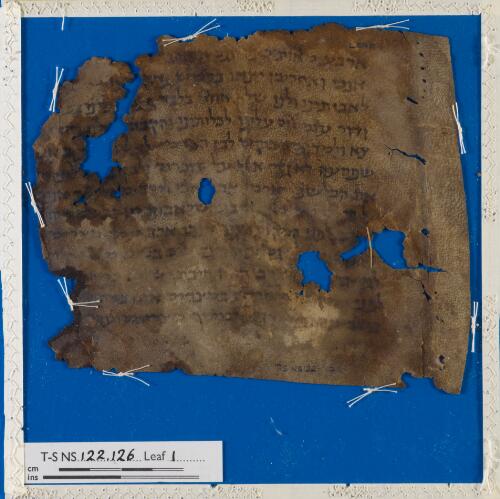
T-S NS 122.126 1v
T-S NS 122.126 2r
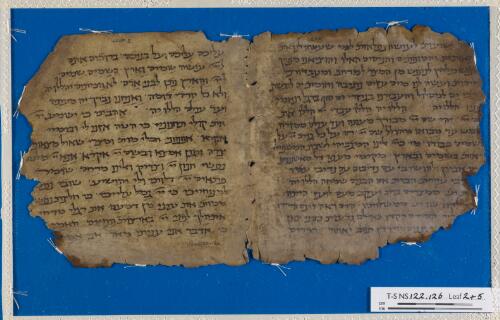
T-S NS 122.126 2v
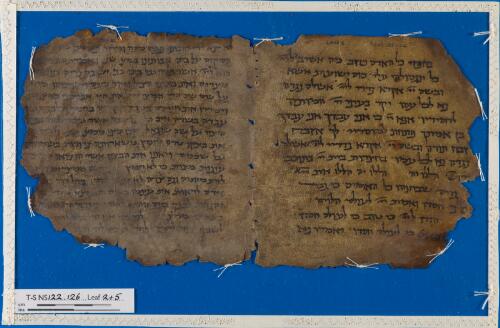
T-S NS 122.126 3r
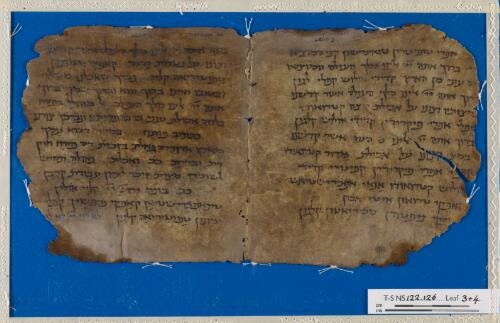
T-S NS 122.126 3v