Literary text: T-S Ar.39.153 + T-S NS 297.51
Literary text T-S Ar.39.153 + T-S NS 297.51What's in the PGP
- Image
- 1 Transcription
- 1 Translation
Description
Two sets of bifolios from an ʿilm-i ḥal manual in Ottoman Turkish. Dating: possibly sixteenth-century or later (per Hathaway). In the introduction to her edition, Jane Hathaway notes: "These two undated documents appear to comprise different sections of a single work of ʿilm-i ḥāl (Arabic, ʿilm al-ḥāl), a ‘primer’ of Muslim practice, written in simple Turkish, for converts to Islam, as well as long-time Muslims who might not be thoroughly versed in accepted Muslim practice, such as women, young people, isolated rural populations, and soldiers.... The language of the sections of T-S Ar. 39.153 dealing with prayer is quite similar to that of the ‘Rules of Prayer’ (Şurūṭ-i ṣalāt) section of Üstüvānī’s Risāle; however, the Genizah document lacks any references or allusions to religious authorities. Most well-known ʿilm-i ḥāl works, in contrast, incorporate numerous references to authoritative treatises on fiqh, or Islamic jurisprudence.... Linguistically, the obvious difference between the Genizah ʿilm-i ḥāl and these well-known Ottoman Turkish examples is that these popular specimens use the form secd-i sehiv for ‘invalidation of prayer’ while the Genizah document uses sehv-i secde. This may indicate that the Genizah documents draw on a different, perhaps little-known, work of ʿilm-i ḥāl. On the other hand, the author, or at least the calligrapher, may have stripped out the practical guide- lines from one or more of these better-known, more elaborate works. The four folios of T-S Ar. 39.153 form a partial ‘pamphlet’ on two subjects common to this genre: (1) şurūṭ-i ṣalāt (Arabic, shurūṭ al-ṣalāt), ‘rules of prayer’, and more specifically what er- rors in practice invalidate prayer, and (2) elfāẓ-i küfr (Arabic, alfāẓ al-kufr), the utterances, whether intentional or accidental, that throw one into unbelief. As Tijana Krstić points out (2019, 84), inclusion of elfāẓ-i küfr in ʿilm-i ḥāl works appears to be an innovation of the Süleymanic era; thus, this Genizah document must date from that period or later." (Hathaway, Ottoman-Era Documents from the Cairo Geniza, 338-342) NB: For exact line numbering and ordered pagination, consult Hathaway's edition directly. The pagination in the PGP is based on the order of the images/fragments rather than the original manuscript's pages. Lines that are combined in Hathaway's translation (e.g. ll. 3–5) have been disaggregated in the PGP version (l. 3, l. 4, l. 5) so that they align properly with the transcription.
Tags
Editor: Hathaway, Jane
Translator: Hathaway, Jane (in English)
T-S Ar.39.153 1r
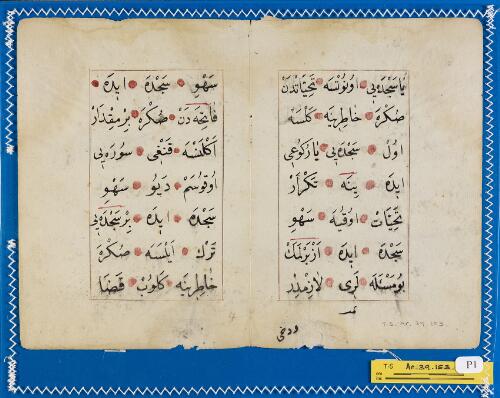
Page 7: Folio 1r, left side
-
sehv-i secde ide.
-
Fātiḥa’dan ṣoñra bir miḳdār
-
eğlense, ‘ḳanġı sūreyi
-
oḳusam’ deyü, sehv-i
-
secde ide. Bir secdeyi
-
terk eylese, ṣoñra
-
ḫāṭırına gelüb, ḳażā
Page 10: Folio 1r, right side
-
ya secdeyi unutsa, taḥiyyātdan
-
ṣoñra ḫāṭırına gelse,
-
ol secdeyi ya rukūʿı
-
ide, yine tekrār
-
taḥiyyāt oḳuya sehv-i
-
secde ide. Ezberlemek
-
bu mesʾeleleri lāzımdir.
-
ve daḫi (bottom left)
Page 7: Folio 1r, left side
-
your prayer is invalid.
-
If, after the Fātiḥa, you hesitate
-
for a while, thinking, ‘Which chapter
- shall I read?',
- your prayer is invalid.
- If you leave out a prostration,
- then later you remember it and perform it,
Page 10: Folio 1r, right side
-
If you forget bowing or prostrations, and
-
you remember after the taḥiyyāt,
-
and you perform the prostration or bowing
-
and recite
-
the taḥiyyāt again,
-
your prayer is invalid.
-
You must learn these matters by heart.
-
Furthermore (bottom left)
T-S Ar.39.153 1v
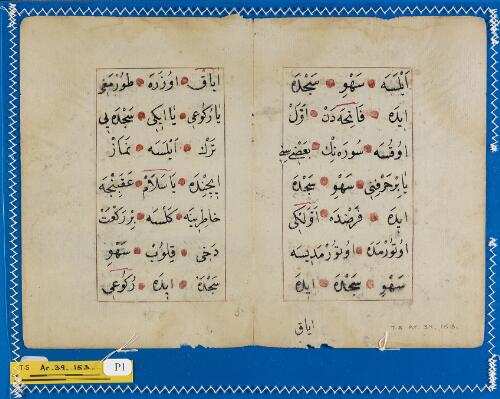
Page 8: Folio 1v, right side
-
eylese, sehv-i secde
-
ide. Fātiḥa’dan evvel
-
oḳusa sūrenin baʿżısını
-
ya bir ḥarfini sehv-i secde
-
ide. Farżda evvelki
-
oturmada oturmadıysa
-
sehv-i secde ide.
- ayaḳ (bottom left)
Page 9: Folio 1v, left side
-
Ayaḳ üzere ṭurmaġı
-
ya rukūʿı ya iki secdeyi
-
terk eylese, namāz
-
içinde ya selām ʿaḳabince
-
ḫāṭırına gelse, bir rekʿat
-
daḫi ḳılub, sehv-i
-
secde ide. Rukūʿı
Page 8: Folio 1v, right side
-
your prayer is invalid.
-
If, before reciting the Fātiḥa,
-
you recite part of the chapter
-
or [even] one letter [of it], your prayer is invalid.
-
If, during an obligatory prayer,
-
you do not perform the first jalsa,
-
your prayer is invalid.
- standing (bottom left)
Page 9: Folio 1v, left side
-
If you leave out standing upright,
-
bowing, or the two prostrations,
-
and you remember in the course
-
of the prayer or following salām
-
and add a rakʿa,
- your prayer
- is invalid.
T-S Ar.39.153 2r
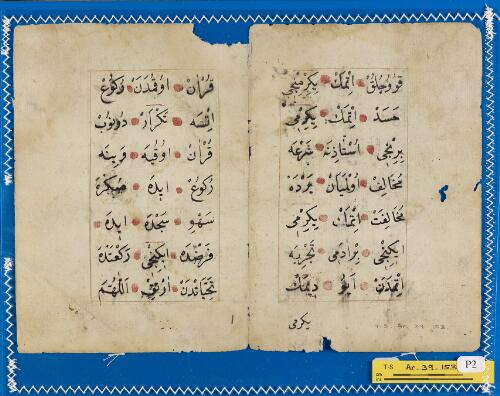
Page 1: Folio 2r, left side (Shurūt al-ṣalāt Section)
-
Ḳurʾān oḳumadan rukūʿ
-
itse, tekrār dönüb,
-
Ḳurʾān oḳuya ve yine
-
rukūʿ ide ṣoñra
-
sehv-i secde ide.
-
Farżda ikinci rekʿatda
-
taḥiyyātdan artıḳ ‘Allahümme
Page 16: Folio 2r, right side
-
ḳovuculuḳ etmek. Yiğirminci
-
ḥased etmek. Yiğirmi
-
birinci üstāzına şerʿe
-
muḫālif olmayan yerde
-
muḫālefet etmek. Yiğirmi
-
ikinci bir ādamı tecribe
-
etmeden ‘ayu’ dimek
- yiğirmi (bottom left)
Page 1: Folio 2r, left side ("Rules of Prayer" Section)
-
If you bow without reading [a chapter from] the Qurʾān,
-
then go back
-
and read the Qurʾān and
-
bow again afterward,
-
your prayer is invalid.
-
If, during the second rakʿa of [one of the five] obligatory prayers,
-
before the taḥiyyāt,
-
you have already said
Page 16: Folio 2r, right side
- to commit slander. The twentieth
- is to be envious. The twenty-
- first is to
- oppose your master [or teacher] when
- he has not violated the sharīʿa. The twenty-
- second is to call a man
- 'stupid' without testing him.
- the twenty-[third] (bottom left)
T-S Ar.39.153 2v
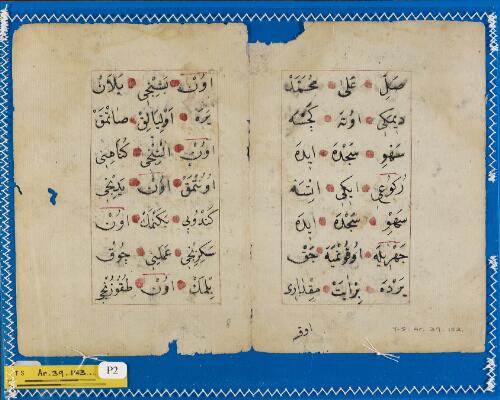
Page 2: Folio 2v, right side
-
ṣalli ʿala Muḥammed’
-
dimeği öte geçse
-
sehv-i secde ide.
-
Rukūʿ iki itse,
-
sehv-i secde ide.
-
Cehriyle oḳunmayacaḳ
-
yerde bir āyet miḳdārı
- okusa (bottom left)
Page 15: Folio 2v, left side
-
On beşinci yalan
-
yere evliyālıḳ ṣatmaḳ.
-
On altıncı günāhını
-
unutmaḳ. On yedinci
-
kendüyi begenmek. On
-
sekizinci ʿamelini çoḳ
-
bilmek. On ṭoḳuzuncı
Page 2: Folio 2v, right side
- ‘May God have mercy on Muḥammad’,
- mixing them up,
- your prayer is invalid.
- If you bow twice [in succession],
- your prayer is invalid.
- If you recite a number of verses audibly
- when they should not be recited [aloud],
- if you recite (bottom left)
Page 15: Folio 2v, left side
- The fifteenth is to
- sell ‘sainthood’ [friendship with God] on false pretences.
-
The sixteenth is to forget your sin.
-
The seventeenth is
-
to be pleased with yourself.
-
The eighteenth is to know your deeds too well [exact meaning unclear].
- The nineteenth is
T-S Ar.39.153 3r
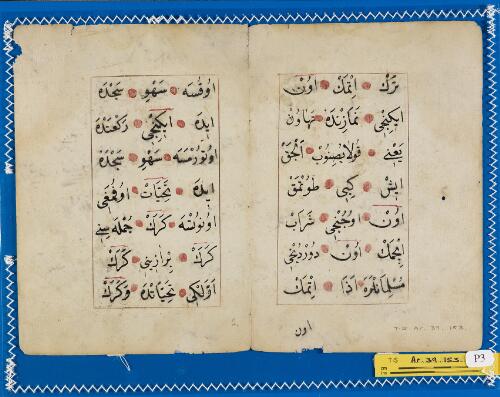
Page 3: Folio 3r, left side
-
oḳusa, sehv-i secde
-
ide. İkinci rekʿatda
-
oturmasa, sehv-i secde
-
ide. Taḥiyyāt oḳumaġı
-
unutsa, gerek cümlesini,
-
gerek birazını, gerek
-
evvelki taḥiyyātda ve gerek
Page 14: Folio 3r, right side
-
terk etmek. On
-
ikinci namāzında tehāvün
-
yaʿnī ḳolayṣınub alcaḳ
-
iş gibi ṭutmaḳ.
-
On üçünci şarāb
-
içmek. On dördünci
-
Müslimānlara ezā etmek.
- on (bottom left)
Page 3: Folio 3r, left side
-
your prayer is invalid.
-
If, during the second rakʿa,
-
you do not sit down, your prayer is invalid.
-
If you forget to recite the taḥiyyāt,
-
whether all of it,
-
or a little of it, or
-
in the first taḥiyyāt or
Page 14: Folio 3r, right side
- The twelfth is to behave
- carelessly during your prayer—
- that is, as if you were undertaking
- something easy or insignificant.
- The thirteenth is to drink wine.
- The fourteenth is
- to harm Muslims.
- the [fif]teenth (bottom left)
T-S Ar.39.153 3v
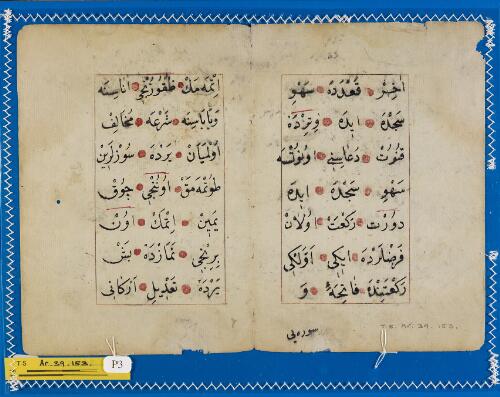
Page 4: Folio 3v, right side
-
āḫir ḳaʿdede sehv-i
-
secde ide. Vitir’de
-
ḳunūt duʿāsını unutsa,
-
sehv-i secde ide.
-
Dört rekʿat olan
-
farżlarda iki evvelki
-
rekʿatında Fātiḥayı ve
-
sūreyi (bottom left)
Page 13: Folio 3v, left side
-
etmemek. Ṭoḳuzuncı anasına
-
ve bābāsına şerʿe muḫālif
-
olmayan yerde sözlerin
-
ṭutmamaḳ. Onuncı çoḳ
-
yemīn etmek. On
-
birinci namāzda beş
-
yerde taʿdīl-i erkānı
Page 4: Folio 3v, right side
-
in the last qaʿda, your prayer is invalid.
-
If, during the witr prayer,
- you forget to say the ‘qunūt’ prayer,
-
your prayer is invalid.
-
If, during the first two rakʿas in
-
[one of the three] four-rakʿa obligatory prayers,
-
you leave out both the Fātiḥa and
-
the chapter (bottom left)
Page 13: Folio 3v, left side
- The ninth is not to obey your mother
- and father when they have
- not violated the sharīʿa.
- The tenth is to make
- too many vows.
- The eleventh is to abandon
- the correct performance of the five obligatory prayers.
T-S Ar.39.153 4r
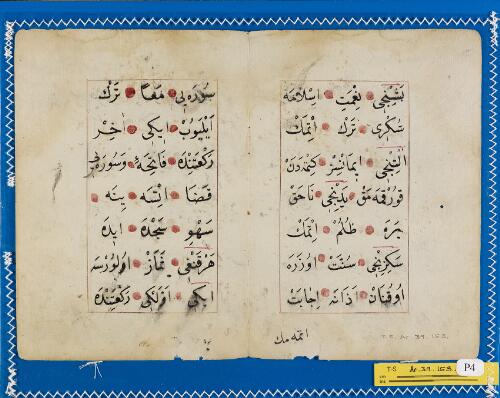
Page 5: Folio 4r, left side
-
sūreyi maʿen terk
-
eyleyüb, iki āḫir
-
rekʿatında Fātiḥayı ve sūreyi
-
ḳażā itse, yine
-
sehv-i secde ide.
-
Herḳanġı namāz olursa,
-
iki evvelki rekʿatında
Page 12: Folio 4r, right side
-
Beşinci niʿmet-i İslām’a
-
şükri terk etmek.
-
Altıncı īmānsız gitmeden
-
ḳorḳmamaḳ. Yedinci nā-ḥaḳḳ
-
yere ẓulüm etmek.
-
Sekizinci sünnet üzere
-
oḳunan ezāna icābet
- etmemek (bottom left)
Page 5: Folio 4r, left side
- the chapter,
- then in the last two
- rakʿas, you say the Fātiḥa and the chapter,
- again,
- your prayer is invalid.
- Whateer obligatory prayer it is,
- if in the first two rakʿas
Page 12: Folio 4r, right side
- The fifth is to abandon gratitude
- for the blessing of Islam.
- The sixth is not to fear falling into faithlessness.
- The seventh is unjustly
- to oppress someone.
- The eighth is not to answer
- the customary call to prayer
- not to [answer] (bottom left)
T-S Ar.39.153 4v
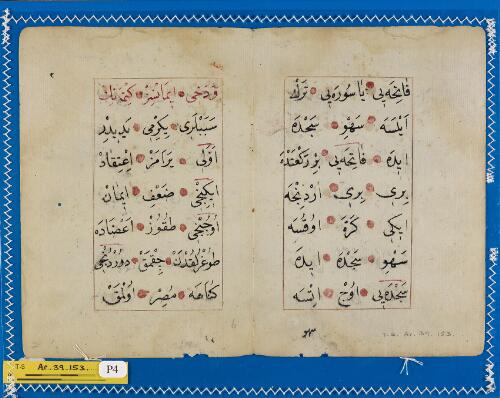
Page 6: Folio 4v, right side
-
Fātiḥa’yı ya sūreyi terk
-
eylese, sehv-i secde
-
ide. Fātiḥa’yı bir rekʿatda
-
biri biri ardınca
-
iki kerre oḳusa,
-
sehv-i secde ide.
-
Secdeyi üç itse
- sehv (bottom left)
Page 11: Folio 4v, left side (Alfāẓ al-kufr Section)
-
[in red ink] Ve daḫi īmānsız gitmenin
-
sebebleri yiğirmi yedidir.
-
Evveli yaramaz iʿtiḳād.
-
İkinci żaʿf īmān.
-
Üçüncü ṭoḳuz aʿżāda
-
ṭoġruluḳdan çıḳmaḳ. Dördünci
-
günāha muṣırr olmaḳ.
Page 6: Folio 4v, right side
-
you leave out either the Fātiḥa or the chapter,
-
your prayer is invalid.
-
If in one raʿka,
-
one right after the other,
- you recite the Fātiḥa twice,
-
your prayer is invalid.
-
If you prostrate three times,
- invalid (bottom left)
Page 11: Folio 4v, left side ('Utterances of Unbelief' Section)
- Furthermore,
-
there are 27 causes of falling into unbelief
- The first is inadequate conviction.
- The second is weak belief.
- The third is to stray from the
- right [path] by means of the nine organs. The fourth
- is to sin persistently.
T-S NS 297.51 1r
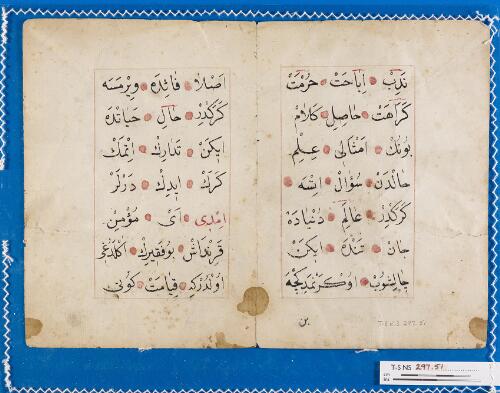
Page 1: Folio 1r, left side (Concluding Section)
-
aṣlā fāʾide virmese
-
gerekdir. Ḥāl-i ḥayātda
-
iken tedārik itmek
-
gerek idin dirler.
-
İmdi [in red ink] ey müʾmin
-
ḳarındaş, bu faḳīrin añladuġı
-
oldur-ki Ḳıyāmet Güni
Page 4: Folio 1r, right side
-
nedib, ibāḥat, ḥürmet,
-
kerāhet. Ḥāṣıl-i kelām
-
bunun emsāli ʿilm-i
-
ḥāldan suʾāl itse
-
gerekdir ʿālem-i dünyāda
-
cān tende iken,
-
çalışub öğrenmedikçe
- ben (bottom left)
Page 1: Folio 1r, left side
- it would certainly be of no use.
- They would say that you should
- have prepared
- when you were [still] alive.
- Now then [in red ink]: O brother believer,
- this is what the poor one [i.e., the author] has come to understand.
- On the Day of Judgement,
Page 4: Folio 1r, right side
-
recommended, permissible, forbidden,
-
and reprehensible. In short,
-
you must ask questions
-
in this way about religious matters
- while you are [still] in this world,
- while life is [still] in the flesh
- Unless you work hard and learn,
- I (bottom left)
T-S NS 297.51 1v
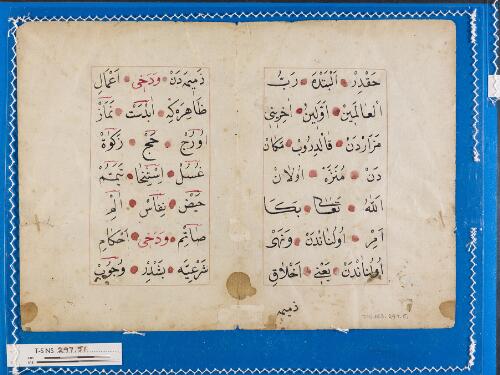
Page 2: Folio 1v, right side
-
ḥaḳḳdır elbetde Rab
-
ul-ʿālemīn evvelin āḫirini
-
mezārdan ḳaldırub, mekān-
-
dan münezzeh olan
-
Allāhü teʿālā bana
-
emir olunandan ve nehy
-
olunandan, yaʿnī aḫlāḳ-ı
- zemīme (bottom left)
Page 3: Folio 1v, left side
-
zemīmeden, ve daḫi [in red ink] aʿmāl-ı
-
ẓāhire—ki abdest, namāz,
-
oruc, ḥacc, zekāt,
-
ġusül, istinḥā, teyemmüm,
-
ḥayż, nifās, alım
-
satım. Ve daḫi [in red ink] aḥkām-ı
-
şerʿīye beşdir: vücūb,
Page 2: Folio 1v, right side
- it is unquestionably true that the Lord
- of the universe
- will raise from the grave from first to last [i.e., everyone].
- God the exalted,
- he without limit, [has shown] me
- what is ordered and what is forbidden,
- that is, the morals of
- reprehensible acts (bottom left)
Page 3: Folio 1v, left side
-
reprehensible acts, and also [in red ink] the public acts of
-
ablution, obligatory prayer,
-
fasting, ḥajj, alms,
-
major ablution, washing in the prescribed manner, ablution with clean earth,
-
[cleansing of] menstrual and vaginal discharge, buying
-
and selling. Furthermore [in red ink], the statutes
-
of the sharīʿa are five [categories]: mandatory,