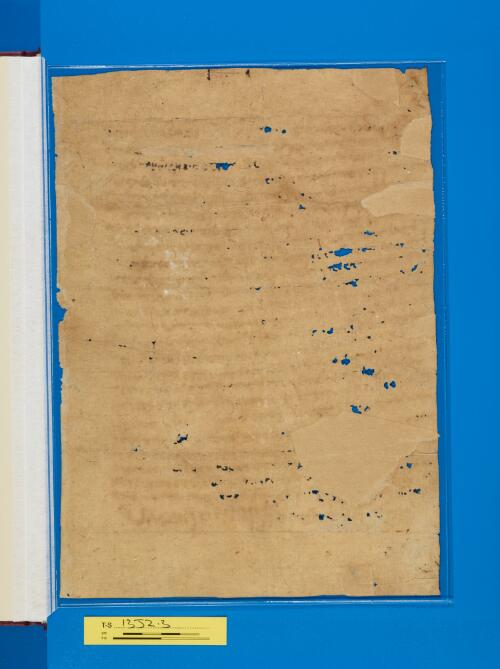
Legal document: T-S 13J2.3
Legal document T-S 13J2.3What's in the PGP
- Image
- 1 Transcription
- 1 Translation
Description
Betrothal record from 1093 in which the obligatory betrothal gift is 4 and one/sixth dinars. The document also stipulates the daughter receives the uppermost floor of a house; if she preferred to live elsewhere, she would receive rent, but her father and his heirs were responsible for the payment of the ground rent and watchman. Signed by Eli ha-Kohen b. Yahya, Avraham b. Yiṣḥaq (the Scholar), and Ezekiel II ha-Kohen he-Ḥaver b. Eli he-Ḥaver I. (S. D. Goitein, Mediterranean Society, 2:522, 3:445, 4:96, 374) EMS
Tags
Editor: Goitein, S. D.
Translator: Zsom, Dora (in English)
T-S 13J2.3 1r
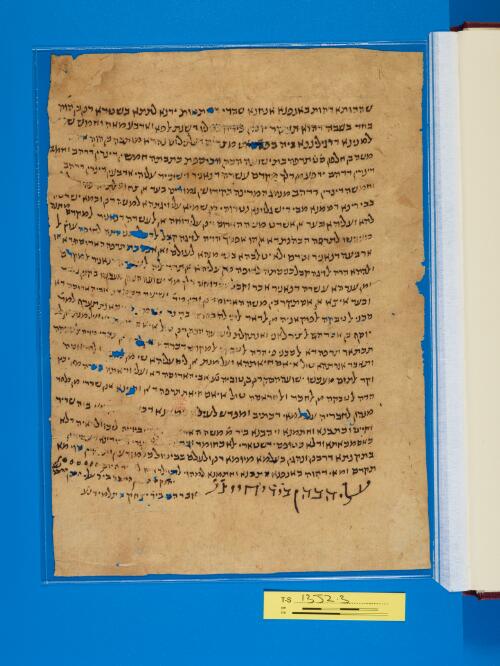
- שהדותא דהות באנפנא אנחנא שהדי ד[ח]תמות ידנא לתתא בשטרא דנן כן הוה
- בחד בשבה דהוא תנישר יומין בירח כסליו דשנת אלפא וארבע מאה וחמש שנ[ין
- למנינא דרגיליננא ביה בפסטאט מצרים דעל נילוס נהרא מותבה כן הוה אירס
- משה בן חלפון סט תרפה בת ישועה הכהן ותוספת כתבתה חמשין דינרין דדהב וחמשה
- דינרין דדהב ידפע מן דלך מקדם עשרה דנאניר וישתייר עלוהי ארבעין דינרין דדהב
- וחמשה דינרין דדהב מנהג המדינה בקידושין גמורים בעד אן צח וכאלת תרפה ד[א לואלדהא
- בבי דינא דממנא מבי ריש גלותא נטרוהי מן שמיא עלי זיגתהא למשה דנן ובמא ישרטה
- להא ועליהא ובעד אן אשרט משה הארוס דנן עלי רוחה אן אלעשרה דנאניר אלמקדם מתנה
- מעכשו לתרפה הכהנת דא אן הו אפסך הדה אלזיגה קבל אלד[כו]ל כניסתה לחופה עוץ אל
- ארבעה דנאניר וסדס ולא יטאלבהא בשי מנהא לעולם ואן אפסכת תרפה הארוסה דא או
- ואלדהא הדה אלזיגה קבל כניסתה לחופה כאן עליהא אן תרד אליה אלעשרה דנאניר אלמקדם
- ומן ענדהא עשרה דנאניר אכר וקבל עלי רוחה דלך מר ישועה הכהן מעכשו בקנין גמור
- ובעד איצא אן אסתקר בין משה הארוס דנן ובין מר ישועה הכהן דנן אבי הארוסה דא
- סכני אלטבקה אלפוקאניה מן אלדאר אלתי לה במצר בקצר אלשמע אלתי כאנת תערף למר
- יוסף בן אברהם אלצידלאני ואנתקלת לישועה הכהן דנן טול איאם חיאתהא ועל מנת אן ליס
- תכתאר תרפה דא אלסכני פי הדה אלטבקה אלמקדם דכרהא כאן להא אן תכרי הדה אלטבקה
- ותאכד אגרתהא טול איאם חיאתהא ועל מנת אן ליס עליהא שי מן [אלח]כר ואלחראסה
- וקד אלתזם מעכשו ישועה הכהן דנן בן טוביה נע` אבי הארוסה דא ועלי וראתה בעדה מא יכץ
- הדה אלטבקה מן אלחכר ואלחראסה טול איאם חיאת תרפה דא וקנינא אנן שהדי מן כל חד
- מנהון לחבריה על כל מאי דכתיב ומפרש לעילא במאנא דכ[שר למקנ]יא ביה שריר
- וקיים וכתבנא וחתמנא ויהבנא ביד מ משה האר[וס דנן למהוי] בידיה לזכו ולראיה דלא
- כאסמכתא ודלא כטופסי דשטארי אלא כחומר וכח[וזק כל ש]טרי דבי דינא דעבידין
- בתקנתא דרבנן ונהגין בעלמא מיומא דנן ולעלם בביטול כל מודעין ותנאין סוי מא
- תקדם ומאי דהוה באנפנא כתבנא וחתמנא למהוי לזכו ולראיה ל[אח]ר היום
- יחזקאל הכהן החבר ביר` עלי הכהן החבר נע
- עלי הכהן ביר` יחיי זל` אברהם ביר יצחק התלמיד נע`
Translated by Dora Zsom
The following testimony was given before us, the undersigned witnesses of the document:
On the first day of the week—which is the 19th of the month Kislev, in the year 1405 [1093 CE] according to our calendar in Fustāt-Misr, which lies on the banks of the Nile—the following happened: Moses ben Ḥalfon betrothed Turfa bat Yeshu‘a ha-Kohen. The addition [to the prescribed sum] of the ketubah was fifty golden dinars and also five golden dinars. He shall pay from that ten dinars, and forty-five golden dinars shall remain with him, [according to the] custom of the city. [He betrothed her] with a complete betrothal after she appointed her father over her marriage to Moses, and over what he shall make conditional for her and upon her, in the court of law, which is appointed from the house of the exilarch. After that, Moses, the groom, made conditional upon himself that the ten dinars given in advance should be considered as a gift to this Turfa, a kohenet [daughter of a kohen], from that moment, in case he cancels the marriage before entering under the wedding canopy, instead of the [usual] four dinars and the sixth [of the value of the gift?], and that he should not demand anything from her, ever.
And if Turfa, this fiancée, or her father, should cancel this marriage before she enters under the wedding canopy, she must return the ten dinars given in advance, and ten other dinars from what is with her. Yeshu‘a ha-Kohen accepted this upon himself as a complete acquisition from this moment. Moreover, Moses, the groom, and Yeshu‘a ha-Kohen, the father of the bride, agreed that they would live in the upper floor of the house which he has in Fustāt, in Qasr al-Sham‘, which was known as belonging to Joseph ben Abraham the druggist, and it [the right of staying in the house] was transferred to Yeshu‘a for all the days of her [Turfa’s] life. And [they agreed that] if Turfa did not choose to live in this floor that has been mentioned before, she could rent this floor and could take its rent all the days of her life, without contributing to the quitrent or to the [expenses of] guarding [the floor]. This Yeshu‘a ha-Kohen ben Tuviah, the father of the bride, assumed as a duty from this moment, for himself and his heirs, that they would pay the quitrent and the [expenses of] guarding this floor throughout the entire lifetime of this Turfa.
And we, the witnesses, performed the qinyan [binding agreement] ceremony, [obligating] each one of them regarding the other to comply with everything that is written and detailed above, by means of an object that is suitable for performing the qinyan, in a fit and sound manner, and we have written it down and have signed it, and we have transferred it into the hands of Moses, the groom, so that it may be in his hands, in order to entitle him and as a legal proof, not as a [mere] scriptural text used as a support, and not as the forms of documents, but as a document that has the legal force of the documents signed in the courts of law that enact ordinances of the rabbis, which are universally valid from this day forever, with the cancellation of every [possible] declaration of protest, and [the cancellation of] every stipulation, with the exception of what has been mentioned above. We have written down what was before us and signed it so that it may be an entitlement and proof for him from this day onward.
Eli ha-Kohen ibn Yaḥyā
Ezekiel ha-Kohen he-ḥaver [the fellow] ben Eli he-ḥaver
Abraham ben Isaac ha-talmid.
T-S 13J2.3 1v