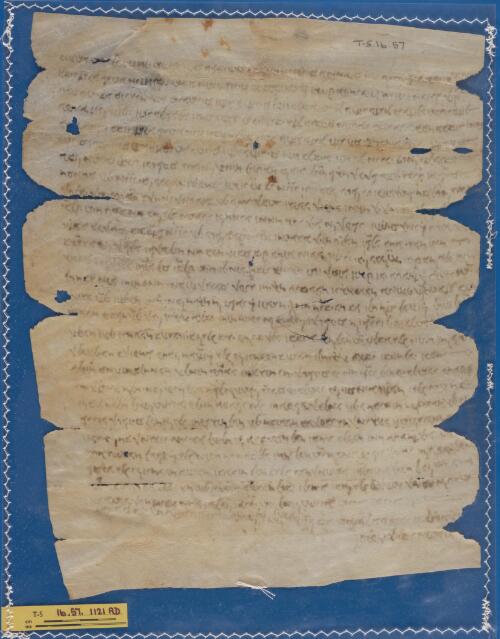
Legal document: T-S 16.57
Legal document T-S 16.57What's in the PGP
- Image
- 1 Transcription
- 1 Translation
Description
Court record written and signed by Ḥalfon b. Menashshe ha-Levi. Location: Fustat. Dated: Middle decade of Ṭevet 1432 Seleucid, which is December 1120 CE. Detailing an allowance for a widow, Sitt al-Ḥusn bt. ʿEli, and her baby, Sitt al-Fakhr bt. Yakhin ha-Kohen, from the community chest. Abū Manṣūr Yakhin b. Abū l-Ḥusayn Yaḥyā ha-Kohen (known as al-Ḥalabī al-Ṣayrafī, i.e. the Aleppan banker) died penniless and as his widow is still nursing their baby she is unable to work. She asks the community judges to give her a monthly allowance (20 dirhams) while she is nursing and raising her daughter. The judges agree, but rule that the money given should be considered a debt granted to the baby by her mother, and that in future the mother will be able to collect the debt from the baby or from the baby’s heirs. Signed by Avraham b. Shemaʿya, Yiṣḥaq b. Shemuel, and Ḥalfon b. Menashshe. (Information from CUDL.)
Editor: Weiss, Gershon
Translator: Weiss, Gershon (in English)
T-S 16.57 1r
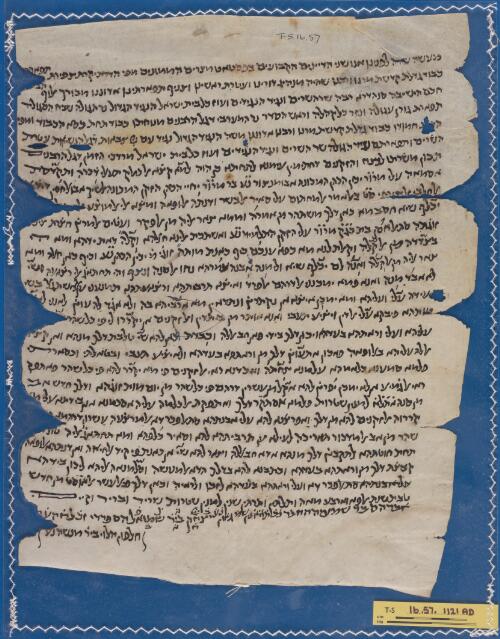
Recto
- מעשה שהיה לפנינו אנו שני הדיינים הקבועים בפסטאט מצרים הממונים מפי הדרת יקרת צפירת תפארת
- כבוד גדלת קדשת מרנו ורבנו שהיה מנהיג דורינו ועטרת ראשינו וצניף תפארתינו אדוננו מבורך אלוף הבי[נות]
- חכם הישיבה סנהדרא רבה שר השרים ונגיד הנגידים ועוז כל בית ישראל הנגיד הגדול נר הגולה שבח הסגולה
- תפארת גורן עגולה ונזר כל קהלה וראש הסדר נר המערבי דגל הרבנים מנוחתו כבוד תחת כסא הכבוד ומפי
- הד[ר]ת חמודו גדלת קדשת מרנו ורבנו אדוננו משה הנגיד הגדול נגיד עם יי צבאות דגל הנשיאות עטרת
- השרים ותפארתם נגיד הגולה שר השרים ונגיד הנגידים ועוז כל בית ישראל מרדכי הזמן דגל הרבנים
- תכון משרתו לנצח והזקנים דחתימין עימנא לתחתא כן הוה למא קצא אלכאלק תעאלי דכרה ותקדסת
- אסמאה עלי מרור יכין הכהן המכונה אבו מנצור נע בר מרור יחיי הכהן הזקן המכונה אלשיך אבו אלחסין דידיע
- אלחלבי אלצירפי סט באלאמר אלמחתום עלי סאיר אלבשר ודנתה אלופאה ומצא אלי אלמוצע אל[חק אליקין ולם]
- יכלף שיא חסב מא כאן דלך משתהר מן אמרה וממא צאר אליה מן אלפקר ועטים אלמרץ חצרת אלינ[א]
- זוגתה סת אלחסן בת כגק מרור עלי הזקן התלמיד נע ואשתכת אלינא חאלהא וקלה דאת ידהא ומא הי
- בצדדה מן אלקלה וקאלת לנא מא כפא ענכם כיף כאנת מותה זוגי מ יכין הכהן נע וכיף כאן חאלה ומא
- צאר אליה מן אלקלה ואנה לם יכלף שיא ולי מנה אבנה עפרהא נחו אלסנה ונצף והי תחתאג אלי רצאעה ושי
- לא אבד מנה ואנא פמא ימכנני אלדרהם אלפרד ואיצא תרביתהא ורצאעתהא תמנעני ען אלאשתגאל בשי
- [א]עידה עלי ועליהא ומא ימכן איצא אן נקתרץ ונתדאין מא ארביהא בה ולא אגד לה עוץ לאנני ל[ ]
- מותהא פיבקא עלי אלדין ויציע תעבי ואנא אותר מן בית דין ואלזקנים אן יקררו לי פי כל שהר [ ]
- עליהא ועלי וראתהא בעדהא ויכון דלך בידי פאן חב אללה וכברת וכאן להא שי טלבת דלך מנהא ואן קצ[א]
- אללה עליהא באלופאת פאכון אתעוץ דלך מן וראתהא בעדהא ולא יציע תעבי ובטאלתי וכסארתי
- פלמא סמענא כלאמהא עלמנא גחתה ואכדנא ראי אלזקנים פי מא יקרר להא פי כל שהר פאתפק
- ראי אלגמיע אן לא ימכן יפרץ להא אקל מן עשרין דרהם פי כל שהר מן יום מות זוגהא ודלך חדש אב
- מן סנה אתלא למנין שטרות פלמא אסתקר דלך ואתפקת אלכלמה עליה אסכמנא אנן בי דינא עלי מ[א]
- קררוה אלזקנים להא מן דלך ואפרצנא להא עלי אבנתהא סת אלפכר דא אלמרצעה עשרין דרהמא [פי כל]
- שהר מן אב אלמדכור תאריכה לעילא ען תרביתהא להא וסאיר כלפהא ומא תחתאג אליה טו[ל ]
- תחת חוטתהא לתקבץ דלך מנהא אדא חב אללה וצאר להא שי אן כאנת פי קיד אלחיאה ואן דנתהא אלופאה
- קבצת דלך מן וראתהא בעדהא וכתבנא להא בדלך הדא אלמעשה וסלמנאה אליהא ליכון בידהא
- עלי אבנתהא סת אלפכר דא ועלי וראתהא בעדהא לזכו ולראיה וכאן דלך פי אלעשר אלאוסט מן חדש
- טבת שנת אלפא וארבע מאה ותלתין ותרתי שנין למנין שטרות שריד ובריר וקיים
- אברהם בר שמעיה החבר נבתויא נין שמ גאון נע יצחק ביר שמואל הספרדי //ב ייי א ל פ// חא ב// זכ לח הע [הב]
- חלפון הלוי ביר מנשה נע
- Report of what happened in our presence — we, the two permanent judges of Fustat, Egypt, who were officially appointed by his Eminence, dignity, crown, glory,
- his honor, greatness, holiness, our master and teacher who was the leader of our generation, the pride of our heads and the turban of our glory, our lord Mevorakh, the champion of intelligences,
- the sage of the Yeshiva, the great Sanhedrin, prince of princes, nagid of negidim, and the strength of all the house of Israel, the great nagid, the light of the diaspora, the excellency of the pride of the chosen people [Israel],
- the glory of a round threshold, the diadem of every community and the head of the scholars, the light of the West, the banner of the Rabbis, may he rest in honor under the divine throne, and by
- his precious Eminence, greatness, holiness, our master and teacher, our lord Moses the great nagid, the nagid of the nation of the Lord of hosts, the banner of the presidency, the pride of
- the princes and their glory, the nagid of the exile, the prince of princes and the nagid of negidim, the strength of all the house of Israel, Mordekhai of the time, the banner of the Rabbis,
- may his position be established forever; [they] and the elders who sign with us at the bottom of this document — This came to pass. When the Creator, may his memory be exalted and his names be holy, decreed
- upon Yākhīn ha-Kohen, surnamed Abū Manṣūr, may he rest in peace, the son of Yaḥyā ha-Kohen the notable, surnamed Abu l-Ḥusayn and known as
- al-Ḥalabī the money assayer, may his end be good; the decree which is destined to all human beings; thus death drew near him [and then he] passed away to the place of the unquestionable truth, without having
- left anything; in his case it was known that he turned poor because of his serious illness. [And so] came to us
- his wife, Sitt al-Ḥusn, the daughter of his honor, greatness, holiness, Eli ha-Talmīd, may he rest in peace, and complained to us about her situation, the shortage of her hand, and
- the state of poverty she was in. She said to us: it has not been concealed from you how my husband Yākhīn ha-Kohen, may he rest in peace, died, how his position was and
- how poor he became so that he did not leave anything. I have a daughter from him of about one-and-a-half years old. She needs to be nursed,
- and has other indispensable needs, but I do not possess a single dirhem. Also, bringing her up and nursing her will prevent me from any work, with which
- I could earn something for myself and for her. It is also impossible that I indebt myself or buy upon credit, as long as I raise her, and not find to it [the loan] any compensation because I [am not sure that she might not]
- die and then the debt will remain upon me and my energy will be wasted in vain: I propose to the court and the elders to grant me a monthly allowance [which will be]
- upon her [the daughter] and upon her heirs after her, but will be handed over to me. And if God wishes, and she matures and possesses something I shall claim it from her; however, if
- God decrees death upon her I should be compensated by her heirs after her so that my work, expenditure of time, and expenses should not be lost.
- When we [the judges] heard her explanations, we recognized their validity. Thus, we have accepted the opinion of the elders that a monthly allotment should be granted to her.
- All agreed that it will not be possible to pay her less than twenty dirhems per month from the day of her husband’s death, namely, the month of Av
- of the year 1431, according to the era of the documents [1120 CE]. When that was established and agreed upon, we, the court, consented upon whatever
- the elders had granted her, and we have assigned to her against her infant daughter Sitt al-Fakhr, twenty dirhems every
- month from the month of Av, the date of which is mentioned above, for bringing up her daughter and all her other expenses, and of whatever need she might have as long as she is
- under her guardianship. [All of] that [she will be entitled] to collect from her, if God wishes and she possesses something, and if she stays alive; however, if death draws near her,
- she shall collect it from her heirs after her. Consequently, we have drawn this deposition for her, and we have delivered it to her so that it be in her hand
- against her daughter Sitt al-Fakhr and against her heirs after her as a title of right and a proof. This happened in the middle decade of the month
- of Tevet in the year 1432 according to the era of the doucments. [This document is] binding, strong, and established.
- Avraham b. Shemaʿya he-Ḥaver nbtva [Psalm 25:13] the descendent of Sher(aʿyahu) Gaon, may he rest in peace. Isḥāq b. Shemuʾel haSefardi, may his memory be cherished in the world to come.
- Ḥalfon ha-Levi b. Menashshe, may he rest in peace.
T-S 16.57 1v