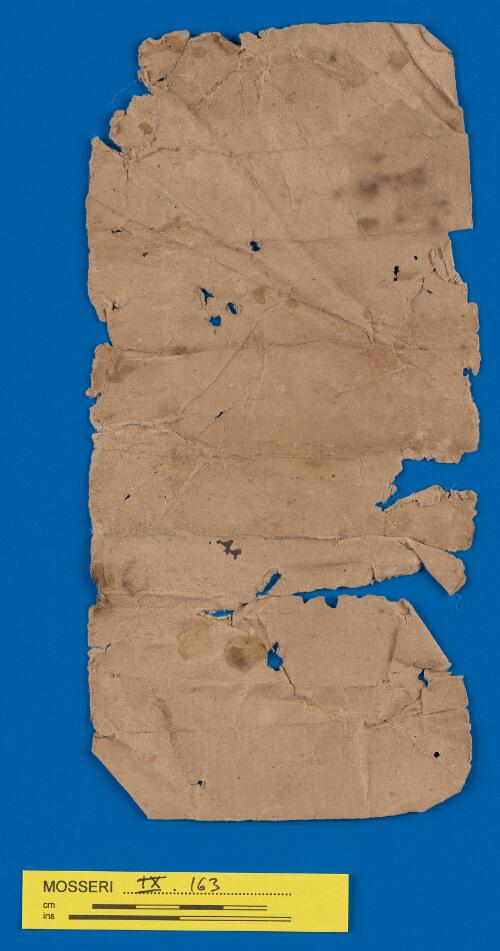
List or table: Moss. IX,163
List or table Moss. IX,163What's in the PGP
- Image
- 1 Transcription
- 1 Translation
Description
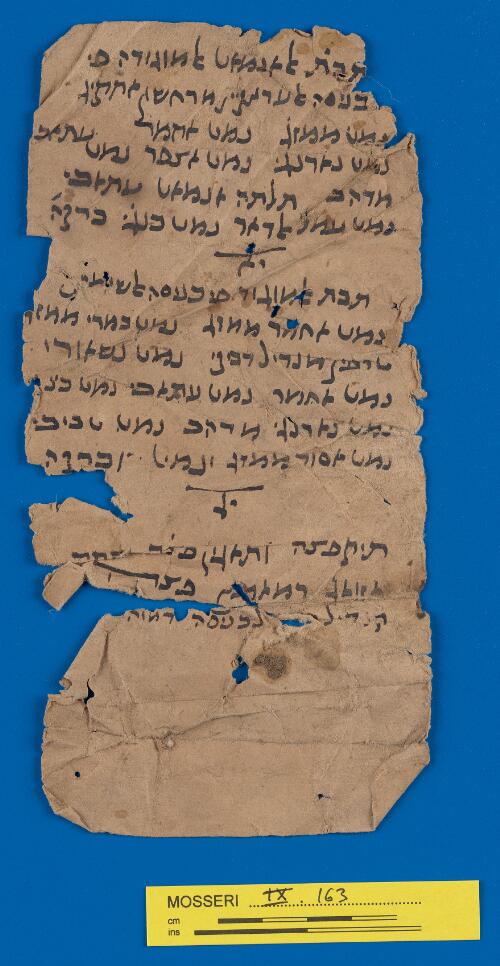
List of textiles and carpets (anmāṭ) and other things found in the synagogues of the Iraqis and Shāmīs in Fustat. Dated October 1201. From Goitein's passage on this document in Mediterranean Society, IV, pp. 124–25: "The flexibility of terms for what we call carpet reflects the variety of uses for the same textile. This is beautifully illustrated by comparing two inventories of the synagogues of the Palestinians and Iraqians in Fustat from the years 1159 [T-S Misc.28.51 + T-S NS J296 (PGPID 1427)] and 1201 [this document] with two others from the eleventh century. In the later documents a section is devoted to the anmāṭ, the term from which anmāṭī, carpet dealer, is derived. The passage in the 1159 inventory says: "The anmāṭ for the two synagogues: Three for the Tora scrolls, decorated with gold threads 'mixed' with niello; one smaller one, of the same type, for the scroll of the readings from the Prophets; two red ones 'mixed' with gold threads; twenty-two namaṭs made of brocade and siglaton; one for rotation; 110 and nine others, partly old and partly worn-out; a piece of cotton woven with cotton, twenty cubits long." The twenty-two namats were the carpets covering the floor of the synagogues, as proved by comparison with an inventory from the year 1075, where mats of different descriptions do the same service (see below). The two red namaṭs decorated with gold threads formed the hangings on the holy arks in the two synagogues, described as "curtains" in the eleventh-century documents. Finally, the namaṭs for the Tora scrolls (not "worn" by them, as is customary today, but put over them as a cover when they were taken out of the ark) were artistically decorated but otherwise of the same material (brocade or siglaton) as the floor carpets and were therefore called by the same name. "The inventory from which the translated passage is taken was written in 1159, when a new beadle took over. We may assume that it was made also because some or many of the possessions of the synagogues had been lost during the terrible period of internecine wars and anarchy experienced by Egypt in the 1150s. The assumption is even safer with regard to the list of the anmāṭ found in the two synagogues in October 1201. A low Nile caused famine, followed by epidemics and a complete breakdown of the public order. It is possible that the inventory, of which only the part on the anmāṭ is completely preserved, was compiled before everything was hidden away in a safe place. "The list has some interest for our purpose. Each textile is called namaṭ and is defined by its dominant color (red, three times, orange, twice, wine-colored, yellow, black, and so on) or by its make, ʿaṭṭābī, tabby, listed five times. Six of the twenty-four pieces were decorated with gold threads or "mixed" (gold and other threads), which means that they served as covers or hangings. Of the namaṭs covering the floor one is described as "made in the House," namely, the Carpet House of Fustat, that is, locally manufactured, and not imported as most others, and another as "a physician's carpet," namaṭ ṭabībī."
Tags
Editor: Goitein, S. D.
Translator: Rustow, Marina
Moss. IX,163 1r
Recto
- תבת אלאנמאט אלמוגודה פי
- כניסה אלעראקיין מרחשון אתקיג
- נמט ממזג נמט אחמר
- נמט נארנגי נמט אצפר נמט עתאב[י
- מדהב תלתה אנמאט עתאבי
- נמט עמל אלדאר נמט כנגי כרקה
- יא
- תבת אלמוגוד פי כניסה אלשאמיין
- נמט אחמר ממזג נמט כמרי ממזג
- טרפין מנדיל דביקי נמט נשאורי
- נמט אחמר נמט עתאבי נמט כצף
- נמט נארנגי מדהב נמט טביבי
- נמט אסוד ממזג ונמט . ו כרקה
- יג
- תיקפצה ותאגין פצה ספר
- . . . . רמא[הא פצה
- . . . . ] . לכניסה . דמוה
Recto
- Register of the carpets found in
- the synagogue of the Iraqīs, Marḥeshvan 1513 (Sel.):
- a variegated carpet; a red carpet;
- an orange carpet; a yellow carpet; an ʿattāb[ī] carpet;
- a gilded one; three ʿattābī carpets;
- a carpet of the Dār's manufacture; a khanjī (?) carpet, worn out.
- (Total) 11 (items)
- Register of what is found in the synagogue of the Shāmīs:
- a red, variegated carpet; a wine-colored, variegated carpet;
- two pieces of a Dabīqī kerchief; a nīshāwurī carpet;
- a red carpet; an ʿattābī carpet; a khaṣif (black-and-white?) carpet;
- an orange, gilded carpet; a physician's carpet;
- a black, variegated carpet; and a carpet [ ... ], worn out.
- (Total) 13 (items)
- A silver Torah case and two silver crowns; a [Torah] scroll;
- ... [its] ... of silver
- ... ] for the synagogue ... Dammūh
Moss. IX,163 1v