Scholarship on Legal query or responsum: T-S 10J22.8
Legal query or responsum T-S 10J22.8- Bibliographic citation
- S. D. Goitein, unpublished index cards (1950–85), #9883. Princeton Geniza Lab, Princeton University.
- Relation to document
- Discussion
- Bibliographic citation
- Rachel Richman's digital edition (2025), with minor emendations by Amir Ashur and Alan Elbaum, 2025, available online through the Princeton Geniza Project at https://geniza.princeton.edu/documents/7912/.
- Relation to document
- Digital Edition
- Bibliographic citation
- Rachel Richman, Alan Elbaum and Pratima Gopalakrishnan's digital translation, available online through the Princeton Geniza Project at https://geniza.princeton.edu/documents/7912/.
- Relation to document
- Digital Translation
Editor: Richman, Rachel
Translators: Richman, Rachel; Elbaum, Alan; Gopalakrishnan, Pratima
T-S 10J22.8 1r
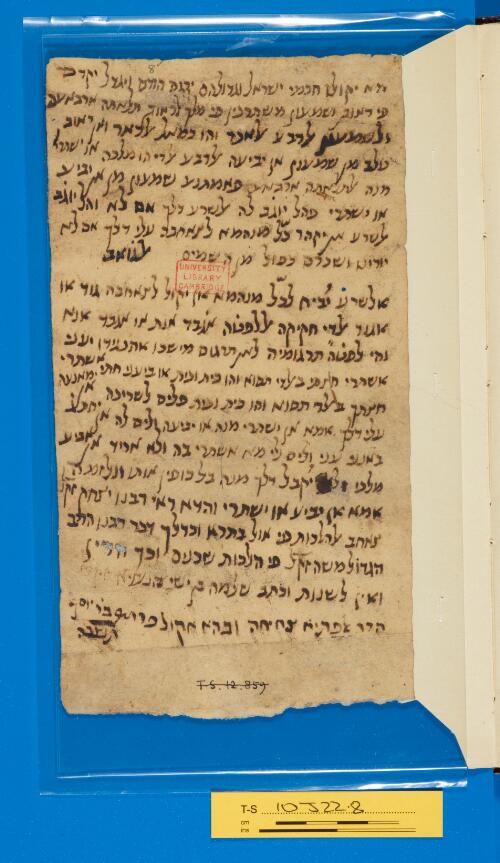
- מא יקולו חכמי ישראל וגדולהם ירום קודם ויגדל יקרם
- פי ראובן ושמעון משתרכין פי מלך לראובן תלאתה ארבעאה
- ולשמעון אלרבע אלאכר והו כמאל אלדאר ואן ראובן
- טלב מן שמעון אן יביעה אלרבע אלדי הו מלכה או ישתרי
- מנה אלתלאתה ארבאע פאמתנע שמעון מן אן יביע
- או ישתרי פהל יוגב לה אלשרע דלך אם לא והל יוגב
- אלשרע אן יקהר כל מנהמא לצאחבה עלי דלך אם לא
- יורינו ושכרם כפול מן השמים
אלגואב
- אלשרע יביח לכל מנהמה אן יקול לצאחבה גוד או
- אגוד אלדי חקיקה אללפטה אגבר אנת או אגבר אנא
- והי לפטה תרגומיה לאן תרגום מישכו את נגידו יעני
- אשתרי חצתי באלדי תסוא והו כית וכית או ביעני חתי אשתרי
- חצתך באלדי תסוא והו כית וכית פליס לשריכה אן ימאנעה
- עלי דלך אמא אן ישתרי מנה או יביעה וליס לה אן יחתג
- באנני עני וליס לי מא אשתרי בה ולא אריד אן אביע
- מלכי ל[א] יקבל דלך מנה בל כופין אותו ונלזמה
- אמא אן יביע או ישתרי והדא ראי רבנו יצחק זקל
- צאחב אלהלכות פי אול בתרא וכדלך דבר רבנן הרב
- הגדול משה זקל פי הלכות שכנים וכך הדין
- ואין לשנות וכתב שלמה בן ישי הנשיא זקל
- הדה אלפתיח צחיחה ובהא אקול פרחיה בר יוסף
- תנצבה
-
What do the sages of Israel, may their glory be exalted and their honor increased, say
-
in regard to the case of Reuben and Shimon, who collectively hold property. Reuben has three-quarters of it
-
and Shimon has the other quarter. And that is the whole dār (i.e. there are no other owners). Reuben
-
asked Shimon to sell him the quarter he owns or to buy
-
the three-quarters from him. Simon refused to buy
-
or sell. Does the law require this of him, or not? And does
-
the law require either of them to (be able to) coerce the other in this, or not?
-
May they teach us, and may their reward be doubled from heaven.
The Answer
-
The law permits either of them to tell the other "either you extend (possession over the whole property)
-
or I extend (possession)" the true meaning of which is “you compel or I compel.”
-
This is an Aramaic expression, as the Targum of “mishkhu et” is “negidu”, meaning
-
“You buy my share for what is is worth, which is such and such, or sell (it to) me so I can buy
-
your share for what it is worth, which is such and such.” His partner cannot refuse this, he
-
must either buy from him or sell (his share).
-
He cannot protest, “But I am poor and don’t have anything to buy it with, and I don’t want to sell
-
my property.” This is not accepted from him. Rather, we compel him
-
either to buy or to sell. This is the opinion of our teacher Yiṣḥaq [al-Fasī], (may his) h(oly) m(emory) b(e a blessing),
-
Master of the Halakhot in the first (chapter of Bava) Batra and likewise, the word of our teacher the rav
-
the great Moshe, (may his) h(oly) m(emory) b(e a blessing) in Hilkhot Shekhenim, and this is the law,
-
and one must not change it. Written by Shelomo b. Yishai ha-Nasī, (may his) h(oly) m(emory) b(e a blessing).
-
This legal opinion is proper, and I stand by it: Peraḥya b. Yosef,
-
m(ay his) s(oul) be bound up in t(he bundle of) l(ife)
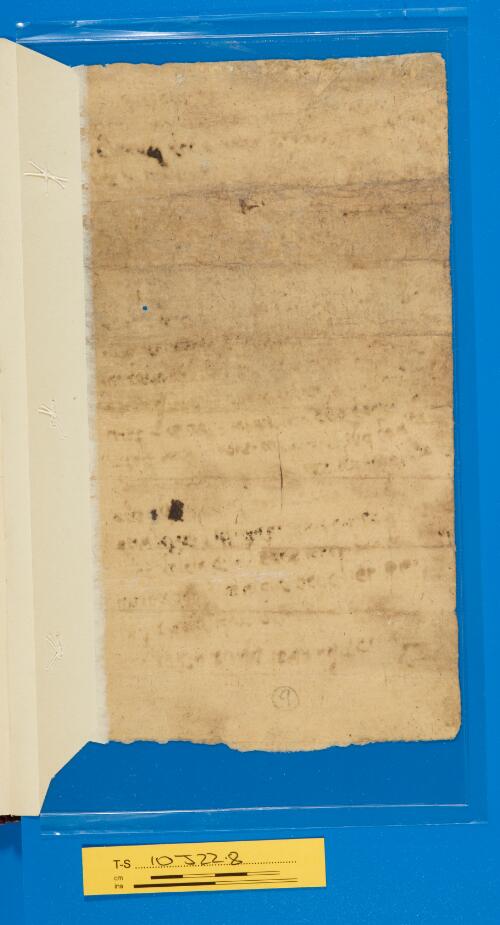
T-S 10J22.8 1v