Scholarship on Literary text: T-S Ar.44.218
Literary text T-S Ar.44.218- Bibliographic citation
- Yaron Serri and Efraim Lev, "A Judaeo-Arabic Fragment of Ibn-Biklarish’s Kitab al-Musta‘īnī, Part of a Unique 12th-Century Tabular Medical Book Found in the Cairo Genizah (T-S Ar.44.218)," Journal of the Royal Asiatic Society 20, no. 4 (n.p., 2010), 407–40.
- Relation to document
- Digital Translation
- Bibliographic citation
- Posen Library of Jewish Culture and Civilization (Yale University Press, 2026), vol. 3: Encountering Christianity and Islam.
- Location in source
- Relation to document
- Discussion
- Bibliographic citation
- Yaron Serri and Efraim Lev, "The Book of Musta‘īnī," in Posen Library of Jewish Culture and Civilization (Yale University Press, 2026), vol. 3.
- Relation to document
- Translation
Translators: Serri, Yaron; Lev, Efraim (in English)
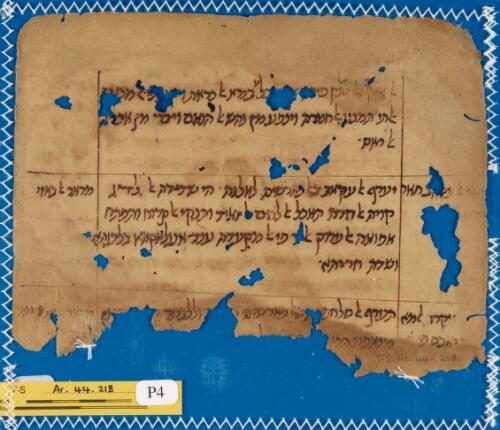
T-S Ar.44.218 1r
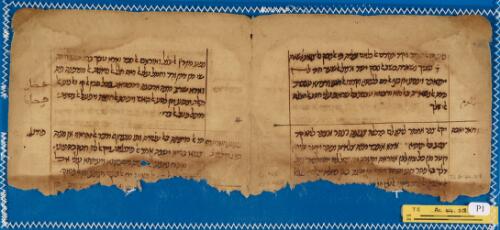
Gall of hyena hot, dry in the fourth degree
The hyena is an animal of the carnivores . . . . Some call it ḍab‘ [or ḍabu‘] and . . . and . . . ḍab‘ is the name of both male and female, ḍib‘ān for the male, umm ‘āmir, and their offspring is called al-fur‘ul. Arabs claim that one year it is a male and one year it is a female. When smeared on the rectum, it is useful against [fissure] and opens passages when eaten. It is effective with honey for ulcerous mange and for vaginal pains.
Gall of sheep
Gall of fish hot, dry in the fourth degree
Fish is all kinds of fish, especially those with scales on their body. One physician said that it is all kinds of fish whether they have scales or not. Strengthens the eye and dries its moistures and reduces its roughness, I mean roughness of the eyelids, and it is useful as eye medications and it is useful against ulcerous mange when smeared on with rose oil.
One for another . . .
Bone marrow hot, dry in the fourth degree
Marrow means fatness which exists within the bone of the calf or the arm and so on. The most useful is the deer’s marrow, then that of calf, and that of sheep—especially of she-goat. It dissolves and softens indurations and stony muscles and tendons. When applied as a pessary it is useful against uterine diseases. It repels reptiles when smeared on. When taken and dried in a non-reachable place with a dry bayleaf. Can be stored by spraying it with water and drinking? . . . and cleaning it until the water sinks . . . [ . . . ]
[Wild thyme]
It helps with damaged muscles and hepatic tumours, and when boiled with vinegar and soaked? in unguent [oil] of roses and when plastered on?, a dose of four drachma drunk with vinegar stops also the vomiting [of blood]. The third kind helps against reptile bites and melts [kidney] stones. Its cultivated kind does the same as the wild one.
Mint hot, dry in the third degree and some said—in the second degree
It is the mint in Spanish dialect; it is well known. Al-Zahrāwī mentioned that it has a wild kind that is similar to one of the kinds of fūdanj [=mint] and it is called: ḥabaq bustānī. Masīḥ: Good for the stomach—it heats and helps its digestion, it stops gripes which are caused by phlegm and is useful against hiccups . . .
fūdanj
[Visnaga] hot, dry in the second degree
Some call it al-nashi and also Ethiopian cumin. Some people thought that it is Karmānī cumin, which is mentioned under the letter kāf. It is sanabona. Iṣḥāq: When drunk with wine it is good against reptile bites and it also draws down the menses and helps with difficult micturation which is caused by coarse moistness. When mixed in lichen and vitiligo medications it strengthens their power. When burned from below with pine resin so as to make a thick smoke, it cleanses the uterus. When eaten with honey it kills the worms and the flukes and dissolves flatus and stops gripes and melts [kidney] stones and heats stomach, liver, hips, kidneys and womb.
Celery seeds.
[Naphtha]
. . . from a black stick and then “rising” it so it becomes white; it is Babylonian asphalt. Masīḥ: It both draws down the menses and sets micturition going and is helpful for chronic coughs, . . . [bloody] expectoration, ache of thighs and reptile bites. al-Rāzī: it kills worms and Ṣufār when applied. Ibn al-Jazzār: It is useful against . . . and albugo when applied, smelled, or burnt to produce thick smoke from below. It is suitable for women’s pain caused by uterine suffocations and against vitiligo.
Sal-ammoniac hot, dry in the fourth degree
It is a white and red salt which is produced from a salty mineral brought from Khurāsān. There is another kind that exists in smoke of spas/baths where excrement/faeces and bones are burned. al-Rāzī: Hot, useful against relaxation of uvula, quinsies and albugo. al-Ṭabari: It cleans, softens.
Borax or salt.
[Meadow saffron hot,] dry in the second degree
Some people say it is the Afīmārūn and some say it is a kind of Sūrinjān [=Meadow saffron], Ibn Julul: Asmārūn is Jawz mātā. Sūrinjān is known in Spanish dialect as Fastālan; it is Qalb al-arḍ [=land’s heart]. Masīḥ: warms in the third degree, it relieves the gouty pain, it dries, it has good results, it softens wounds in the third degree, it relieves both the gouty and the joints pain. It is unreliable.
[Tanning sumach] cold, dry [in the second degree]
Some say it is the Namsam and some call it Samaduq and Samalaq. It is a tree with clusters which contain red fruit. Masīḥ: Dyes hair black, helps ears discharging pus, it is useful against internal pain, stops amenorrhoea, intestinal pain, diarrhoea, and is good for gums and teeth.
Root of sorrel or mulberry.
Cypress hot in the first degree, wet in the second degree
Its tree is called . . . , it is the cedar tree, it is called in Roman ja‘da. Masīḥ: Its small, pale-green berries chopped up and taken in drink with wine are good for coughing up blood, intestinal ulcers, stomach into which residues flow, and for asthma. Extract made of its decoction does the same. Chopped up together fresh with milk as a dressing, they soften indurations and cure the fleshy excrescences in the nostrils. Dressing made of it mixed with myrtle water is useful against pustules. Cypress leaves do the same.
[Rue]
It is the Fayjan, in Spanish dialect: Rūṭa. Masīḥ: The cultivated rue is hot, dry in the third degree, clears the viscous phlegm and stops gastric flatulence.
T-S Ar.44.218 1v
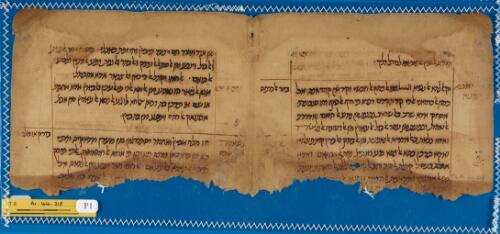
T-S Ar.44.218 2r
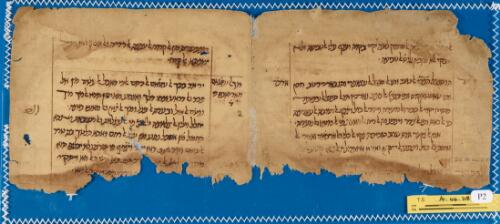
T-S Ar.44.218 2v
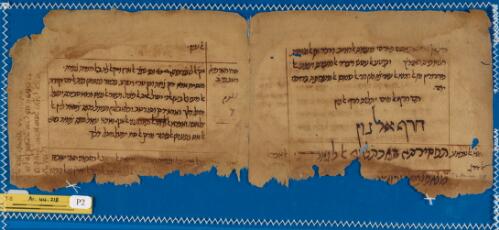
T-S Ar.44.218 3r
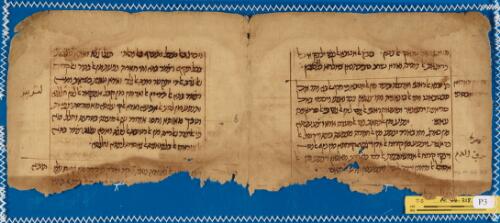
T-S Ar.44.218 3v
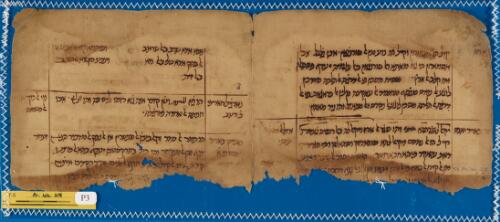
T-S Ar.44.218 4r
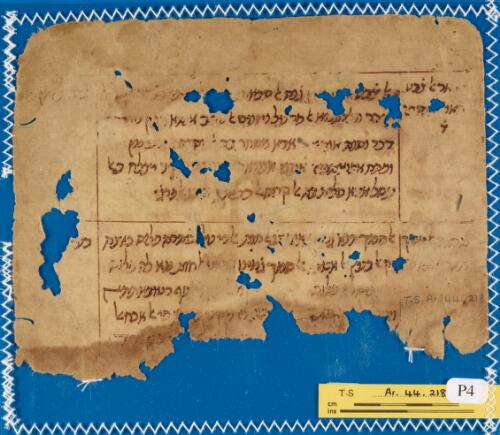
T-S Ar.44.218 4v