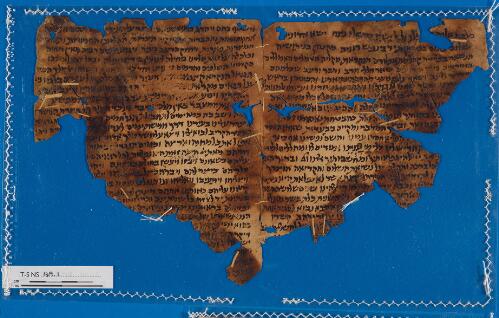
Letter: T-S NS 149.1
Letter T-S NS 149.1What's in the PGP
- Image
- 1 Translation
Description
A letter from a man from Palermo in which he described the hardship of the Jews in Sicily during civil war and invasion of foreign armies. The letter is addressed to a Jewish notable. Scheiber and Z. Malachi, who were first to publish it, suggested it was sent to Spain to Hasdai Ibn Shaprut, and dated it accordingly to the 10th century. This assumption is based on the reconstruction of the opening lines, which are very damaged, and the name of Hasdai is not mentioned at all in the letter. The historical event fits better with the 1030's-40's. (Data from FGP)
Tags
Translator: Simonsohn, Shlomo (in English)
T-S NS 149.1 1r
To be read in front of our lord, highness, excellency, . . . sereneness, president, king and son of king, father . . . son of . . . of heaven [ . . . ]
Greetings to our master for ever, kissing your hand with sorrowing heart, from the lowliest left over among the survivors of the community in Palermo, called Sicily, the poor victims of events, among the casualties of the sword, pestilence and famine, all insulted by the enemy; for we are left but a few of many, as a beacon upon the top of [a mountain]; we have been depressed, cut up and destroyed, our widows are increased, they [almost ki]lled us, but for the grace of God which never ended and His many mercies which never stopped; and if [the Lord] had told us in our ear even if not determined as a consumption, and if we are weary with our groaning, [our heart was hot wi]thin us, therein shall be left us this remnant as the true promise: who is this [that cometh up from the wilderness, and] yet for all that blessed be the One who speaks and keeps as in the testimony, with whom there is mercy [and plenteous redemption, blessed be the Lord, for] He hath shewed me His marvellous kindness, which holdeth our soul in life, although [we have no deeds], listened to us throughout our troubles, we thank thee and praise thy glorious name . . . ; many, O Lord my God, are thy wonderful works which thou hast done, and thy thoughts which are to us-ward, and blessed be thy glorious name, which is exalted above all blessing and praise, for bringing peace and invitation, we [now] had to inform your highness some of which is not marvellous in your eyes, [which happened to] his people and came to us of the trials of our God, two or three which [occurred; the fir]st the thinning of [hands and feet], and the second the corruption of flesh from stink[ing] bones. [ . . . ]
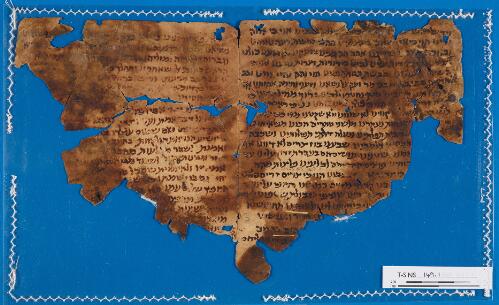
And he raged through them, destroyed their food, and besieged the city for a long time. Disturbances and chaos increased, and the tribulations, light and heavy, multiplied; agitation branched out and hunger grew in the city, affecting thousands left destitute. For that we would harden ourselves in sorrow to God that we have no sin. Nevertheless the insurgents, lowly and high, did not desist. They banded together and sent to the king of the great metropolis called Constantinople, and asked him to assist them with his legions, on his terms. He assented in his reply and commanded his army. He travelled until he came to the shore of the straits, and crossed them quiet and secure. He conquered the fortified town, populated and high, and stopped there for a while to plan strategy. The [king of the] Girgashi [=North African Saracens] attacked him and laid siege on us in our town for five days, to wage [war on it for some] days. When he was come near to enter, the Edomite [=Christian] commander attacked him and defeated . . . [him] and beat his entire army as water spilt on the ground of a slope [and he poured] their blood. It was the Lord’s doing, it is marvellous in our eyes. They [overcame] them with their masses, they plundered them and did as they wanted with their army. And it came to pass . . . [and they called for help] to their leaders and fled as an unwanted shadow, and went . . . He triumphed over him, put him to shame and to flight in . . . When we beheld them we called after them: Who gave Jacob as a spoil [and Israel to the robbers]?
T-S NS 149.1 1v