Letter: T-S Ar.39.425
Letter T-S Ar.39.425What's in the PGP
- Image
- 1 Transcription
- 1 Translation
Description
Letter in Ottoman Turkish addressed to Salmūn [al-Iskandarānī] from Pervīz Ağa. Dated in the verso seal: 1030 AH (1620/21 CE). In the introduction to her edition, Jane Hathaway notes that this is: "a straightforward letter of introduction from one Pervīz Agha, whose seal, on the document’s verso, appears to bear the date 1030, implying that the letter was composed in or shortly after 1621 CE. Pervīz asks Salmūn to look out for the interests of the bearer, the divisional commander (ser bölük, or bölükbaşı) Manṣūr, who is on his way to ‘the noble Kaʿba’, probably meaning that he is undertaking the ʿumra, the pilgrimage that can be performed at any time of year.... Pervīz himself is clearly a high regimental officer, and if he is sending someone to Alexandria en route to Mecca, he himself must be located north or west of Al- exandria, possibly even in the imperial capital. The tone of his appeal to Salmūn makes it clear that for anyone passing through Alexandria, the customs director was an invaluable contact. Perhaps the most noteworthy feature of this letter is its emphasis on hometown ties: Pervīz insists that Salmūn must help Manṣūr because they both come from Alexandria. Manṣūr is not a common name among military personnel from the Ottoman central lands, and if this Manṣūr is a native Arabic-speaker from Alexandria, then he represents an exceedingly rare instance of an Arab joining the Ottoman military and rising to mid-level officer rank." (Hathaway, Ottoman-Era Documents from the Cairo Genizah, 128-129)
Tags
Editor: Hathaway, Jane
Translator: Hathaway, Jane (in English)
T-S Ar.39.425 1r
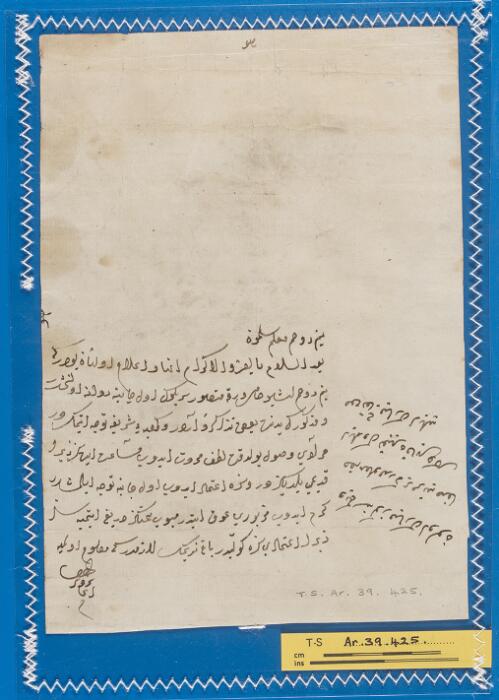
Recto, main text
-
Benim rūḥum Muʿallim Salmūn,
-
Baʿde’s-selām bi’l-ʿizz ve’l-ikrām, inhāʾ ve iʿlām olunan budur ki:
-
Benim rūḥum, işbu ḥāmil-i varaḳa Manṣūr ser bölük ol cānibe revāne olunmuştur.
-
Ve mezkūrun yedinde baʿżı tezākir vardır. Ve Kaʿbe-i şerīfe teveccüh itmekdir
-
murādı. Vuṣūl bulduḳda, luṭf [ü] mürüvvet idüb, müsāʿade idesiz zīrā
-
ḳadīmī beledīnizdir, ve size iʿtimād idüb, ol cānibe tevec- cüh eylemişdir.
-
Kerem idüb, mezbūrı ʿavḳ itdirmeyüb, himmetiniz dirīġ itmeyesiz
-
zīrā iʿtimādı size ke-velīdir [?], bāġ-ı ḳadīmin lāzımdır ki maʿlūm olmaya.
Recto, signature
-
El-faḳīr
-
Pervīz
-
Aġa
Recto, right margin
-
Ve yeni senenüz mübārek olsun.
-
Ḥaḳḳa maʿlūmdur ki bir mertebe ṣafā
-
eyledük [ki] taʿbīre ḳābil degil,
-
Ḥaḳḳ-ı Teʿālā mübārek eyleye.
Recto, main text
-
My dear Muʿallim Salmūn,
-
Following greetings with nobility and honour, the commu- nication and announcement are as follows:
-
My dear, the bearer of this letter, Manṣūr the divisional
commander, has travelled to that region.
-
The aforementioned [bearer] has several documents in
hand and intends to proceed to the noble Kaʿba.
-
When he arrives, demonstrate your generosity and favour
him because
-
he has long been your fellow townsman. He has proceeded to that region relying on you.
-
Be noble, and do not hinder or refuse the aforementioned [bearer] your support
-
because he trusts you like a patron [?]. Your old bond must not be forgotten.
Recto, signature
-
The poor one
-
Pervīz
-
Agha
Recto, right margin
-
May you have a blessed new year.
-
God knows that we have been enjoying ourselves
-
so much that it can’t be put into words.
-
May God the exalted bless [the new year].
T-S Ar.39.425 1v
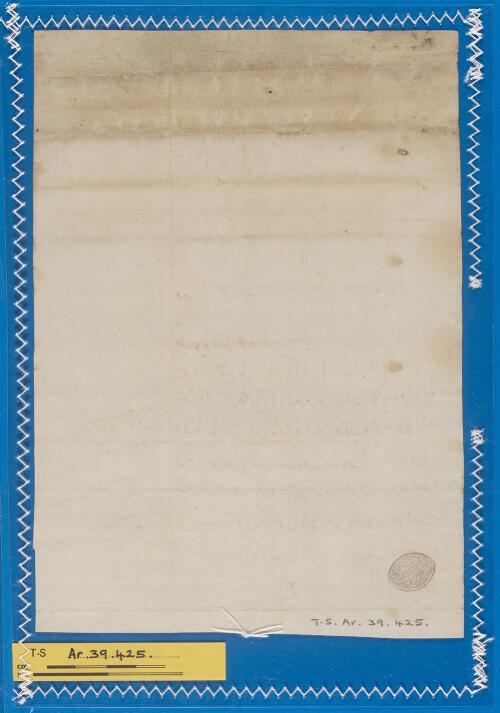
Verso, seal
-
Maẓhar-ı
-
luṭf-i ilāhī
-
Pervīz
Verso, seal
-
The one honoured by
-
divine favour,
-
Pervīz