Letter: T-S Ar.38.111
Letter T-S Ar.38.111What's in the PGP
- Image
- 1 Transcription
- 1 Translation
Description
Letter in Ottoman Turkish addressed to Maʿallim Salmūn in Alexandria. Dating: late sixteenth- or early seventeenth-century. Another letter addressed to the recipient contains a seal bearing the year 1030 AH (1620/21 CE). In the introduction to her edition, Jane Hathaway notes that this letter to: "Salmūn al-Iskandarānī, the Jewish director of Alexandria’s customs.... open with the affectionate benim rūḥum (literally, ‘my soul’ or ‘my spirit’), although the formalities that follow imply that both officers are reporting to Salmūn. The power hierarchy is more ob- vious in 38.111, a surprisingly emotive letter from Salmūn’s agent (Ottoman Turkish, vekīl) Süleymān Bostāncı. Ordinarily, this sobriquet would indicate a member of the corps of ‘Gardeners’ (Bostāncılar) at the imperial palace in Istanbul—or, particularly during the second half of the seventeenth century, in Edirne—who had the duty of rowing the sultan’s barge, as well as guarding the palace and the city at large, along with other corps of palace soldiery (Uzunҫarşılı 1945b, 465–87). To judge from his seal, which identifies him as ‘ibn ʿAbdullāh’, a patronymic that typically designates a convert to Islam, Süleymān was also a devshirme recruit.... The main text of TS 38.111 demonstrates that other high-ranking military officers (aghas) looked to Salmūn to pay their salaries, or at least to augment them, when Egypt’s governor would or could not. Being able to fulfil such a role would make Salmūn a supremely powerful figure, comparable to financiers, including other customs directors, in other parts of the seventeenth-century Ottoman Empire.... Like these other financiers, he also seems to have played a role in the supply of critical provisions to Egypt, most notably, at least so far as our first document is concerned, wood. In the main text of his letter, Süleymān notes that he, presumably on Salmūn’s behalf, provided unspecified ‘men of state’ with wood. His marginal emendations, in addition to mentioning Salmūn’s sale of wood on behalf of Meḥmed Agha, question Salmūn about sales to the son of ʿĀmir Abū ʿAlī and to the son of ʿImmiyā ʿAlī, who may be the same person. Since Egypt was deficient in wood, supplies routinely reached the province by ship from Anatolia, and this sort of shipment may have been key to Süleymān Bostāncı’s work for Salmūn." (Hathaway, Ottoman-Era Documents from the Cairo Geniza, 126-128) Previous PGP description: Letter in Ottoman Turkish addressed to Maʿallim Salmūn in Alexandria from Sulaymān Bostancı[?] dating from the sixteenth-eighteenth centuries. There is some damage to the sender's signature but if this reading of his title is correct, this may be a letter sent from Istanbul by a member of the Imperial Guard / Bostancı corps. This seems plausible given that the letter mentions at least four other members of the Ottoman military– Sinān Ağa, Qāsim Ağa, ʿİssa Ağa, and Meḥmed Aǧa. These state functionaries, are occasionally referenced as such i.e. "Sinān Ağa ṣaḥib-i devlet / protector of the state" (l. 8). One other business partner is mentioned in line four, a certain Maʿallam İsḥāk. Much of the letter's contents are related to payments and other correspondence between those referenced. The verso bears two ink stamps and an address on the upper fold, which suggests that this letter was likely sent and received by the recipient Muʿallim Salmūn Iskenderānī who appears in other Ottoman Turkish fragments. MCD.
Tags
Editor: Hathaway, Jane
Translator: Hathaway, Jane (in English)
T-S Ar.38.111 1r
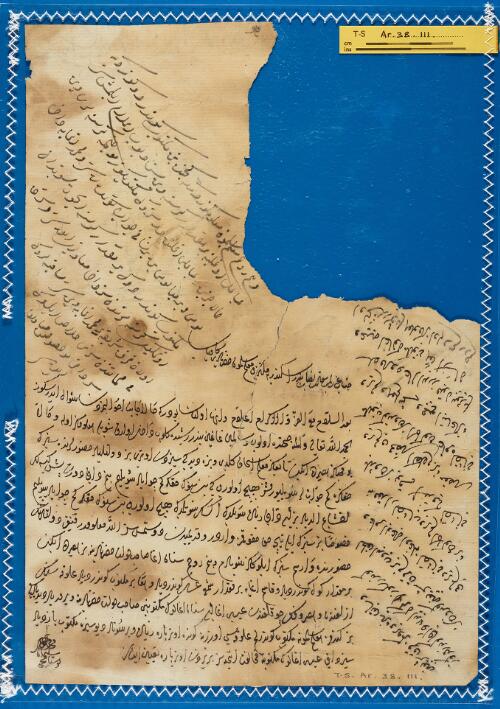
Recto, main text
-
Cenāb-i ʿizzet meʾāb-ı saʿādet-niṣāb, bender-i İskenderiyye mültezimi Muʿallim Salmūn ḥażretleri-yi kāmyāb:
-
Baʿde’s-selām maʿa’l-ʿizz ve’l-ikrām, iʿlām ve inhāʾ olunan budur ki: Ḥālā cānib-i aḥvālimizden suʾāl idersenüz,
-
el-ḥamdü li-llāh teʿālā ve’l-minne ṣıḥḥatda olub ve sālimīn ve ġānimīn bender-i Reşīd’e gelüb, dāḫil olduḳ şöyle maʿlūmunuz ola. Ve ḥālā
-
bu muḥibbiniz Mıṣır’da iken tābiʿniz Muʿallim İsḥāḳ geldi ve bize didi ki sizden ötüri biz devletliler ḥużūrlarında sizin
-
ḥaḳḳınıza kem cevāblar söylüyormuşuz. Hīҫ olur mı ben senün ḥaḳḳına kem cevāblar söyleyim? Benim daḫa dört- beş kīselik
-
aḫşābım aldılar, biz ise daḫa ziyāde söyledük, eksik söylemedik. Hīç olur mı ben senün ḥaḳḳına kem cevāblar söyleyim?
-
Ḫuṣūṣan biz sizin ile niҫe ḥaḳḳ-ı ḥuḳūḳumuz vardır. Ve ḳadīmīden dostumuzsuz Allāh’a maʿlūmdur. Ḳanġı devletlinin
-
ḥużūrunda [sic] varsam, sizin eylüğünüz söylerim. Ve benim rūḥum Sinān Aġa sāḥib-i devlet ḥażretlerine biz Mıṣır’da iken
-
bir miḳdār gül gönderdiler ve Ḳāsım Aġa’ya bir miḳdār şemʿ-i ʿasel gönderdiler ve maʿan bir mektūb gönderdiler. ʿUlūfesinin
-
azlıġından ve maṣrūfun çoḳluġundan, ʿĪsā Aġa ise Sinān Aġa’nun mektūbunı ṣāḥib-i devlet ḥażretlerine virmediler, didiler ki
-
‘Biz kendümüz Muʿallim Salmūn’a mektūb gönderelim, ʿulūfesi üzerine günde onar pāra ziyāde virsünler’ deyü size mektūb yazdılar.
-
Siz daḫi ʿĪsā Aġa’nun mektūbuna muḫālefet itmeyesiz, bir yerden onar pāra taʿyīn idesiz.
Recto, signature
- El-faḳīr
- muḥibb-i muḫliṣ [?]
- Süleymān
- Bostāncı
Recto, right margin, upside-down
-
Ve sābıḳā size virdiğimiz ḳırḳ şerīfīyi
-
göndersenüz [[??]] gerek idi. Daḫa göndermedinüz.
-
Luṭf idüb, bizim ḳırḳ şerīfīyi göndüresiz.
-
Ve ʿĀmir Ebū ʿAlī oġluna aḫşābı virelim mi?
-
Ne miḳdār aḫşāb virelim, ana göre bize
-
bildüresiz, yoḳsa istedüği aḫşābı
-
virelim mi? Muḥaṣṣalü’l-kelām bize mufaṣṣal
-
mektūb gönderesiz, ana göre ʿĀmir’e aḫşābı
-
virelim. Ve Muʿallim Şems’e [?] ve cemīʿ etbāʿnıza
-
selāmlar ve duʿālar ideriz, ḳabūl buyurıla.
-
Ve ʿĪsā Aġa’nun mektūbı maʿan irsāl
-
olunmuşdur şöyle maʿlūmunuz ola. Ve benim rūḥum
Recto, top left, diagonal
- 1. Ve benim rūḥum Muʿallim Salmūn, maʿlūmunuzdur ki geçende bize mektūb gönderdünüz ve ki
- ‘ʿImmiyā ʿAlī oġlına bir miḳdār kereste viresiz’ diyüb, iʿlām eylemişsiz.
- Ḥālā cezīre-i ʿImmiyā ʿAlī oġlundadır. Sizün mektūbunuz mūcebince keresteleri vire-
- lü mi, virmeyelü mü bize bir şāfī cevāb gönderesiz. Ve Meḥmed Aġa’ya daḫi
- mektūb gönderdük. Bir miḳdār kereste içün sevvīdan [?]
- o temlīk kerestelerinden siz daḫi muʿāvenet idesiz ve sizde
- olan ḳırḳ şerīfīyi Meḥmed Aġa’ya viresiz. Sāḳiyelerin [?]
- mi memātından sizi ḫalāṣ eyledik.
- Siz daḫi bu ḫuṣūṣda muʿāvenet
- idesiz.
Recto, main text
- To the noble and felicitous tax-farmer of the port of Alexandria, his excellency Muʿallim Salmūn:
- After greetings with glory and honour, the announcement and communication are as follows: if you ask about how we are doing,
- know that thanks to God the exalted and his goodness, we are well and have come safe and sound to the port of Rosetta and entered it. And now,
- while this affectionate friend of yours [i.e., the writer] was in Cairo, your client Muʿallim Isḥāq arrived and accused us
- of speaking ill of you in the presence of men of state. Could it ever happen that I would speak ill of you? They also took four or five purses’ worth
- of my wood; as for us, we said more, not less. Could it ever happen that I would speak ill of you?
- In particular, consider how deep a friendship we have with you. God knows that you have been our friend for a very long time. Whatever man of state’s
- presence I enter, I will speak of your goodness. Furthermore, my dear, while we were in Cairo, Sinān Agha sent his excellency the possessor of fortune [i.e., the Ottoman governor of Egypt]
- a bunch of roses, and he sent Ḳāsım Agha a bunch of bees- wax candles, and with them he sent a letter. Because his salary
- is too little and his expenses too great, ʿĪsā Agha did not give Sinān Agha’s letter to his excellency the governor but
- [instead] they wrote you a letter, saying ‘Let’s write a letter to Muʿallim Salmūn ourselves, asking him to increase his [i.e., ʿĪsā Agha’s] salary by ten pāras a day’.
- As for you, don’t oppose ʿĪsā Agha’s letter. Allocate the ten pāras from somewhere.
Recto, signature
-
The poor one,
-
The sincere friend [?],
-
Süleymān
-
Bostāncı
Recto, right margin, upside-down
-
And you were supposed to send [illegible word crossed out]
the forty [gold] sherīfīs that we had given you previously.
-
You still haven’t sent them,
-
[so] please send our forty sherīfīs.
-
And shall we give the wood to the son of ʿĀmir Abū ʿAlī?
-
What amount shall we give [him]?
-
Tell us accordingly; otherwise shall we give him any [amount of] wood he wants?
-
In short, send us a detailed letter,
-
and we shall give ʿĀmir the wood accordingly.
-
We send greetings and prayers to Muʿallim Şems [?] and all your clients,
-
may they [the prayers] be accepted.
-
Be aware that [this] was sent with ʿĪsā Agha’s letter.
-
And my dear
Recto, top left, diagonal
-
And my dear Muʿallim Salmūn, you know that in the past, you sent us a letter and that
-
you told us, ‘Give the son of ʿImmiyā ʿAlī a quantity of wood’.
-
It is still in the village/holding of ʿImmiyā ʿAlī’s son. In ac-
cordance with your letter,
-
do we givethe wood to him,or do we not give it to him? Send us a clear answer. We also sent a letter to Meḥmed Agha.
-
For a quantity of wood, equally [?],
-
you should also provide assistance with wood from that property,
-
and you should give Meḥmed Agha the forty sherīfīs that you have.
-
We have saved you from death.
-
In this matter
-
you should also provide assistance.
T-S Ar.38.111 1v
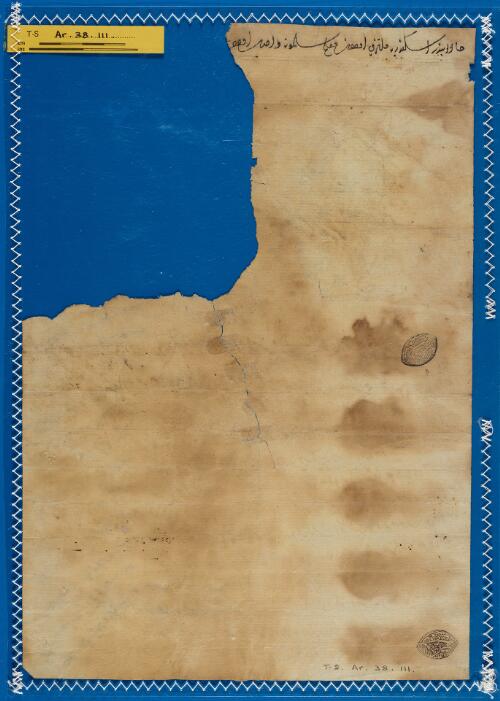
Verso, address
-
Ḥālā bender-i İskenderiyye mültezimi olan Muʿallim Salmūn’a vāṣıl ola [ ].
Verso, seal
-
...ilā Allāh
-
el-faḳīr
-
Süleymān ibn ʿAbdullāh
Verso, address
-
May [this letter] reach Muʿallim Salmūn, currently the tax farmer of the port of Alexandria [ ]
Verso, seal
-
...to God
-
the poor one,
-
Süleymān ibn ʿAbdullāh