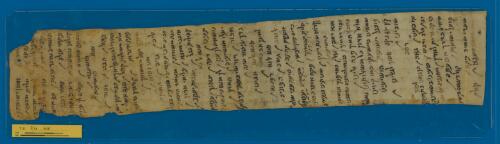
Scholarship on Legal document: T-S 24.68
Legal document T-S 24.68- Bibliographic citation
- S. D. Goitein, unpublished index cards (1950–85), #8529. Princeton Geniza Lab, Princeton University.
- Relation to document
- Discussion
- Bibliographic citation
- Mordechai Akiva Friedman, Jewish Marriage in Palestine: A Cairo Geniza Study (Tel Aviv University, Chaim Rosenberg School of Jewish Studies, 1980), vol. 2 (The Ketubba Texts).
- Location in source
- Doc. #3, 55
- Relation to document
- Digital Edition
- Digital Translation
- Edition
- Bibliographic citation
- Mordechai Akiva Friedman, "Termination of the Marriage upon the Wife's Request: A Palestinian Ketubba Stipulation,"Proceedings of the American Academy for Jewish Research 37 (American Academy for Jewish Research, 1969), 29-55.
- Relation to document
- Digital Translation
Image
Transcription
Translation
Editor: Friedman, Mordechai Akiva
Translator: Friedman, Mordechai Akiva (in English)
T-S 24.68 1r
°
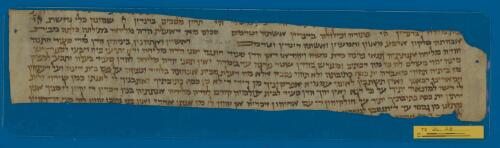
Mordechai Akiva Friedman, Jewish Marriage in Palestine: A Cairo Geniza Study (Tel Aviv University, Chaim Rosenberg School of Jewish Studies, 1980), vol. 2 (The Ketubba Texts).
- [ ]... הי בית מוטלי הי תרין מסכים בדנרין ח שמונה כלי נחשת הי
- בית מולח בדנרין הי פתורה וכילולה בדנרין אשתה וטרמס סכום מה דאעלת הדה מליחה בתולתה כלתה מבית
- אבהתה סלקון ארבע מאוון וחמשין ואשתה דינרין וטרמס ואשוון ואתקנון ביניהון הדן מרי סעיד חתנה
- והדה מליחה אנתתיה תנאי פרנה כדת משה ויהודאי דאן הדן סעיד חתנה יסני הדה מליחה ולא יתרעי ביה ויבעי למפרוש
- מינה יהוי משלם לה כל מה דכתיב ומפרש בהדן שטר פרנה עד גומרה ואין תסני הדה מליחה להדן סעיד בעלה ותבעי למפוק
- מן ביתיה תהווי מאבדה ית כסף כתובתה ולא תהוי נסבה אלא מה דעלת מבית אבהתה בלחוד ונפקה על פם בית דינה ועל דעתיהון
- דמארינן רבאנן ואין תשתבי>י<ן לאומי עממיא אפרקוניך מן דידי די לא מן כסף כתובתיך ואתבניך לי לאנתו כמן שירוי ולית
- לי רשו למונאה יתיך על כל דנא ואין יהך הדן סעיד לבית עולמיה קודם להדה מליחה אנתתיה בנין דכרין די יהוון לי מניך אנון
- ירתין ית כסף כתובתיך יתיר על חולקיהון די עם אחיהון דכרי>י<ה אן יהוון לי מן אנתו אחרי ואין בנן נקבן יהוון ליך מני יהוויין
- מתזנן מן נכסי עד דיתנסבן לגוברין י[הודאין ...]
- למ[תנ]סב לגבר אחרן [...]
Mordechai Akiva Friedman, Jewish Marriage in Palestine: A Cairo Geniza Study (Tel Aviv University, Chaim Rosenberg School of Jewish Studies, 1980), vol. 2 (The Ketubba Texts).
- [...] ...—15 [dinars], a mwṭly container—15, two curtains—8 dinars, eight copper vessels—15,
- a mwlḥ container—15 dinars, a table and all that goes with it—six and one third dinars. The sum of what this bride Malīḥa, the virgin, brought in from the house
- of her father totals 456 1/3 dinars. They agreed and fixed between themselves—this master Saʿīd, the groom,
- and this Malīḥa, his wife—the stipulations of the marriage contract, as the law of Moses and the Jews: If this Saʿīd, the groom, hates this Malīḥa does not desire her, and wants to separate
- from her, he shall pay her all that is written and specified in this marriage contract completely. And if this Malīḥa hates this Saʿīd, her husband, and desires to leave
- his home, she shall lose her ketubba money, and she shall not take anything except that which she brought in from the house of her fathers alone; and she shall go out with the authorization of the court and with the consent of
- our masters, the sages. "And if you are taken captive among the gentiles, I will ransom you with my possessions, exclusive of your ketubba money, and I will take you back as my wife, as at first. And I (will) have
- no right to wrong you concerning all of this." And if this Saʿīd goes to his eternal home before this Malīḥa, his wife: "Male children whichI may have by you (they)
- shall inherit your ketubba money, beyond their portions with their male siblings, if I have (sons) from another wife. And if you have female children by me, they shall
- be sustained from my property until they are married to J[ewish] men. [And you shall dwell in my house and be supported from my estate for the duration of your widowhood, until you desire]
- to be [ma]rried to another man [..."]
Recto
-
and this Mr. Saʿīd, the groom, and this Malīḥa, his wife,
-
agreed and fixed between themselves ketubba stipulations according to the law of Moses and the Jews: that if this Saʿīd, the groom, hates this Malīḥa and does not desire her, but wants to separate
-
from her, he will pay her all that is written and specified in this ketubba completely. And if this Malīḥa hates this Saʿīd, her husband, and desires to go out
-
from his house, she will lose her ketubba money and will take nothing except that which she brought from her fathers’ house, that alone, and she will go out with the permission of the court and on the authority
-
of our lords the rabbis.
T-S 24.68 1v
°