Legal query or responsum: T-S 10K8.9
Legal query or responsum T-S 10K8.9What's in the PGP
- صورة
- 1 Transcription
- 1 Translation
الوصف
The recto and verso of this document are both copies of the same responsum written to Avraham Maimonides. The debtor requests Avraham's intervention to secure sixty dirhems for him and to convince the creditor to change the terms of the loan from twenty to ten dirhems per month. Friedman believes the handwriting "resembles that of Elijah ben Zechariah who served as judge in Alexandria at least from 1204 and in Fustat during the years 1222–36. He was in charge of the poor and the orphans, and many petitions to him have been preserved in the Genizah, including requests that he seek Abraham Maimonides' intervention." (Information and quotation from Friedman, "Responsa of Abraham Maimonides on a Debtor's Travails")
Editor: Friedman, Mordechai Akiva
Translator: Friedman, Mordechai Akiva (in English)
T-S 10K8.9 1r
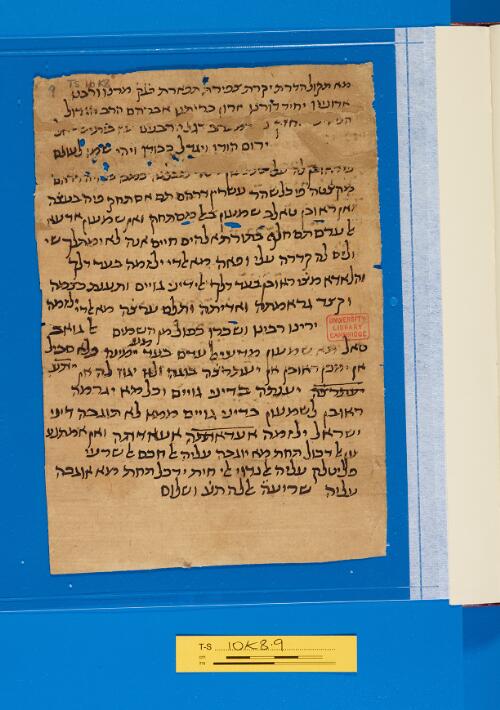
recto
What does his excellency, the esteemed and splendid diadem, (his) h(onour), g(reatness) and h(oliness), our master and rabbi, our lord, the unique (scholar) of our generation, sovereign of our covenant, Abraham, the great rabbi, the powerful hammer, the western luminary, banner of the rabbis, fortress of the house of Israel, say concerning Reuben who holds Simeon's IOU for the sum of 500 dirhems payable in instalments of twenty dirhems per month, some of which has become due? Reuben demanded payment of what is due from Simeon. And Simeon claimed to be destitute and then swore by the Torah of the living God that he has no possessions and cannot pay it. What is his obligation afterwards? And if Reuben goes afterwards to a gentile court and harasses his fellow litigant, with the intention of causing him damage and harm and defaming him, what is incumbent upon him? May our lord instruct us and may he be granted a double reward by heaven.
Answer: As long as Simeon claims to be destitute following with an oath, there is no way at all that Reuben can hinder him. And it is forbidden for him to harass him in a gentile court. Reuben must return to him whatever damages he causes him in the gentile court not required by Jewish law. Should he refuse to abide by what the law requires of him, he is to be placed under the ban until he abides by what the law of the exalted God requires of him. And peace.
T-S 10K8.9 1v
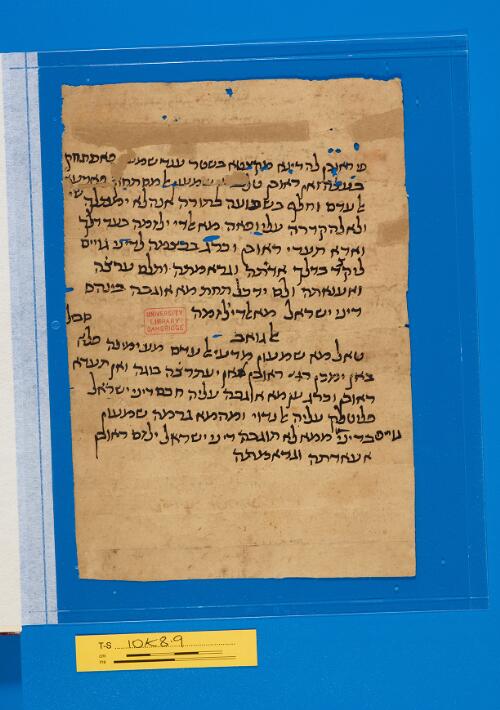
- פי ראובן לה דינא מקצטא בשטר ענד שמע[ון] פאסתחק
- בעצה ואן ראובן טלב מן שמעון אלמסתחק פאדעא
- אלעדם וחלף בשבועה בתורה אנה לא ימתלך שי
- ולא לה קדרה עלי ופאה מא אלדי ילזמה בעד דלך
- ואדא תעדי ראובן וכרג בכצמה לדיני גויים
- ליק[צ]ד בדלך אד[י]תה וגראמתה ותלם ערצה
- ואענאתה ולם ידכל תחת מא אוגבה בינהם
- דיני ישראל מא אלדי [י]לזמה
- אלגואב
- טאל מא שמעון מדעי אלעדם מע ימינה פלא סביל
- באן ימכן <<רוא?>> ראובן <<ב>>אן יעתרצה בוגה ואן תעדא
- ראובן וכרג ען מא אוגבה עליה חכם דיני ישראל
- פליטלק עליה אלנדוי ומהמא גרמה שמעון
- בדיני [גויים] ממא לא תוגבה דיני ישראל ילזם ראובן
- אעאדתה וגראמתה
Concerning Reuben who holds Simeon’s IOU for a debt to be paid in instalments, some of which has become due. Reuben demanded payment of what is due from Simeon, but he claimed to be destitute and swore with an oath by the Torah that he has no possessions and cannot pay it. What is his obligation afterwards? And if Reuben transgresses by going out and suing his fellow litigant in a gentile court, with the intention of causing him harm and damage and defaming and harassing him, and does not abide by what Jewish law requires of him concerning the matter that is between them, what is incumbent upon him?
Answer: As long as Simeon claims under oath to be destitute, there is no way at all that Reuben can hinder him. And if Reuben transgresses and deviates from what the ruling of Jewish law requires of him, he is to be placed under the ban. Reuben must make restitution to Simeon and compensate him for any damages he causes him in the gentile court not required by Jewish law.