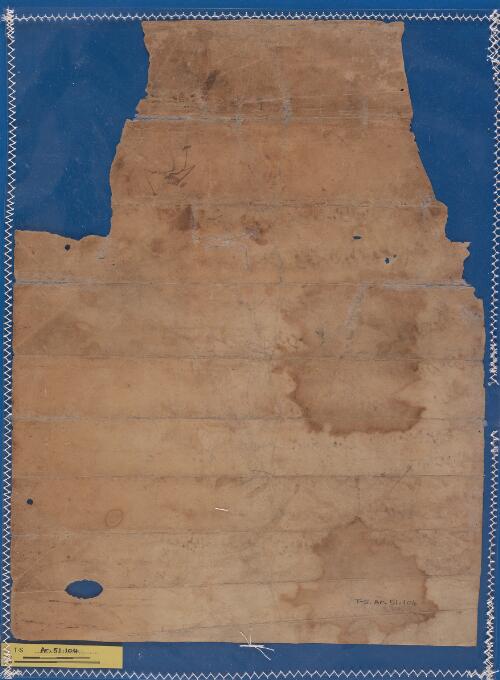
وثيقة شرعيّة: T-S Ar.51.104
وثيقة شرعيّة T-S Ar.51.104What's in the PGP
- صورة
- 1 Transcription
- 1 Translation
الوصف
Legal agreement regarding the Rabbanite Jewish communal pious endowment of Cairo (al-Qāhira al-Maḥrūsa) and Old Cairo/Fustat (Miṣr al-ʿAtīqa). In Arabic script. Date: 26 Ramaḍān 9[04] AH (1499 CE). In the introduction to her edition, Jane Hathaway notes: "This document is a legal agreement (taṣāduq). Numerous words in the text are obscured by tears, and in addition, the date with which the text concludes is difficult to read, apart from the day and the month, 26 Ramaḍān. Nonetheless, the involvement of Nathan Sholāl, the penultimate Raʾīs al-Yahūd, in the case allows us to interpret the year as ar[baʿ?] tisʿa [miʾa], ‘nine [hun- dred] [and four?]’, i.e., 1499 or thereabouts.... By the terms of this agreement, Nathan Sholāl grants administrative rights over Rabbanite waqf properties in Cairo and ‘Old Cairo’, or Fusṭāṭ, to Muʿallim ʿAbd al-Karīm ibn Mūsā ibn Ṣadaqa ‘known as Ibn Ṣanīʿa’ and a man who may be his uncle, Muʿallim Saʿīd ibn Ṣadaqa ibn Muhadhdhab. In the document, Nathan is called first Ibrāhīm, a name not attested for him in other known sources, then Natān ibn Saʿīd ibn Natān.... The properties that the two muʿallims will administer are called waqf in our document. This term was not simply a convenient Arabic synonym for the halakhic endowment known in Hebrew as heqdesh. By the late fourteenth century, all Jewish pious endowments were established in Muslim courts as waqf. This practice was the Jewish community’s response to a 755 AH/1354 CE law placing all inheritance cases, regardless of confessional community, under state jurisdiction, thus assigning them to sharīʿa courts. Endowing properties as waqf allowed the Rabbanite community to control the revenues they produced and avoid having the properties or their revenues confiscated by the Mamluk state. As for the endowed properties themselves, the document does not specify where in Cairo and in Fusṭāṭ they are located." (Hathaway, Ottoman-Era Documents from the Cairo Genizah, 291-292, 294) Previous PGP description: Bill of testimony. In Arabic script. The Raʾīs Ibrāhīm known as Natan b. Saʿīd b. Natan the Rabbanite Jew appoints ʿAbd al-Karīm b. Mūsā b. Ṣadaqa al-Sabbāk the Rabbanite Jew and Saʿīd b. Ṣadaqa b. Muhadhdhab al-Mutaṭabbib the Rabbanite Jew as his representatives/delegates for an official communal position related to the waqf of the Jews of Cairo (al-Qāhira al-Maḥrūsa) and Fustat (Miṣr al-ʿAtīqa). A witness mentioned in the document is Sulaymān b. Yūsuf b. Shemuel known as Ibn al-Tājir the Rabbanite Jew. There are two witness signatures (of Muslims). The date is 26 Ramaḍān but the year is difficult to read. Likely Mamluk or early Ottoman era based on handwriting. ASE
العلامات
Editor: Hathaway, Jane
Translator: Hathaway, Jane (in English)
T-S Ar.51.104 1r
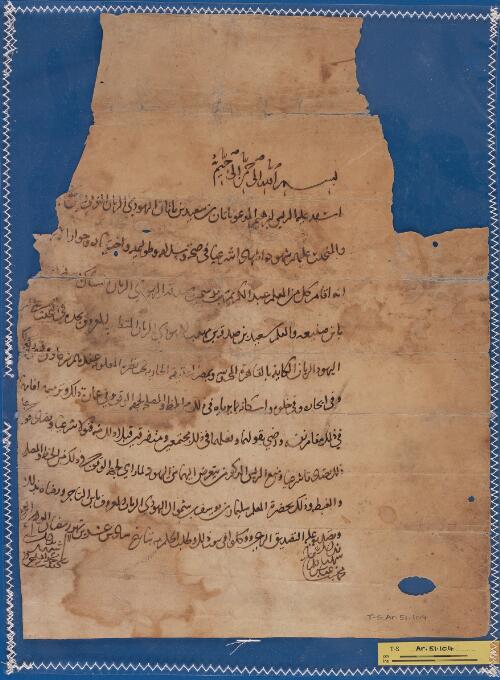
Recto
- باسم الله الرحمن الرحيم
- اشهد على الريس ابراهيم المدعو ناتان بن سعيد بن ناتان اليهودي الربان ال[م] غربي ريس... [اليهود]
- والمتحدث عليهم شهوده واشهادا شرعيا في صحة وسلامة وطوعية واختيار وجواز الامر [ ]
- انه اقام كل من المعلم عبد الكريم بن موسى بن صدقة اليهودي الربان الساكن ب[ ] [المعروف]
- بابن صنيعة والمعلم سعيد بن صدقة بن مهذب اليهودي الربان المتطبب المعروف بجده في التحدث علي ا[وقاف؟]
- اليهود الربان الكاينة بالقاهرة المحروسة وبمصر العتيقة الجارية تحت نظره المعلومة عندهم شرعا وفي قبض ريع ذلك
- وفي ايجاره وفي خلوه واسكانه بما يرياه في ذلك من الحظ والمصلحة لجهة الوقف وفي عمارة ذلك وترميمه اقامهما
- في ذلك مقام نفسه ورضي بقولهما وفعلهما في ذلك مجتمعين ومتفرقين قبلا ذلك منه قبولا شرعيا وتصادقو[۱] على
- ذلك تصادقا شرعيا ومنع الريس المذكور من يتعرض اليهما من اليهود لما راي لجهة الوقف في ذلك من الحظ والمصلحة
- والغبطة وذلك بحضرة المعلم سليمان بن يوسف بن شموال اليهودي الربان المعروف بابن التاجر ورضاه بذلك
- وتصديقه على التصديق الشرعي ووكلوا في ثبوت ذلك وطلب الحكم به بتاريخ سادس عشرين شهر رمضان الحرام سنة ار[بع و] تسع [ماية]
Witnesses, first
- شهد بذلك محمد ابن عباس الما قال[؟]
Witnesses, second
- شهد بذلك علي ابن محمد المستاجر [؟]
Recto
-
In the name of God, the merciful, the compassionate.
-
The [lit., ‘its’] witnesses [to the case] testified on behalf of Raʾīs Ibrāhīm, called Nātān [i]bn Saʿīd [i]bn Nātān, the Maghribī Rabbanite Jew, Raʾīs ... [al-Yahūd]
-
and spokesperson for them [i.e., the Rabbanite Jews] in legal testimony while he was in a state of health, well-being, free will, and choice and ability to conduct affairs [ ]
-
that he appointed each of Muʿallim ʿAbd al-Karīm [i]bn Mūsā [i]bn Ṣadaqa the Rabbanite Jew living in [ ] [known]
-
as Ibn Ṣanīʿa, and Muʿallim Saʿīd [i]bn Ṣadaqa [i]bn Mu- hadhdhab the Rabbanite Jew, the physician, known as his grandfather, as responsible for [the waqfs of?]
-
the Rabbanite Jews existing in well-protected Cairo and in neighbouring Old Cairo under his [Nathan’s] supervision, known to them legally; and for receiving the revenue of [all of] that [the waqf property];
-
and for renting it out; and for allocating it as commercial or residential property, as they see fit, for the prosperity and benefit of the waqf; and for [the property’s] construction and repair. He appointed the two of them
-
over [all the waqf property] in his own place and approved their speech and action over [the waqf property], together and separately. They accepted that from him [i.e., Nathan] legally and agreed to it
-
in a legal agreement. The aforementioned raʾīs forbade anyone from opposing the two of them among the Jews, seeing fit [to do so] for the sake of the waqf with regard to prosperity, benefit, fit [to do so] for the sake of the waqf with regard to prosperity, benefit,
-
and happiness. This was in the presence of Muʿallim Sulaymān [i]bn Yūsuf [i]bn Shamawʾāl the Rabbanite Jew, known as Son of the Merchant, and his approval of [all of] this
-
and his authentication of the legal authentication. They were appointed as agents to certify this and to obtain a legal ruling on it on the date 26 Ramaḍān the sacred in the year 9[04] [15 May 1499].
Witnesses, first
-
Muḥammad ibn ʿAbbās al-Mā ... bore witness to that.
Witnesses, second
-
ʿAlī ibn Muḥammad the renter [?] bore witness to that.
T-S Ar.51.104 1v