رسالة: T-S 20.104
رسالة T-S 20.104What's in the PGP
- صورة
- 1 Transcription
- 1 Translation
الوصف
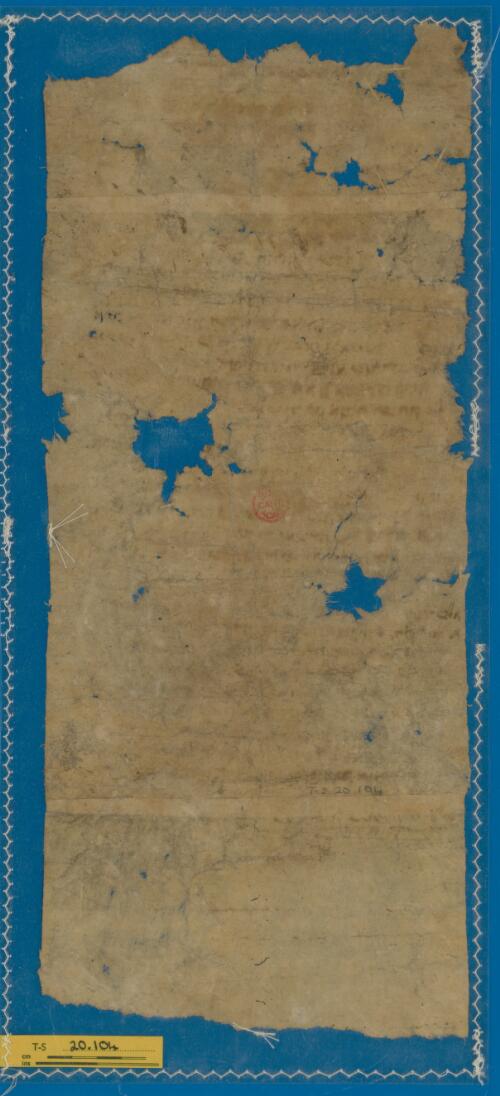
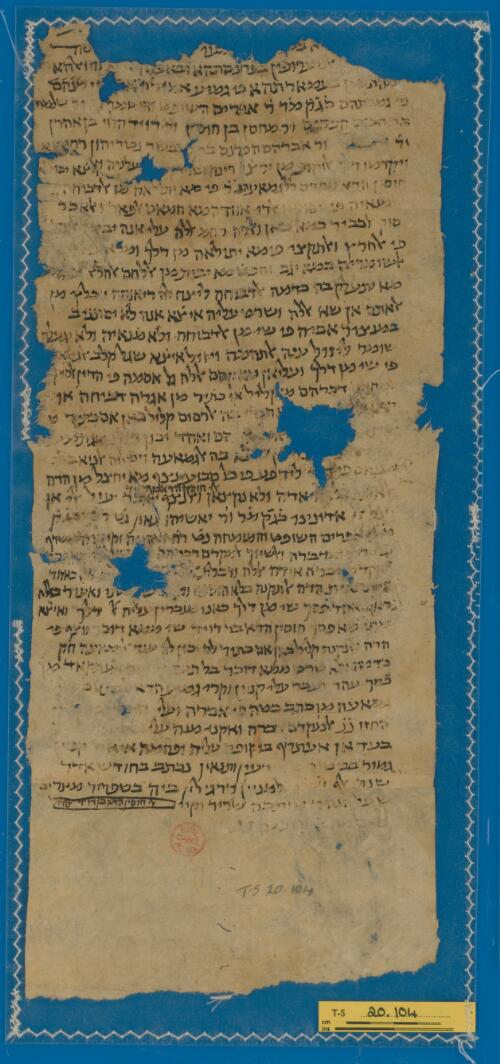
Statute (‘taqqana’) about the conduct of two slaughterhouses, one at the Great Bazaar and one at the Bath of the Mice, issued by a committee of seven individuals elected by the community. The document records the decision to appoint Yefet b. David to be cantor and the supervisor of butchering instead of his father, who had died. Yefet will be responsible for these two markets in Fustat where kosher meat is available, and must send half of the weekly income to Yoshiyyahu Gaon, head of the Yeshiva in Jerusalem, ca. 1015–1025 CE. Goitein dates the document to after 1024; it must date to before May, 1025, when Shelomo b. Yehosef became Gaʾon (for less than a year until Shelomo b. Yehuda took on the leadership role). (Information from Gil, Palestine, vol. 2, 583-585, #319; Goitein, “The Social Services of the Jewish Community as Reflected in the Cairo Geniza Records,” Jewish Social Studies (1964), 10; and Goitein’s index cards) VMR, EMS, MR
العلامات
Editor: Gil, Moshe
Translator: Zsom, Dora (in English)
T-S 20.104 1r
Recto
- [ ]ב[ אגת]מעו [מעהם פי כני]סה
- [אלשאמיין במצר] אלמערופין בפרנסתהא ובאפ[וטרופסי] אחואלהא
- אלמהתמין בעמארתהא פי גמיע אמורהא [אל]די {מנהם}
- פי גמלתהם כגק מר ר אפרים השופט והמומחה ומור שלמה
- בר חכים הפרנס ור מחסן בן חוסין ור דויד הלוי בן אהרן
- ור [ ] ור אברהם הפרנס בר מבשר נטריהון רחמנא
- ויקדמו דלך אלוקת מן ירצו דינה וטריק[תה ו]עלמה ואיצא תולא
- חוסין הדא מקדם ללגמאעה נר פי מא יתולאה מן אלדביחה
- ואלמנאיה פי אלסוקין אלדי אחדהמא חמאם אלפאר ואלאכר
- סוק אלכביר כמא כאן ואלדה רחמ אללה עלי אנה יבאדל אלי הדא
- פי אלחרץ ואלתקצי פי מא יתולאה מן דלך ומראעה אלי
- אלשומרים במא יגב וחפט מא יבית מן אללחם אלחלאל [ו]גמיע
- מא יתעלק בה כדמה אלדביחה ליצח לה דיאנתה ויכלץ מן
- אלאתם אן שא אללה ושרט עליה איצא אנה לא יסתניב
- במנצור אכיה פי שי מן אלדביחה ולא מנאיה ולא יגעלה
- שומר ליזול ענה אלתהמה ויזול איצא שגל קלב אלגמא[עה]
- פי שי מן דלך ועלי אן מא קסם אללה גל אסמה פי הדין אלסוק[ין]
- אלמקדם דכרהם מן קליל או כתיר מן אגרה דביחה או
- כאן [ ] תגמע בה אלרסום קליל כאן אם כתיר מ[ן]
- [ ] אסם ואחד יכון דלך באגתמא[ע]
- אלפרנסה [או מ]ן י[ר]צא בה אלגמאעה ויסאלוה אלניאבה
- מנהם פי ה[דא] לידפע פי כל סבוע נצף מא יחצל מן הדה
- אלאסואק בלא זיאדה ולא נקצאן //אלי חוסין הדא אבן דויד// ואלנצף אלאכר יעזל אלי אן
- יוצל אלי אדונינו כגק מר ור יאשיהו גאון נט רח וכגק
- מרור אפרים השופט והמומחה נט רח שהדה וקימוה משרף
- עלי דלך ומדברה ואלשיוך אלמקדם דכרהם [ר דויד ה]ל[וי] בן אהרן
- אלמקדם דכרה אידה אללה ודכלת אל [ ] באחד
- [ ]ת הדה אלתקנה בלא חומלה [ ]ני ואעוד באללה
- כאן אחד פסך שי מן דלך כאנו מנכרין עליה {אל} דלך ואיצא
- מתי מא פסך חוסין הדא בר דויד שי ממא דוכר ווצף פי
- הדה אלתקנה קליל כאן אם כתיר לם יכון לה ענד אלגמאעה חק
- כדמה ולא שרט ממא דוכר בל תע[ ] אעתקאד מן
- פסך עהד ועבר עלי פניין וקרי גמיע הדא אלכתאב עלי
- גמאעה מן כתב כטה פי אכרה ועלי חוסין הדא בן דויד
- החזן ננ אלמקדם דכרה ואקני מנה עלי [מא פי הדא אלכתאב מן אלשרוט]
- בעד אן אעתרף בוקופה עליה ופהמה איאה קניין
- גמור בביטול כל מודעין ותנאין נכתב בחודש אדר
- שנת אלף ושלו למניין דרגילין ביה בשפריר מצרים
- שעל הנהר מותבה שריר וקיי /אלי חוסין הדא בן דויד צחיח
Translated by Dora Zsom.
. . . and those who gathered with them in the Palestinian synagogue in Fustāt, recognized as its parnasim and the representatives in charge of its affairs, who are responsible for all matters regarding its structure, among whom are the honorable, great, and saintly master R. Ephraim, the judge and the expert, and our master R. Solomon bar Ḥakīm, the parnas, and R. Muḥassin ibn Ḥusayn, and R. David ha-Levi ben Aaron, and R. . . . and R. Abraham, the parnas, bar Mevasser, may God protect them.
And on that day, they appointed one whose religion, way of acting, and knowledge were satisfactory to them.
Moreover, our master Ḥusayn is acceptable to the community, may God preserve them, with respect to that with which he is entrusted, in the matter of slaughtering and checking, in the two markets—one of which is the Ḥammām al-Fār [Bath of the Mice], the other, the Great Bazaar—as his father was, may God have mercy on him—on the condition that he make an effort to be like him in supervising and finishing what he was entrusted with, and supervising the guards with respect to what is obligatory, and guarding what remains from the ritually permitted meat for the night, and everything that the service of slaughtering includes, so that his piety might be correct, and in order to be saved from sin, God willing.
And it was stipulated that he should not ask for help from Manṣūr his brother for any matter pertaining to slaughter or inspection. And he shall not appoint him as a watchman, to remove suspicion from himself and also to alleviate the concerns of the community regarding all things pertaining to this matter. As God, may His name be exalted, shall decree, in the two abovementioned markets, whether little or great, by way of payment for slaughter or . . . as the payments shall be collected, both small and large, . . . [they shall be collected] in one name, and the matter shall be by agreement of the parnasim—or one with whom the community is pleased and they ask him to be their representative in this matter—who will pay each week half of the income from these markets, no more and no less, to this Ḥusayn ben David and the other half shall be set aside, until it is sent to our lord the honorable, great, and saintly master and teacher Josiah Ga’on, may God preserve him. And the honorable, great, and saintly master and teacher Ephraim the judge and expert, may God protect him, will be the witness to that; and they appointed him supervisor and overseer for that. And the aforementioned elder: R. David ha-Levi ben Aaron, the aforementioned, may God protect him. It entered . . . on the first . . . this takkanah. And God forbid, if anyone should violate any of this, they will castigate him. Similarly, if this Ḥusayn ben David should violate any matter of what we have written and specified in this takkanah, whether small or large, he will no longer have any right to work for the community or any entitlement to the terms mentioned . . . for he violated the covenant and transgressed the qinyan [a formal, binding agreement]. This writ was read aloud before the assembled people, whose signatures appear at its end, and before this aforementioned Ḥusayn ben David, the ḥazan, may he rest in Eden, and we made a formal qinyan with him according to the terms in this writ, after he acknowledged that he read it and understood it. A complete qinyan, with no conditions, written in the month of Adar, 1336 [1025] according to the calendar we are accustomed to in Fustāt on the Nile. Correct and binding.
To this Ḥusayn ben David. Truth.
Solomon ibn Ḥakīm.
T-S 20.104 1v