رسالة: T-S NS J270
رسالة T-S NS J270What's in the PGP
- صورة
- 1 Transcription
- 1 Translation
الوصف
Letter from Ashkelon to Bilbays about the ransom of a captive. Goitein's description from his unpublished Mediterranean People files: Boy offered as collateral against a loan on interest sought for the ransom of a girl kept captive by a Crusader in Nablus. This letter must have been written at a time when Ascalon, Palestine, was in the hands of the Crusaders (1153–1187) and a Frank from Nablus could freely visit there. Three points are remarkable in this story: 1. Ransom for an adult person was 33 1/3 dinars, as is well known from literature and copiously attested to in the Geniza documents, see Med. Soc., I, p. 329. For this Jewish girl far more than 60 dinars were demanded, for 60 remained as debt, as our letter reports. She was perhaps very beautiful, and for this reason her brother hoped to obtain the ransom in Egypt, namely that a young man would take her as wife and pay the ransom as her bride price. Such possibilities are referred to in the Geniza. 2. Giving a child as a collateral for a debt is reported for Ascalon from Roman times. 2 A similar case, referring to Byzantium, is reported in a Geniza letter. But we should not assume that this was foreign, and not Muslim, practice. A woman appealing to the community of Fustat mentions as an every day occurrence that her children were given as a pledge for a debt. 3. We see that Jews writing Arabic lived peacefully in Ascalon under the Franks. There must have been there a considerable number of them, for otherwise the writer would not have emphasized their lack of generosity, but their small number and inability to help.
العلامات
Editor: Gil, Moshe
Translator: Goitein, S. D.
T-S NS J270 1r
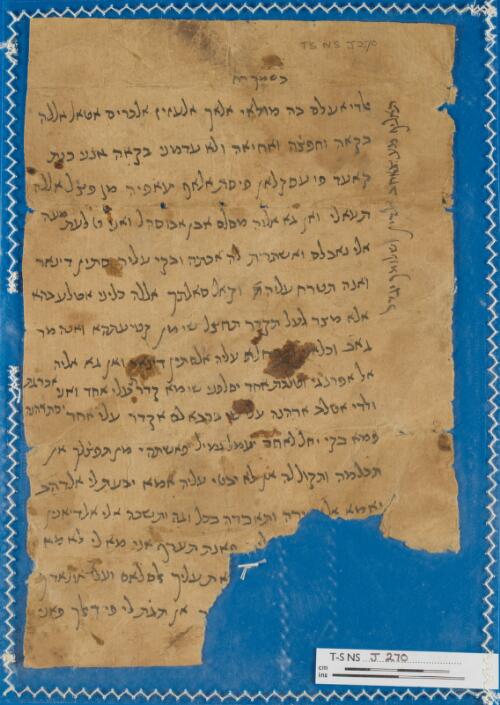
Recto
- בשמך רח
- אלדי אעלם בה מולאי אלאך אלעזיז אלכרים אטאל אללה
- בקאה וחפצה ואחיאה ולא עדמני בקאה אנני כנת
- קאעד פי עסקלאן פי סת אלאף עאפיה מן פצל אללה
- תעאלי ואן גא אליה מסלם אבן אבו סהל ואני טלעת מעה
- אלי נאבלס ואשתרית לה אכתה ובקי עליה סתין דינאר
- ואנה תטרח עליה [[וץ]] וקאל סאלתך אללה כליני אטלע בהא
- אלא מצר לעל תקדר תחצל שי מן קטיעתהא ואנא מר
- גאב וכלאני וקד חלת עליה אלסתין דינאר ואן גא אליה
- אלפרנגי וטלבת אחד יסלפני שי מא קדר/ת/ עלי אחד ואני אכרגת
- ולדי אטלב ארהנה עלי שי ברבא לם אקדר עלי אחד יסתרהנה
- פמא בקי יחל לאחד יעמל גמיל פאשתהי מן תפצלך אן
- תכלמה ותקול לה אן לא יבטי עליה אמא יבעת לי אלדהב
- ואמא אלצ[ג]ירה ותאכדה בכל וגה ותשכה אלי אלדיאנין
- [ ] ל[ ] פאנת תערף אני מא לי לא מא
- [ קר]את עליך אלסלאם ועלי אולאדך
- [אלסלאם ומן תפצלך] אן תגת לי פי דאלך פאני
Recto - right margin
- תאליף מע צאחב אלדין ושלומך יגדל
Goitein
In (your) name, O Merci(ful).
My lord, dear and noble brother, may God prolong your life, keep and preserve you and never deprive me of you.
I had been living here in Ascalon in six thousand states of wellbeing, thanks to the beneficfence of God, the exalted, when Musallam b. Abī Sahl approached me. I went with him up to Nablus and bought for him his sister. A debt of 60 dinars remained on me, and he entreated me saying: "I ask you by God, let me bring her up to Fustat. She might be able to obtain part of her ransom."
Now he is gone and has disappeared, leaving me with a debt of 60 dinars. The Frank came to me, and I was looking for someone granting me a loan , but was not successful with anyone.
Then I presented my boy as a collateral against a loan on interest, but no one was prepared to take him as a collateral. It seems, there has not remained here anyone who believes that one is permitted to do a good work.
I ask you now to be so kind and to talk to Muaallam and to tell him not to keep me any longer in abeyance; he should send me either the money or the girl. Approach him from any possible avenue and bring him to the (Jewish) courts. [ ... ] you know that I do not possess either [ ... ] Kindest regards to you and to your sons [also. Please] take urgent action in this matter for [ . ] I wish to be on good terms with the creditor. And your wellbeing may increase.
Address:
To Bilbays, to his honor, my dear brother, the elder Abu 'l-Bahā Ibn Ghanāʾim
From his brother, who kissses his handa, Abū Saʿd Ibn Ghanāʾim
T-S NS J270 1v
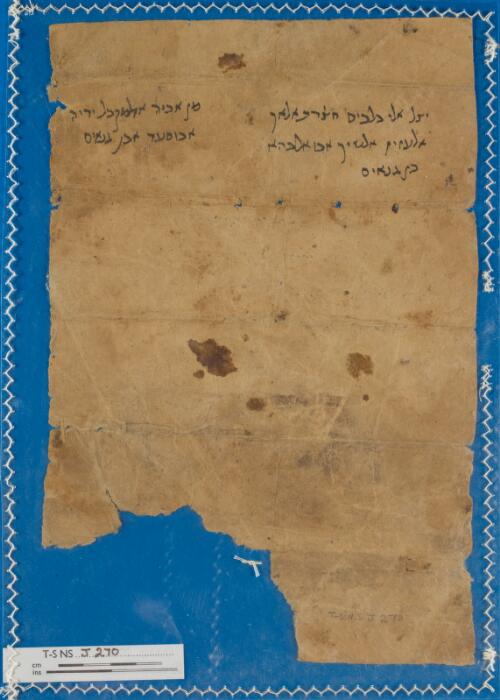
Verso - address
- יצל אלי בלביס חצרת אלאך מן אכיה אלמקבל ידיה
- אלעזיז אלשיך אבו אלבהא אבו סעד אבן גנאים
- בן גנאים
