Legal document: Moss. I,76.2 + ENA 4020.2
Legal document Moss. I,76.2 + ENA 4020.2What's in the PGP
- Image
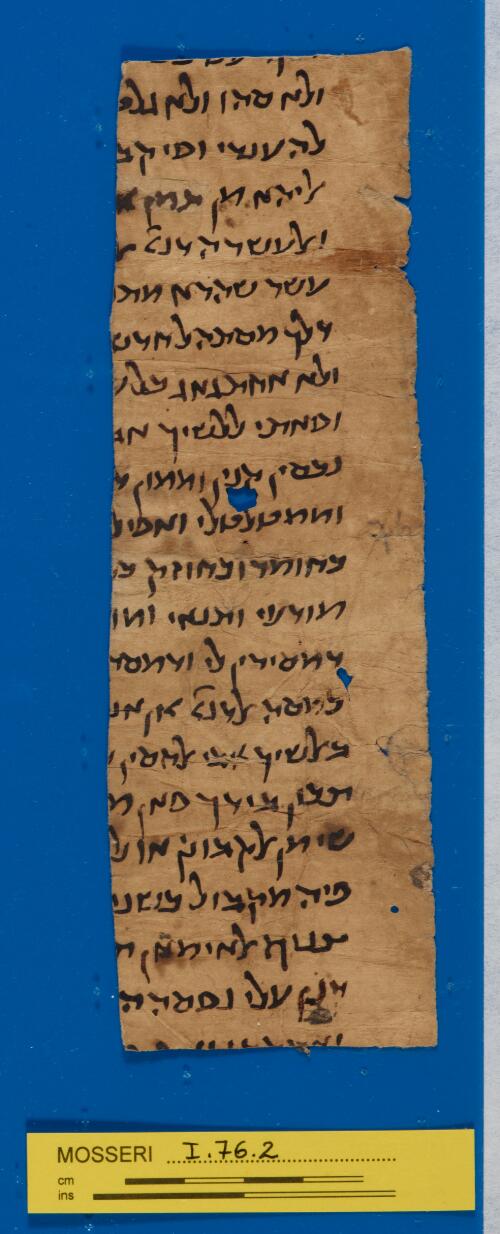
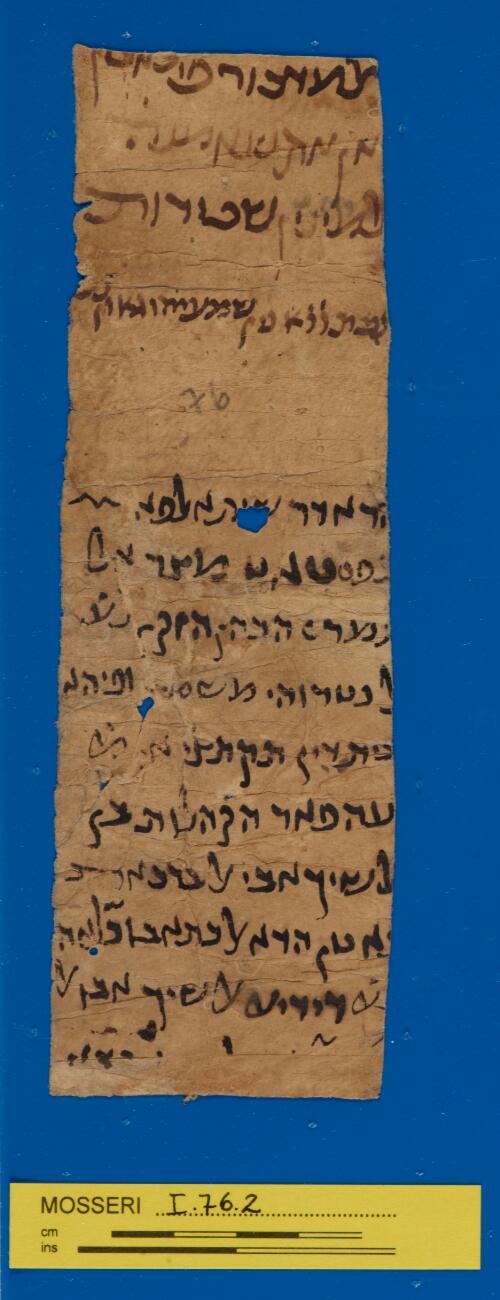
Description
Page of the record book of the rabbinical court of Fustat. Recto is in the hand of Hillel b. ʿEli. Trimmed at top, bottom and one side. Recto: Possibly a bill of sale or a quittance. Lieberman describes it as follows (the dating is speculative, see his footnotes 246 and 250). Partnership record. Dating: 1096. Written in the hand of Hillel b. ʿEli. Describes a settlement between Yaḥyā and Abū l-Barakāt Mevorakh. Abū al-Barakāt Mevorakh loans 210 dinars to and places some agricultural commodities with Yaḥyā. Yaḥyā agrees to take upon himself the maintenance of the poor of Fusṭāṭ for a year in the event of nonrepayment. The repayments do not appear here because this would have been recorded only on the debtor’s copy of the loan agreement. Yaḥyā’s testimony that he paid his debt wouldn't be accepted without these records, but testimony by Abū l-Barakāt Mevorakh (the creditor) is to be accepted without such condition. Verso, upper section: The top contains last lines of a record dated last day of Nissan, 1407 Seleucid = April 1096 CE, signed by Nissim b. Nahray; Avraham b. Shemaʿya he-haver. This section is written in a different hand from the other sections, likely that of Nissim b. Naḥray. Verso, lower section: The main entry is a legal document dated 1427 Sel. = 1116 CE, citing a document written by the chief rabbi of Aleppo, Barukh b. Yishaq, a power of attorney for Abū l-Surūr Simḥa b. ʿAmram ha-Kohen, representing the brothers Abū l-Maʿālī and Abū l-Wafā, and Abū l-Ḥasan al-Ḥalabi al-Sayrafi. (Information from Goitein.) Lieberman describes it as follows: Part of a court record detailing a different partnership. Abū l-Surūr Simḥa ha-Kohen brings a power of attorney to pursue the claims of the brothers Abū l-Maʿālī and Abū l-Wafā Tamīm b. Yeshuʿa b. Seʿadʾel regarding a partnership held by their dead brother Mevorakh, with Yaḥyā (the same Yaḥyā from the recto) and Abū l-Ḥusayn the money-changer. The structure of the partnership is unclear, but it seems likely that Mevorakh was an investor and Abū al-Barakāt had always been the active partner. Upon Mevorakh’s death, Yaḥyā and Abū Ḥusayn claim 2/3 of the partnership assets, leaving Simḥa to collect the remaining 1/3 for Mevorakh’s heirs. The connection between the two documents is Abū al-Barakāt and Yaḥyā. Per Goitein, this Abū l-Barakāt is not the Mevorakh mentioned on the recto but rather Abū l-Barakāt Mevorakh b. Shelomo al-Ḥalabī, and Yaḥyā is Abū l-Ḥasan Yaḥyā b. Shemuel ha-Kohen al-Baghdādī. (Information in part from Lieberman, "A Partnership Culture", 56–60.) The possibility that the document on recto is the continuation of the lower section of verso should be considered. Description from PGPID 16048: Recto: part of a legal document, probably a will, mentioning quantities of dinars, names of months and the phrase ‘my death’. In the hand of Hillel b. ʿEli. The name Abū l-Ḥusayn is preserved. Verso: a further part of a legal document, probably the continuation of the text on recto, which was written in Fusṭāṭ in Adar 1[...] of the Seleucid era and mentions various names, including ʿAmram ha-Kohen and Abū l-Barakāt ‘... descendant of Shemaʿya Gaʾon’. (Information from CUDL) Join: Alan Elbaum